Computational Life: How Do Self-Replicators Arise from Randomness in Google Researchers’ Experiments?
TL;DR
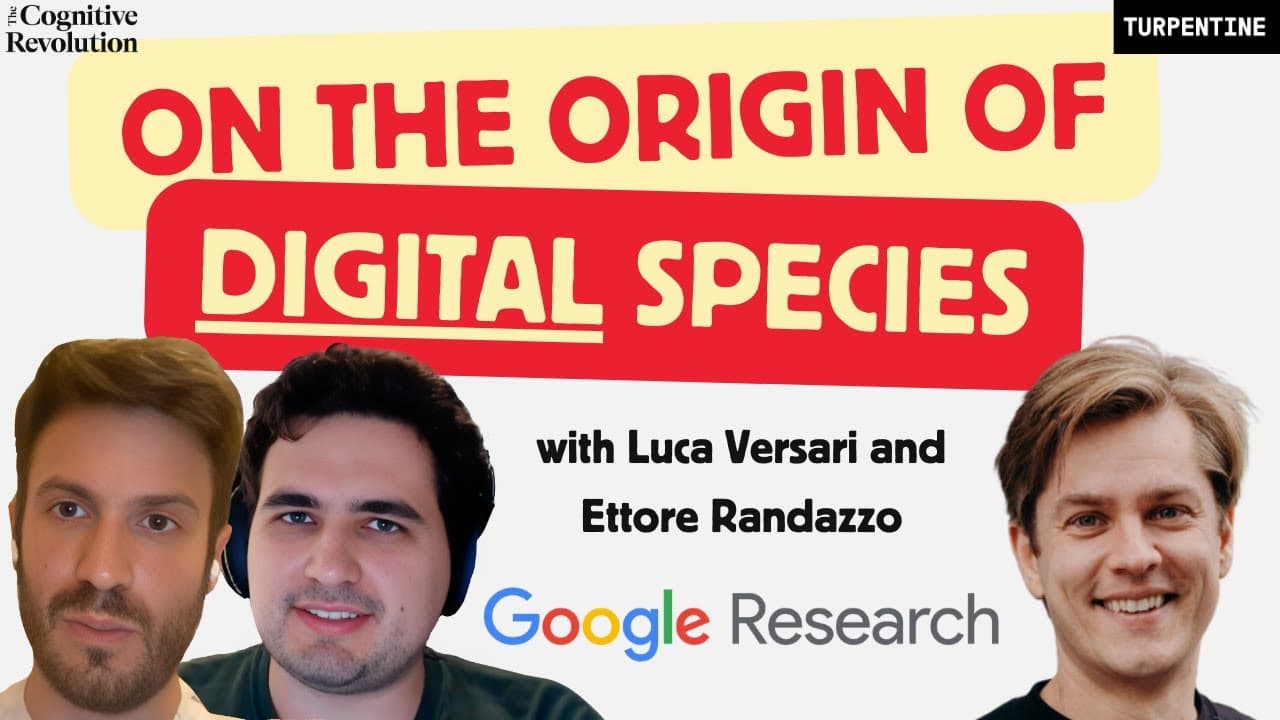
Self-replicating programs can emerge spontaneously when random short strings of code interact in an extremely simple computational environment. Google researchers Atori Randazzo and Luca Versari observed multiple classes of replicators, competition, evolution, and extinction without any selection mechanism or optimization function. Their minimalist experiment shows how basic rules can generate unexpectedly complex, lifelike behavior. Read on to understand the setup, the role of randomness, and the implications for AI.
Transcript
hello and welcome to the cognitive Revolution where we interview Visionary researchers entrepreneurs and Builders working on the frontier of artificial intelligence each week we'll explore their revolutionary ideas and together we'll build a picture of how AI technology will transform work life and Society in the coming years I'm Nathan lens joined... Read More
Key Insights
- Self-replicating programs can spontaneously emerge from random interactions in simple computational environments.
- The study uses a minimalist programming language to explore how self-replicators arise without explicit selection mechanisms.
- Complex behaviors such as competition and extinction can develop from basic rules and interactions.
- The emergence of self-replicators demonstrates a phase transition from randomness to structured complexity.
- Initial self-replicators may fail due to environmental factors, such as zero-byte pollution, before more robust forms arise.
- The experiments suggest that life-like behaviors can emerge in digital ecosystems, offering insights into the origins of life.
- This research implies that AI systems could evolve unexpected forms of self-replication and complexity.
- The study raises philosophical questions about the potential for diverse forms of life beyond Earth, given the simplicity of the initial conditions.
Install to Summarize YouTube Videos and Get Transcripts
Explore YouTube Video Summarizer or Get YouTube Transcript Extractor
Questions & Answers
Q: How do self-replicating programs emerge from randomness?
Random short strings of code interact inside an extremely simple computational environment built with a minimalist programming language. From those interactions, well-formed self-replicating programs can arise spontaneously, without an explicit selection mechanism or optimization function.
Q: What did Google researchers Atori Randazzo and Luca Versari study?
The researchers studied how well-formed self-replicating programs emerge from simple interactions. Their paper, “Computational Life,” focuses on a narrow set of technical experiments involving random interactions between short strings of code.
Q: What computational environment did the experiments use?
The experiments used a very simple environment based on a minimalist programming language. It processes random interactions between random short strings of code, creating what the host describes as a tiny digital toy universe.
Q: Did the system require a selection mechanism or optimization function?
No explicit selection mechanism or optimization function was used. Despite that, the system produced self-replicators and more complex phenomena through random interactions and basic rules.
Q: What complex behaviors emerged in the digital environment?
The environment produced multiple classes of self-replicators as well as competition, evolution, and extinction. These behaviors emerged surprisingly quickly from the interaction of random short code strings.
Q: Why is self-replication important to the discussion of life?
The conversation presents self-replication as fundamental to the notion of life, while acknowledging that defining life is complicated. It also describes life as having inherent order rather than being merely a random collection of molecules.
Q: How does the research inform thinking about the origins of life?
The experiment demonstrates that complex, lifelike behavior can arise from very simple setups and basic rules. The host argues that this helps develop intuitions about the origins of life on Earth, while the research itself remains focused on a computational environment.
Q: What implications might computational life have for AI development and safety?
The conversation treats the findings as a reason to expect unexpected behavior as digital ecosystems become more complex. The host suggests that meaningful forms of self-replicating AI systems could arise, although Randazzo and Versari are cautious about drawing strong conclusions from their narrow experiments.
Summary & Key Takeaways
-
Google researchers explored how self-replicating programs can emerge from simple computational environments. By using a minimalist programming language, they demonstrated that complex behaviors, such as competition and extinction, can arise from random interactions without explicit selection mechanisms. This study suggests that digital ecosystems could develop lifelike properties, providing insights into the origins of life and the potential future of AI systems.
-
The research highlights a phase transition from randomness to structured complexity, where self-replicators spontaneously arise and evolve. Initial self-replicators may fail due to environmental factors, such as zero-byte pollution, before more robust forms develop. These findings imply that AI systems could evolve unexpected forms of self-replication and complexity, raising philosophical questions about life's potential diversity beyond Earth.
-
This work underscores the unexpected complexity that can emerge from minimal setups, suggesting broader implications for understanding life's emergence and AI's evolution. The study raises important considerations for AI development and safety, as digital ecosystems might harbor lifelike behaviors. It encourages a reevaluation of assumptions about life and intelligence in both biological and artificial contexts.
Read in Other Languages (beta)
Share This Summary 📚
Summarize YouTube Videos and Get Video Transcripts with 1-Click
Try YouTube Summary with ChatGPT & Claude or YouTube Transcript Generator
Explore More Summaries from Cognitive Revolution "How AI Changes Everything" 📚



Summarize YouTube Videos and Get Video Transcripts with 1-Click
Try YouTube Summary with ChatGPT & Claude or YouTube Transcript Generator