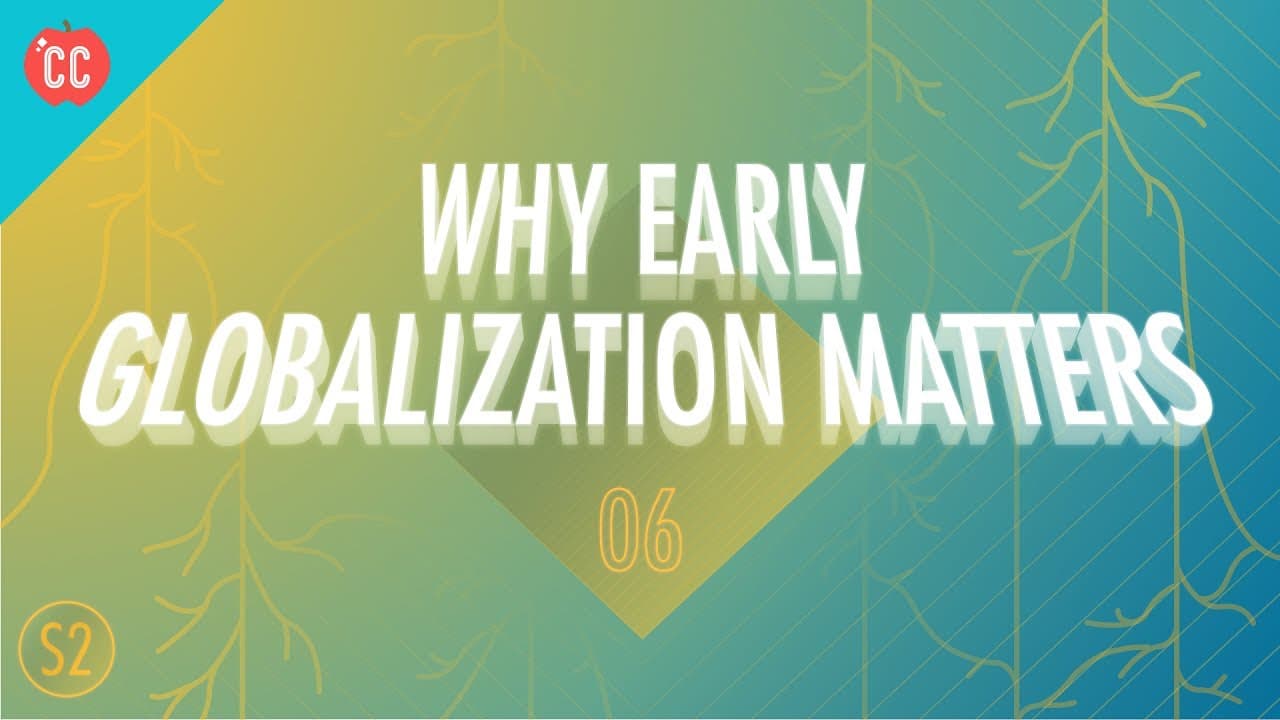
Why Does Early Globalization Matter for Human Progress?
TL;DR
Early globalization significantly advanced collective learning by connecting previously isolated world zones, impacting ideas, agriculture, and health. It facilitated the spread of printing technology, boosted agricultural yields through the introduction of the potato, and unfortunately transmitted plagues that devastated populations. This duality of positive and negative effects has shaped human societies and continues to influence globalization today.
Transcript
Hi, I’m Emily Graslie and this is Crash Course Big History, and today we’re talking about globalization - a process that goes back hundreds of years, and deeply impacted the collective learning of humanity. As we’ve discussed in previous episodes, collective learning is the process that has raised the complexity of human societies for all 250,000 y... Read More
Key Insights
- Globalization has been a centuries-long process that significantly influenced collective learning, enhancing human societies' complexity through the exchange of ideas and technologies.
- Collective learning, a key driver of human advancement, relies on the connectivity and number of potential innovators, both of which were amplified by globalization.
- Printing, originating in East Asia, revolutionized information dissemination, increasing literacy and the spread of knowledge, ultimately fueling the scientific revolution.
- The introduction of the potato to Europe and Asia from the Americas significantly boosted agricultural productivity, supporting population growth and delaying famines.
- Plagues, particularly the Black Death, demonstrated the negative consequences of globalization, as diseases spread rapidly across interconnected regions, devastating populations.
- The Columbian Exchange brought about a massive loss of life in the Americas due to diseases, which severely hindered the region's contribution to global collective learning.
- Globalization's impacts were both positive, such as increased knowledge sharing, and negative, like cultural homogenization and loss of diversity.
- The ongoing process of globalization continues to shape our world, with the potential to enhance innovation and connectivity if managed wisely.
Install to Summarize YouTube Videos and Get Transcripts
Explore YouTube Video Summarizer or Get YouTube Transcript Extractor
Questions & Answers
Q: How did printing impact collective learning?
Printing revolutionized collective learning by making written knowledge more accessible. It enabled the rapid dissemination of information, increased literacy rates, and facilitated the exchange of complex ideas. This was pivotal in fueling the scientific revolution and enhancing global connectivity, as more people could access and contribute to the pool of knowledge.
Q: What role did the potato play in globalization?
The potato, introduced from the Americas to Europe and Asia, played a significant role in globalization by boosting agricultural productivity. Its adaptability to various climates and nutrient-rich properties supported population growth and delayed famines. This increase in population contributed to a rise in potential innovators, further enhancing collective learning.
Q: What were the negative impacts of plagues during early globalization?
Plagues, such as the Black Death, had devastating impacts during early globalization. They spread rapidly across interconnected regions, causing massive population losses. In the Americas, diseases introduced by Europeans resulted in the deaths of millions, severely hindering the region's ability to contribute to global collective learning and leading to cultural homogenization.
Q: How did early globalization affect the Americas?
Early globalization had catastrophic effects on the Americas, primarily due to the introduction of diseases like smallpox and measles by Europeans. These diseases decimated indigenous populations, killing an estimated 50 million people, which drastically reduced the region's potential for contributing to global collective learning and resulted in European cultural dominance.
Q: What is collective learning and why is it important?
Collective learning is the process of accumulating and transmitting knowledge across generations, enabling societies to innovate and adapt. It is crucial for human advancement, as it allows for the continuous improvement of technologies and ideas, raising societal complexity and fostering global connectivity through shared knowledge and innovation.
Q: How did the silk roads contribute to globalization?
The silk roads were instrumental in early globalization by facilitating the exchange of goods, ideas, and technologies across Afro-Eurasia. They connected distant regions, enabling cultural and economic interactions that enriched collective learning and laid the groundwork for more extensive global networks in later centuries.
Q: What were the positive impacts of globalization on collective learning?
Globalization positively impacted collective learning by increasing the flow of information and ideas across regions. It connected diverse cultures, leading to innovations and advancements in various fields. The exchange of technologies and resources accelerated societal development, contributing to significant historical milestones such as the scientific and industrial revolutions.
Q: How does globalization continue to shape our world today?
Globalization continues to shape our world by enhancing connectivity and innovation. It fosters international collaboration, cultural exchange, and economic interdependence, driving technological advancements and addressing global challenges. However, it also presents challenges like cultural homogenization and economic disparities, requiring careful management to maximize its benefits and minimize its drawbacks.
Summary & Key Takeaways
-
This episode of Crash Course Big History explores the early stages of globalization and its profound effects on collective learning, focusing on the roles of printing, potatoes, and plagues. These elements significantly transformed the global exchange of ideas and resources.
-
Printing, originating in China, played a crucial role in spreading knowledge more efficiently, leading to increased literacy rates and the rapid exchange of complex ideas, which fueled the scientific revolution and enhanced global connectivity.
-
The introduction of the potato from the Americas to Europe and Asia boosted agricultural yields, supporting population growth and delaying famines. However, globalization also spread devastating plagues, highlighting its dual potential for positive and negative impacts on societies.
Read in Other Languages (beta)
Share This Summary 📚
Summarize YouTube Videos and Get Video Transcripts with 1-Click
Try YouTube Summary with ChatGPT & Claude or YouTube Transcript Generator
Explore More Summaries from CrashCourse 📚


Summarize YouTube Videos and Get Video Transcripts with 1-Click
Try YouTube Summary with ChatGPT & Claude or YouTube Transcript Generator