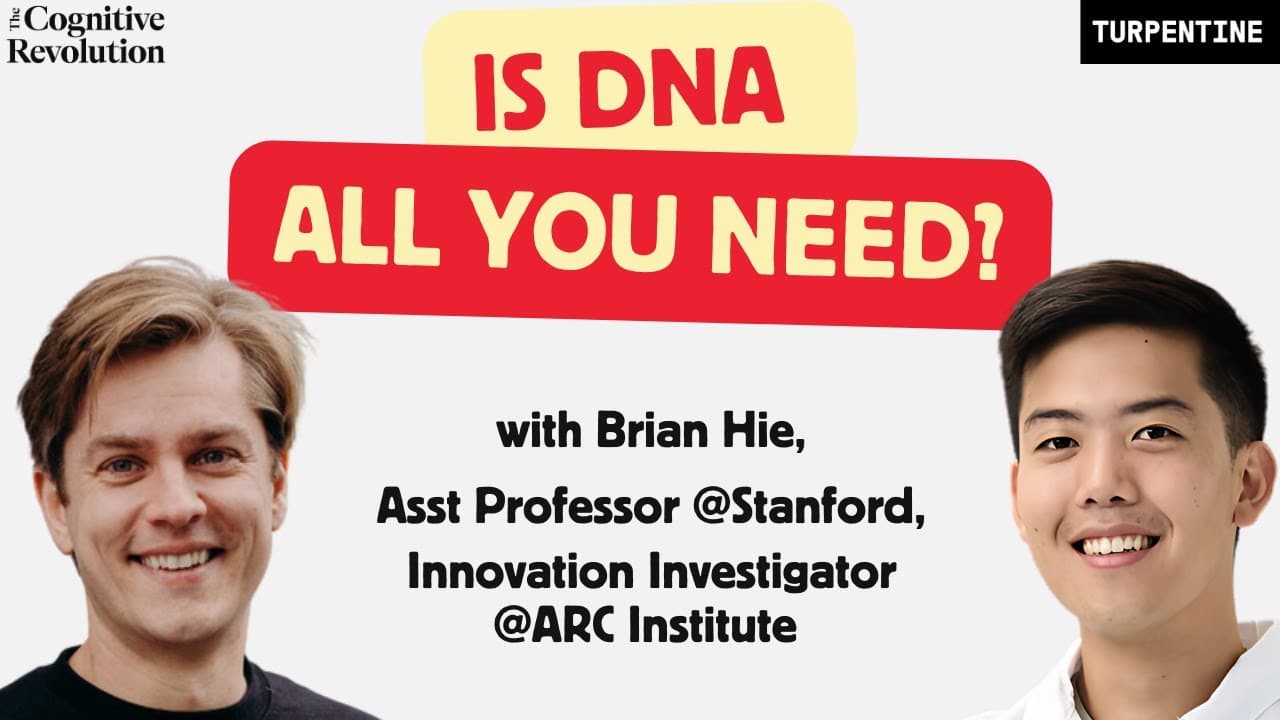
How AI Transforms Biology: Insights from Brian Hie
TL;DR
AI is revolutionizing biology by addressing grand challenges like understanding causal interactions in biological systems and designing targeted interventions. Brian Hie's work demonstrates AI's potential to predict gene essentiality, design novel CRISPR variants, and improve antibody binding, showcasing AI's ability to generalize beyond training data, offering transformative possibilities for drug discovery and biosecurity.
Transcript
hello and welcome to the cognitive Revolution where we interview Visionary researchers entrepreneurs and Builders working on the frontier of artificial intelligence each week we'll explore their revolutionary ideas and together we'll build a picture of how AI technology will transform work life and Society in the coming years I'm Nathan lens joined... Read More
Key Insights
- AI is beginning to address biology's grand challenges, such as understanding causal interactions in biological systems.
- Machine learning models trained on DNA sequences can predict gene essentiality without prior knowledge of experimental outcomes.
- Hybrid AI architectures, combining state space and attention mechanisms, show promise in biological applications.
- AI models like Evo can generate novel CRISPR variants, potentially enhancing gene editing capabilities.
- The Evo model demonstrates AI's ability to generalize higher-level biological concepts from sequence data alone.
- AI-guided evolution of antibodies can significantly improve their binding affinity, offering new possibilities for drug discovery.
- Biological data exclusion and careful evaluation are crucial for ensuring AI models are safe and beneficial.
- The ARC Institute supports innovative research in AI and biology, fostering collaboration and rapid scientific advancement.
Install to Summarize YouTube Videos and Get Transcripts
Explore YouTube Video Summarizer or Get YouTube Transcript Extractor
Questions & Answers
Q: How is AI transforming biology?
AI is transforming biology by addressing major challenges such as understanding the causal web of interactions in biological systems and designing targeted interventions. It enables predictions of gene essentiality, designs novel CRISPR variants, and improves antibody binding, showcasing its potential to generalize beyond training data and offering transformative possibilities for drug discovery and biosecurity.
Q: What are the grand challenges in biology that AI is addressing?
The grand challenges in biology that AI is addressing include understanding the causal interactions within biological systems and designing interventions that are both effective and narrowly targeted. AI is beginning to change the game by enabling predictions of gene essentiality and designing novel CRISPR variants, which are crucial for drug discovery and improving human health.
Q: How does the Evo model work with DNA sequences?
The Evo model is trained on DNA sequences and uses a hybrid architecture combining state space and attention mechanisms. It predicts gene essentiality by evaluating the likelihood of sequences under the model, and it can generate novel CRISPR variants. This model demonstrates AI's ability to generalize higher-level biological concepts from sequence data alone, offering new possibilities for drug discovery.
Q: What is the significance of AI-guided evolution of antibodies?
AI-guided evolution of antibodies is significant because it can significantly improve their binding affinity, which is crucial for drug discovery and therapeutic applications. By using AI models to predict and test mutations that stabilize protein complexes, researchers can enhance antibody effectiveness, potentially leading to better treatments for various diseases.
Q: How do hybrid AI architectures benefit biological applications?
Hybrid AI architectures, which combine state space and attention mechanisms, benefit biological applications by offering improved performance on tasks like sequence modeling and design. These architectures can handle long contexts and predict higher-level biological concepts, making them well-suited for complex challenges in biology, such as predicting gene essentiality and designing novel CRISPR variants.
Q: Why is data exclusion important in AI models for biology?
Data exclusion is important in AI models for biology to ensure safety and prevent misuse. By excluding potentially harmful sequences, such as viruses that infect eukaryotes, researchers can reduce the risk of AI models being used to create bioweapons. Careful evaluation and adherence to biosecurity guidelines are crucial to ensure AI models benefit humanity and do not pose threats.
Q: What role does the ARC Institute play in AI and biology research?
The ARC Institute plays a crucial role in AI and biology research by providing support for innovative projects and fostering collaboration among researchers. It offers a conducive environment for rapid scientific advancement, enabling researchers like Brian Hie to explore the cutting-edge intersection of AI and biology. The institute's focus on collaboration and innovation is driving significant progress in the field.
Q: How can AI models predict gene essentiality?
AI models can predict gene essentiality by evaluating the likelihood of sequences with and without mutations. Models like Evo, trained on DNA sequences, can identify essential genes by detecting significant likelihood changes when mutations are introduced. This ability to predict gene essentiality without prior experimental data offers valuable insights for drug discovery and understanding biological systems.
Summary & Key Takeaways
-
AI is revolutionizing biology by tackling grand challenges such as understanding causal interactions in biological systems and designing targeted interventions. Brian Hie's work highlights AI's potential to predict gene essentiality and design novel CRISPR variants, demonstrating AI's ability to generalize beyond training data.
-
Hybrid AI architectures, combining state space and attention mechanisms, are proving effective in biological applications. The Evo model, trained on DNA sequences, can predict gene essentiality and generate CRISPR variants, showcasing AI's transformative potential for drug discovery and biosecurity.
-
AI-guided evolution of antibodies can improve binding affinity significantly, offering new drug discovery possibilities. The ARC Institute supports innovative research in AI and biology, fostering collaboration and rapid scientific advancement while ensuring AI models are safe and beneficial.
Read in Other Languages (beta)
Share This Summary 📚
Summarize YouTube Videos and Get Video Transcripts with 1-Click
Try YouTube Summary with ChatGPT & Claude or YouTube Transcript Generator
Explore More Summaries from Cognitive Revolution "How AI Changes Everything" 📚



Summarize YouTube Videos and Get Video Transcripts with 1-Click
Try YouTube Summary with ChatGPT & Claude or YouTube Transcript Generator