What Is the Inverse Fourier Transform?
TL;DR
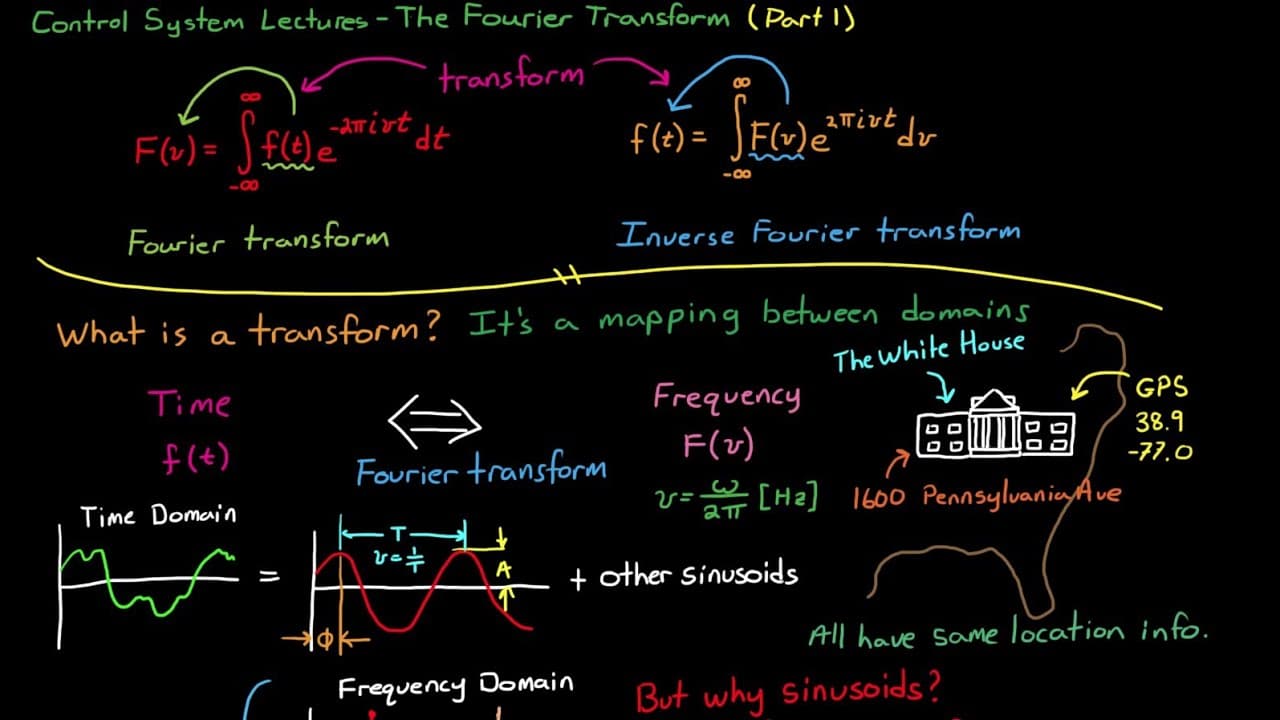
The inverse Fourier transform converts a frequency domain function back into a time domain function. This process involves summing sinusoids of various frequencies, amplitudes, and phases to reconstruct the original time signal. The transform is essential in signal processing and control systems for analyzing and designing systems efficiently.
Transcript
welcome back to control system lectures this is the first video covering the fundamentals of the 48 transform and in this video I'll focus on what we use 4A transforms for then I'll give you an intuitive way of thinking of the transform then we'll back up that thinking with a little bit of math and in the process hopefully simplify the topic for yo... Read More
Key Insights
- The Fourier transform converts time domain signals to frequency domain.
- Inverse Fourier transform reconstructs time domain from frequency data.
- Transforms map information between different domains, preserving data.
- Sinusoids are preferred for transformations due to LTI system properties.
- Complex numbers capture both amplitude and phase information of signals.
- Euler's formula is used to describe sinusoids in the complex plane.
- Negative frequencies help cancel imaginary parts in signal reconstruction.
- Fourier transform simplifies control system design and analysis.
Install to Summarize YouTube Videos and Get Transcripts
Explore YouTube Video Summarizer or Get YouTube Transcript Extractor
Questions & Answers
Q: What is the inverse Fourier transform?
The inverse Fourier transform is a mathematical operation that converts data from the frequency domain back into the time domain. It involves summing sinusoids of different frequencies, amplitudes, and phases to reconstruct the original time-based signal. This process is vital in fields like signal processing and control systems for analyzing and designing systems.
Q: How does the inverse Fourier transform work?
The inverse Fourier transform works by taking complex frequency domain data and using it to reconstruct the time domain signal. This involves multiplying frequency data by complex exponentials (sinusoids) and summing these across all frequencies. The result is the original time domain signal, reconstructed from its frequency components.
Q: Why are sinusoids used in Fourier transforms?
Sinusoids are used in Fourier transforms because they maintain their shape when passing through linear time-invariant (LTI) systems. This property makes them ideal for analyzing and designing control systems, as they allow for straightforward calculations of amplitude and phase changes across frequencies without altering the waveform shape.
Q: What role do complex numbers play in Fourier transforms?
Complex numbers in Fourier transforms capture both the amplitude and phase information of signals. They are essential for accurately representing the frequency components of a signal, as they allow for the expression of phase shifts and amplitude changes in a single mathematical entity, facilitating the transformation between domains.
Q: How does Euler's formula relate to Fourier transforms?
Euler's formula relates to Fourier transforms by providing a way to express sinusoids in the complex plane. It states that e^(iθ) = cos(θ) + i*sin(θ), allowing for the representation of sinusoids as complex exponentials. This is fundamental in Fourier analysis, enabling the conversion of signals between time and frequency domains.
Q: What are negative frequencies in Fourier transforms?
Negative frequencies in Fourier transforms are used to handle the symmetry of real-valued signals in the frequency domain. They help cancel out imaginary components that arise during the transformation process, ensuring that the reconstructed time domain signal is real-valued and accurately represents the original data.
Q: Why is the Fourier transform important in control systems?
The Fourier transform is important in control systems because it allows engineers to analyze and design systems in the frequency domain. This perspective is often more intuitive and manageable, enabling the use of various mathematical tools to assess system stability, performance, and response characteristics effectively.
Q: How does the inverse Fourier transform simplify signal processing?
The inverse Fourier transform simplifies signal processing by providing a method to reconstruct time domain signals from frequency domain data. This allows for the analysis and manipulation of signals in the frequency domain, where complex operations can be performed more easily, before converting back to the time domain for practical applications.
Summary & Key Takeaways
-
The inverse Fourier transform is a mathematical process that converts a function from the frequency domain back to the time domain. It involves summing sinusoids of varying frequencies, amplitudes, and phases to reconstruct the original signal. This tool is crucial in signal processing and control systems, offering a way to analyze and design systems efficiently.
-
Transforms like the Fourier transform map information between the time and frequency domains, preserving the underlying data. Sinusoids are used in these transformations because they maintain their shape in linear time-invariant systems, making them ideal for control system analysis.
-
Complex numbers, which capture both amplitude and phase information, are essential in the Fourier transform process. Euler's formula helps describe sinusoids in the complex plane, facilitating the conversion between domains. Negative frequencies are integral in canceling out imaginary parts, ensuring accurate signal reconstruction.
Read in Other Languages (beta)
Share This Summary 📚
Summarize YouTube Videos and Get Video Transcripts with 1-Click
Try YouTube Summary with ChatGPT & Claude or YouTube Transcript Generator
Explore More Summaries from Brian Douglas 📚

Summarize YouTube Videos and Get Video Transcripts with 1-Click
Try YouTube Summary with ChatGPT & Claude or YouTube Transcript Generator