What is control theory and why learn it today
TL;DR
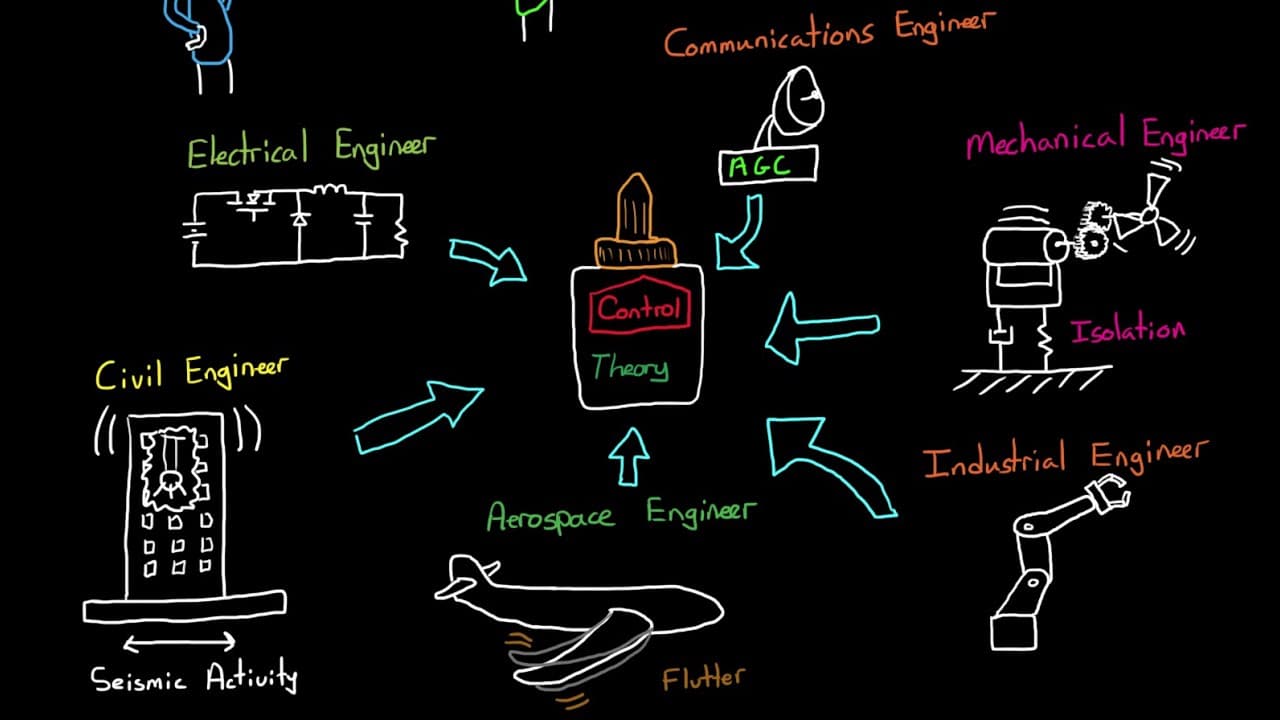
Control theory ties together many engineering fields and builds intuition about how systems behave. It emphasizes modeling, simulation, and disturbance rejection, using feedback to achieve desired performance. The course aims to spark curiosity and provide a practical, low math understanding that can be expanded with further study.
Transcript
welcome to control system lectures you are here because you're interested in learning about the awesome world of control system theory or perhaps you just clicked here accidentally either way welcome and I hope you find it useful this is an educational channel with the goal of explaining topics that can be difficult to grasp in a way that might be ... Read More
Key Insights
- Control theory is the glue that stitches together engineering fields and enables cross-disciplinary problem solving.
- Intuition is cultivated by combining simple explanations with minimal math and visual aids to illustrate dynamic behavior.
- Feedback and disturbance rejection are core ideas that help systems maintain desired performance under real world conditions.
- Modeling and simulation are essential for predicting system behavior before implementation.
- Understanding energy dissipation, damping, and the effect of sensors and actuators helps design robust systems.
- Control concepts apply across electrical, mechanical, civil, aerospace, and industrial engineering disciplines.
- Learning control theory opens doors to a wide range of engineering problems beyond traditional control tasks.
- The course encourages active learning through questions, discussion, and exposure to multiple perspectives.
Install to Summarize YouTube Videos and Get Transcripts
Explore YouTube Video Summarizer or Get YouTube Transcript Extractor
Questions & Answers
Q: How can control theory help an electrical engineer design switching regulators?
Control theory provides a framework to design feedback systems that regulate voltage and current, ensuring stability and desired response. By modeling the regulator, selecting sensors and actuators, and tuning feedback gains, an electrical engineer can predict performance, damp oscillations, and reject disturbances, leading to reliable operation across varying load conditions.
Q: What is the core value of intuition in learning control theory?
Intuition helps learners grasp how systems behave without relying solely on heavy mathematics. By focusing on energy dissipation, damping, and the impact of feedback, students form a mental model of dynamics. This foundational understanding makes it easier to learn more advanced topics and apply concepts to real devices.
Q: Why is control theory described as the glue of engineering disciplines?
Control theory connects principles from different fields by explaining how feedback, sensing, and actuation influence system behavior. This shared perspective helps engineers in electronics, mechanics, civil, and aerospace to interpret problems through a unified lens, enabling cross functional collaboration and more integrated solutions.
Q: How does the course propose to reduce monotony in learning?
The course uses intuitive explanations, minimal math, and cartoons to illustrate concepts. This approach aims to keep learners engaged while gradually introducing key ideas, encouraging questions, and inviting exploration of related topics, which helps build a broader and more enjoyable understanding of control systems.
Q: What role do sensors and actuators play in control systems according to the video?
Sensors provide measurements that feed back into the control loop, while actuators implement the control actions. Together they enable feedback, stabilization, and regulation of the system, and selecting appropriate sensors and actuators is crucial for achieving accurate, robust performance in the presence of disturbances.
Q: In what ways can control theory be applied across engineering disciplines?
Across disciplines, control theory informs design tasks such as switching regulators in electrical engineering, automatic gain control in communications, vibration isolation in mechanical structures, and active damping in tall buildings. The common thread is using feedback and dynamic modeling to achieve stability and desired responses.
Q: What is highlighted as a practical starting point for learning control theory?
A practical starting point is to watch the course videos, engage with questions and discussions, and seek alternative sources to gain different perspectives. This approach builds a foundation of intuition and basic modeling skills, which can then be extended with more rigorous mathematical treatments as needed.
Q: How does the video describe the broader goal of learning control theory?
The broader goal is to foster interest and curiosity about control engineering, enabling learners to read more, watch related videos, and ultimately understand how systems work at a fundamental level. By combining intuitive explanations with experimentation and discussion, learners gain a valuable perspective that transcends single applications.
Summary & Key Takeaways
-
Control theory is the glue that stitches together all engineering disciplines, enabling engineers to solve cross domain problems.
-
The course promotes intuitive understanding over heavy math, using simple explanations and visual aids to reveal how systems respond to changes and disturbances.
-
The material highlights practical applications like sensors, actuators, and feedback loops, encouraging learners to explore more videos and sources to deepen their knowledge.
Read in Other Languages (beta)
Share This Summary 📚
Summarize YouTube Videos and Get Video Transcripts with 1-Click
Try YouTube Summary with ChatGPT & Claude or YouTube Transcript Generator
Explore More Summaries from Brian Douglas 📚
Summarize YouTube Videos and Get Video Transcripts with 1-Click
Try YouTube Summary with ChatGPT & Claude or YouTube Transcript Generator