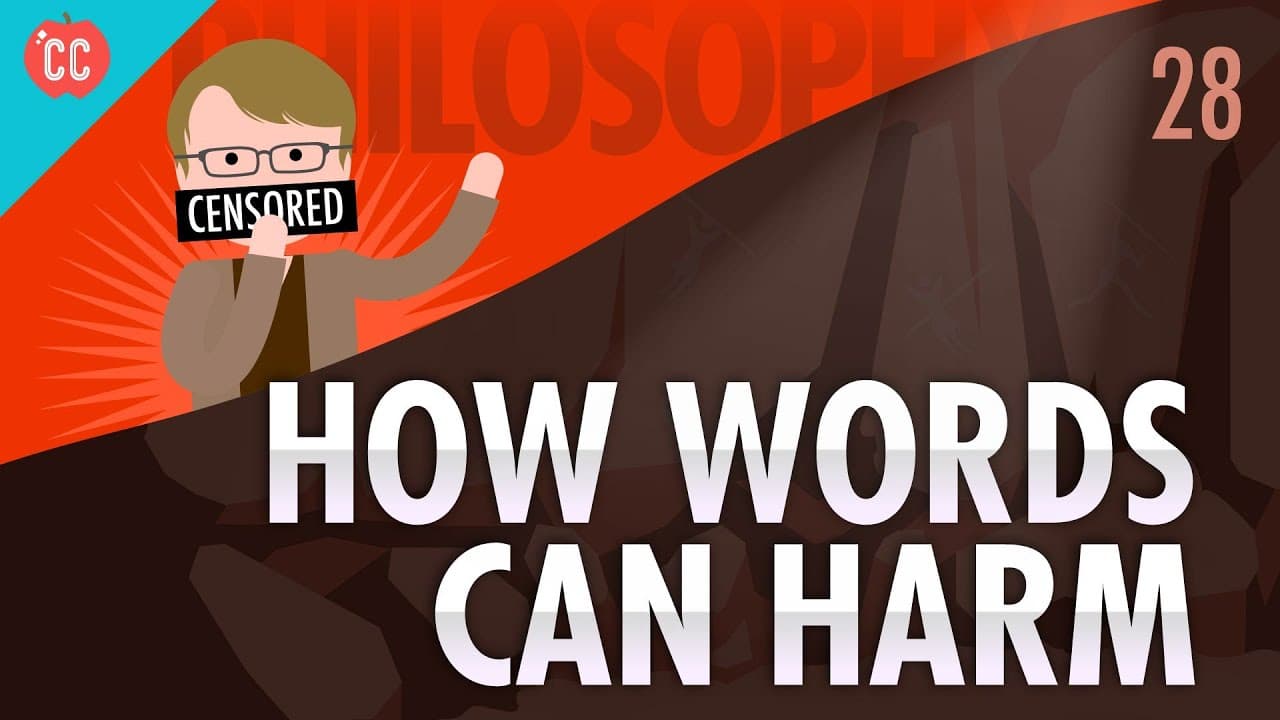
How Can Words Cause Harm in Communication?
TL;DR
Words can cause harm through miscommunication or by conveying harmful attitudes. Misunderstandings occur when the speaker's intended meaning doesn't match the audience's interpretation, while deliberate harmful language, such as hate speech, is designed to inflict pain or degrade personal identity. Understanding the nuances of language helps mitigate these harmful effects.
Transcript
A warning: This episode of Crash Course Philosophy contains language that may be upsetting for some viewers and may not be appropriate for viewing in certain settings. Consider the following sentence: Jason shot a mouse in his boxer shorts. Simple enough. Or is it? Like, my first thought was that Jason was wearing the boxer shorts when he shot the ... Read More
Key Insights
- Miscommunication often arises from the mismatch between speaker meaning and audience interpretation, leading to confusion or unintended humor.
- Words convey not only meaning but also attitudes, which can cause harm when the speaker's attitude differs from the audience's perception.
- The use/mention distinction helps in discussing taboo words by differentiating between using a word and talking about it.
- Dirty words are often offensive due to their nature but are not intended to harm a person's identity, unlike hate speech.
- Hate speech targets individuals based on identity, using thick concepts that bind descriptive meaning with negative attitudes.
- Charles R. Lawrence III argues for legal punishment of hate speech, as it replaces communication with violence and fear.
- Stephanie Ross suggests that words like 'baby' can subtly alter self-perception through metaphorical identification.
- Words like 'slut' carry evaluative content that can harm even when not intended, as they endorse specific attitudes.
Install to Summarize YouTube Videos and Get Transcripts
Explore YouTube Video Summarizer or Get YouTube Transcript Extractor
Questions & Answers
Q: What is the main cause of miscommunication in language?
Miscommunication in language primarily arises when there is a mismatch between the speaker's intended meaning and the audience's interpretation. This often occurs due to differences in context, shared knowledge, and personal experiences, leading to confusion or unintended humor. Understanding these differences is crucial in minimizing miscommunication.
Q: How do words convey attitudes in addition to meaning?
Words convey attitudes by embedding evaluative content within their meanings. This means that words can express not just factual information but also the speaker's perspective or judgment. When these attitudes differ from the audience's, it can lead to misunderstandings or even harm, highlighting the importance of considering both the descriptive and evaluative aspects of language.
Q: What is the use/mention distinction in philosophy?
The use/mention distinction differentiates between using a word to convey meaning and mentioning a word to discuss it. This distinction is particularly useful when addressing sensitive or taboo words, as it allows for analysis and discussion without endorsing the word's typical usage. It helps clarify when a word is being used in its usual context versus when it is being examined as a concept.
Q: Why is hate speech considered more harmful than dirty words?
Hate speech is considered more harmful than dirty words because it targets individuals based on their identity, using language designed to demean and dehumanize. Unlike dirty words, which offend sensibilities, hate speech attacks core aspects of a person's identity, making it more damaging and morally problematic. Philosophers argue that its intent to harm justifies legal restrictions.
Q: What are thick concepts in language?
Thick concepts in language are words that combine descriptive meaning with evaluative content. They carry both factual information and an inherent judgment or attitude, making them difficult to separate. This dual nature means that using such words can convey strong opinions or biases, often unintentionally, impacting how they are perceived and understood by others.
Q: How can words like 'baby' affect self-perception?
Words like 'baby' can affect self-perception through a process called metaphorical identification. When repeatedly used to describe someone, these terms can subtly influence how individuals view themselves, adopting traits associated with the word. For example, being called 'baby' might lead someone to see themselves as helpless or dependent, affecting their behavior and self-image.
Q: What is the argument against protecting hate speech under free speech?
The argument against protecting hate speech under free speech is that such language is intended to incite violence and fear rather than promote open communication. Philosophers like Charles R. Lawrence III argue that because hate speech replaces dialogue with hostility, it should not be constitutionally protected. Instead, it should be treated like 'fighting words,' which are not protected.
Q: Why should we be cautious about using words like 'slut'?
We should be cautious about using words like 'slut' because they carry strong evaluative content that can harm individuals, even if not intended. These words endorse specific negative attitudes about women and sexuality, which can perpetuate harmful stereotypes and judgments. Being mindful of the attitudes conveyed by such words helps prevent unintentional harm and promotes respectful communication.
Summary & Key Takeaways
-
Words can cause harm through miscommunication and deliberate use. Miscommunication occurs when speaker meaning and audience interpretation do not align, leading to confusion or unintended humor. Deliberate harm arises from words that convey attitudes, particularly when those attitudes are not shared by the audience.
-
The use/mention distinction is crucial in discussing taboo words, differentiating between using a word and talking about it. Dirty words offend sensibilities but do not harm identity, unlike hate speech, which targets individuals based on identity and uses thick concepts that combine descriptive meaning with negativity.
-
Philosophers argue about the harm of words. Charles R. Lawrence III suggests legal punishment for hate speech, while Stephanie Ross discusses metaphorical identification, where words like 'baby' alter self-perception. Words like 'slut' carry evaluative content that can harm, even unintentionally, by endorsing specific attitudes.
Read in Other Languages (beta)
Share This Summary 📚
Summarize YouTube Videos and Get Video Transcripts with 1-Click
Try YouTube Summary with ChatGPT & Claude or YouTube Transcript Generator
Explore More Summaries from CrashCourse 📚




Summarize YouTube Videos and Get Video Transcripts with 1-Click
Try YouTube Summary with ChatGPT & Claude or YouTube Transcript Generator