How Can the US Counter Covert Foreign Influence?
TL;DR
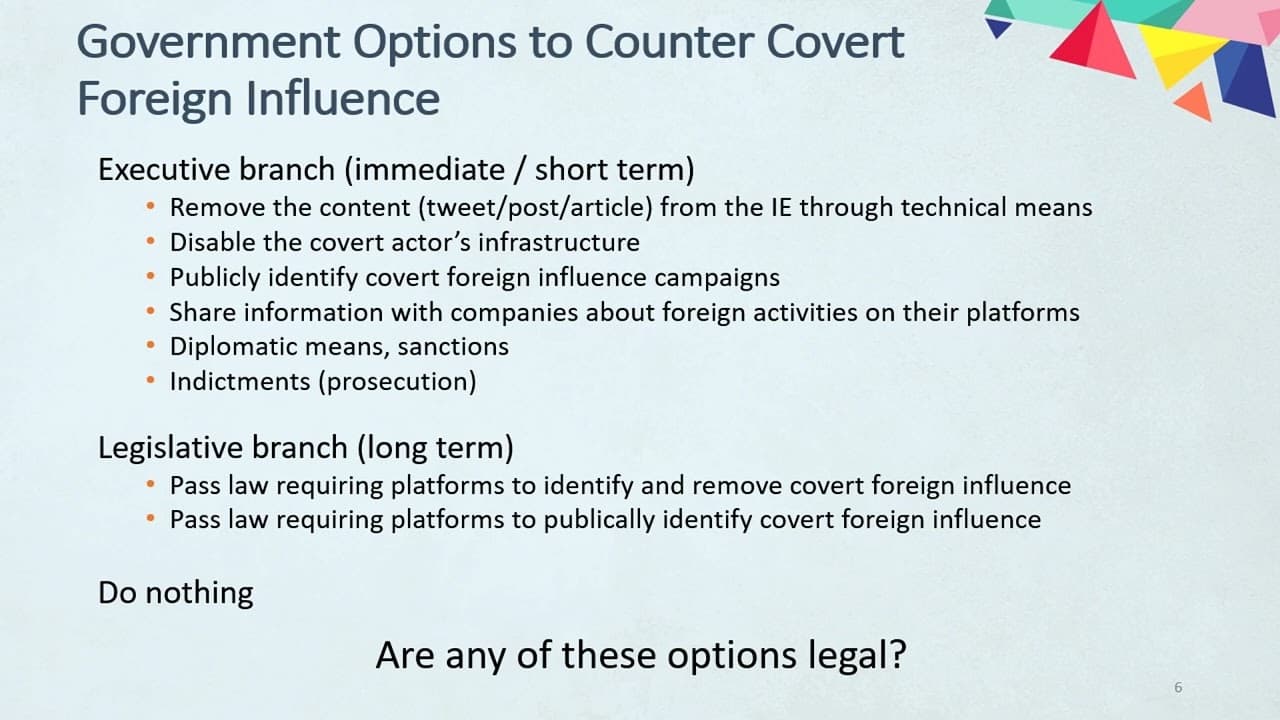
The United States can counter covert foreign influence through public attribution, platform notification, infrastructure disruption, diplomatic action, criminal indictments, or carefully designed legislation. Any response must also preserve free expression, respect limits on domestic intelligence and military activity, protect sensitive intelligence sources, and consider whether an open information environment can address the threat without government intervention.
Transcript
Good morning, everyone. Um, my name is Mary Brooks. I'm a fellow for cybersecurity and emerging threats at the R Street Institute in Washington, DC. You may have noticed that I am not Paul Rosenzweig- ... uh, the original moderator. I have more hair; he has more legal experience. Um, but as your second-string moderator, um, I think you'll still rec... Read More
Key Insights
- Covert foreign influence is especially difficult for democracies because open information environments protect freedom of speech and the right to receive information, while also providing space in which foreign adversaries can distribute manipulative political and social messages.
- Effective influence operations often draw on truthful and observable conditions. Messages about rising fuel costs can resonate because audiences experience those costs directly, even when foreign government agents covertly create and disseminate the broader argument for strategic purposes.
- Foreign influence can damage democratic processes without demonstrably changing individual votes. The panel states that covert operations can motivate people to take to the streets, intensify divisions, diminish the reputations of political institutions, and potentially reduce their effectiveness.
- Content removal is one possible government response, implemented through cooperation with online platforms or through technical means. This option directly limits distribution but raises difficult concerns because the targeted material enters a domestic information environment protected by US law and tradition.
- Infrastructure disruption works by disabling the systems foreign actors use to generate and distribute content. Sensitive intelligence may identify the actors, their location, and their cyber infrastructure, but acting on that information may create risks involving authorities, implementation, and intelligence-source protection.
- Public attribution can warn citizens and platforms that a foreign government is conducting covert activity. The panel distinguishes this broad public notice from private platform notification, which lets a company evaluate the activity and choose a response under its own procedures.
- US institutions operate under distinct legal and organizational constraints. Most intelligence agencies conduct activities overseas, domestic surveillance is restricted, exceptions can require lengthy processes, and military involvement must account for both political limitations and the need to retain public trust.
- Government restraint is itself a policy option. Officials may allow an open information environment, where people can access many competing resources, to respond without intervention, particularly when removing or suppressing content could imperil free expression or other liberal democratic values.
Install to Summarize YouTube Videos and Get Transcripts
Explore YouTube Video Summarizer or Get YouTube Transcript Extractor
Questions & Answers
Q: How can the US counter covert foreign influence?
The available options include removing content through platform cooperation or technical means, disabling the foreign actor's cyber infrastructure, publicly identifying the operation, privately notifying affected platforms, using diplomatic measures, and pursuing criminal indictments when US law has been violated. Longer-term legislation could require platforms to identify and address such activity. Officials may also decide that government intervention would create greater risks and take no action.
Q: Why is covert foreign influence difficult for democracies to address?
Democracies favor an open information environment, freedom of speech, and the right to receive information. Those protections are part of democratic life, but they can also provide room for foreign actors to disseminate covert messages. Government efforts to control or remove those messages may threaten the same liberal values they are intended to defend, especially when the material concerns domestic political debate.
Q: What makes a foreign influence message persuasive?
The most effective influence operations often build their arguments around truth and conditions the intended audience can observe. In the panel's hypothetical scenario, rising fuel costs are real to American audiences, making messages about the price of supporting Ukraine more persuasive. The covert element concerns the foreign government's role in creating and distributing the messages, rather than requiring every underlying statement to be false.
Q: What harms can covert influence cause without changing votes?
Covert influence does not have to change how individuals vote to affect democratic society. According to the panel, foreign operations can motivate people to take to the streets, intensify divisions among Americans, alter public views, diminish the reputations of political institutions, and potentially reduce those institutions' effectiveness. These consequences can make political processes more difficult even when electoral persuasion remains uncertain.
Q: How does public attribution counter a foreign influence operation?
Public attribution places citizens, media organizations, and platforms on notice that a foreign government is conducting a particular kind of covert activity. The government can describe the activity publicly, as occurred before the Russian invasion of Ukraine in the example cited by the panel. This differs from privately notifying a platform, which leaves the company to apply its own procedures and decide whether action is appropriate.
Q: Can the US disable infrastructure used for foreign influence?
Infrastructure disruption is presented as a practical option when sensitive intelligence identifies the foreign actors, their location, and the cyber systems they use to create and disseminate content. Disabling those systems can prevent further distribution regardless of the message's substance. Policymakers must still consider the relevant legal authorities, operational consequences, institutional responsibilities, and the risk that action could reveal highly sensitive intelligence sources.
Q: What limits apply to US intelligence agencies in this area?
The panel states that restrictions on the intelligence community partly arose from perceived and actual abuses examined during the 1970s. Most intelligence agencies are primarily authorized to operate overseas and cannot freely surveil US citizens anywhere in the world or anyone inside the United States. The FBI is identified as an exception, while other exceptions may be pursued through the Foreign Intelligence Surveillance Act and lengthy processes.
Q: When should the government consider taking no action?
Taking no action may be appropriate when officials conclude that an open information environment, with many resources available to challenge foreign messaging, can respond without direct government control. Restraint also avoids some risks to free expression and the exchange of ideas. The choice still requires weighing the operation's potential damage to social cohesion and political institutions against the legal and democratic costs of intervention.
Summary & Key Takeaways
-
Covert foreign influence exploits the openness that democratic societies protect. Foreign actors can use truthful, observable conditions, such as rising fuel costs, to create persuasive messages that divide Americans, weaken confidence in political institutions, motivate public action, and make democratic processes more difficult to carry out effectively.
-
The executive branch has several possible responses: remove content with platform cooperation or technical means, disable the foreign actor's infrastructure, publicly expose an operation, privately alert platforms, pursue diplomatic measures, seek criminal indictments when US law is violated, establish legislative requirements, or refrain from intervening in the information environment.
-
Each option creates legal, policy, operational, and institutional tradeoffs. Intelligence agencies generally focus overseas and face restrictions on surveilling US citizens or people inside the United States. The military must protect public trust, while policymakers must preserve constitutional free expression and avoid exposing highly sensitive intelligence sources when countering covert activity.
Read in Other Languages (beta)
Share This Summary 📚
Summarize YouTube Videos and Get Video Transcripts with 1-Click
Try YouTube Summary with ChatGPT & Claude or YouTube Transcript Generator
Explore More Summaries from RSAC Cybersecurity 📚

Summarize YouTube Videos and Get Video Transcripts with 1-Click
Try YouTube Summary with ChatGPT & Claude or YouTube Transcript Generator