What Causes Income and Wealth Inequality in Economics?
TL;DR
Income and wealth inequality is primarily caused by uneven asset distribution and differences in earnings. Factors such as globalization, technological change, and educational disparities have widened the gap, benefiting skilled workers while leaving unskilled workers behind. Solutions include education reform, tax changes, and policy adjustments, although there is no consensus on the most effective approach.
Transcript
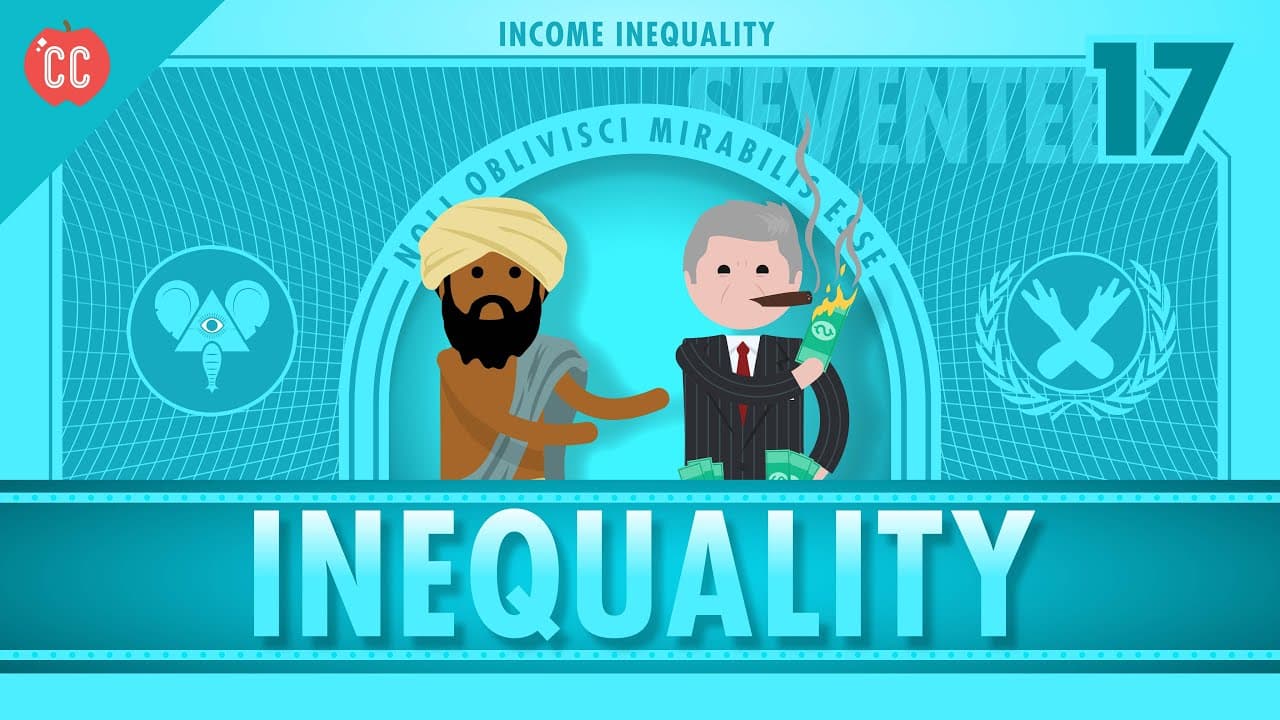
Jacob: Welcome to Crash Course Economics, I'm Jacob Clifford... Adriene: ...and I'm Adriene Hill. The world is full of inequality. There's racial inequality, gender inequality, health, education, political inequality, and of course, economic inequality. Some people are rich, and some people are poor, and it can seem pretty impossible to fix. Jacob:... Read More
Key Insights
- Economic inequality is categorized into wealth inequality and income inequality, both of which differ in terms of asset distribution and new earnings, respectively.
- Global wealth is unevenly distributed, with North America and Europe holding a disproportionate amount of the world's wealth compared to their population sizes.
- The Industrial Revolution and globalization have widened income gaps, benefiting the rich more than the poor, despite improvements for the latter.
- Skill-biased technological change has increased demand for skilled workers, leaving unskilled workers behind and widening the income gap.
- Income inequality in the U.S. has increased over the decades, with the richest 20% earning a significant portion of the total income.
- The GINI Index measures income inequality, with the U.S. having high inequality among Western industrialized nations.
- Some economists argue that income inequality is harmful, associating it with social issues like violence and political inequality.
- Potential solutions include education, increased minimum wage, tax reforms, and reducing regulation, but consensus on the best approach is lacking.
Install to Summarize YouTube Videos and Get Transcripts
Explore YouTube Video Summarizer or Get YouTube Transcript Extractor
Questions & Answers
Q: What are the two main types of economic inequality highlighted in the video?
The video highlights wealth inequality and income inequality as the two main types of economic inequality. Wealth inequality refers to the distribution of accumulated assets like savings and real estate, while income inequality pertains to the distribution of new earnings added to that wealth. Both types are distinct yet interrelated.
Q: How is global wealth distributed according to the video?
Global wealth distribution is highly uneven. North America and Europe, with less than 20% of the world's population, hold 67% of the world's wealth. In contrast, China, with a larger population, has only 8% of the wealth. India and Africa, representing nearly 30% of the population, share just 2% of global wealth.
Q: What role did the Industrial Revolution play in economic inequality?
The Industrial Revolution played a significant role in widening economic inequality. It created an 'economic big bang' that propelled some countries towards higher incomes while others remained stagnant. This divergence increased income gaps globally, with the richest countries becoming significantly wealthier compared to the poorest nations.
Q: How does skill-biased technological change affect income inequality?
Skill-biased technological change has contributed to income inequality by increasing demand for skilled workers who can leverage new technologies. This shift has benefited those with the necessary education and skills, while unskilled workers face job displacement and stagnant wages, thus widening the income gap between skilled and unskilled labor.
Q: What does the Lorenz curve illustrate about income inequality in the U.S.?
The Lorenz curve illustrates the depth of income inequality in the U.S. by showing the distribution of income across households. A straight line represents perfect equality, while deviations indicate inequality. The curve shows that the richest 20% earn a substantial portion of the total income, highlighting the growing disparity over decades.
Q: What is the GINI Index, and what does it reveal about the U.S.?
The GINI Index is a measure of income inequality, calculated from the gap between equal and actual income distribution. In the U.S., the GINI Index reveals high income inequality compared to other Western industrialized nations. This index underscores the significant income disparities present in the country.
Q: What are some proposed solutions to address income inequality?
Proposed solutions to address income inequality include enhancing education to equip workers with skills for higher-income jobs, increasing the minimum wage, reforming tax policies to redistribute income, and reducing regulatory burdens. However, there is no consensus on which approach is most effective in reducing inequality.
Q: Why do some economists believe income inequality is problematic?
Some economists argue that income inequality is problematic because it is linked to social issues such as increased violence, drug abuse, and political inequality. They contend that greater income disparity dilutes political equality, as the wealthy have more influence over policy decisions, often promoting policies that benefit themselves.
Summary & Key Takeaways
-
Crash Course Economics discusses economic inequality, focusing on wealth and income disparities. Wealth inequality involves the distribution of accumulated assets, while income inequality pertains to the distribution of new earnings. The video examines global and national levels of inequality, highlighting factors like globalization and technological change that contribute to widening gaps.
-
The video illustrates how globalization and technological advancements have exacerbated income inequality, benefiting skilled workers and the wealthy. It also discusses the U.S. context, where income disparity has grown over the decades, with the richest earning a disproportionate share of the total income. The video uses the Lorenz curve and GINI Index to explain these trends.
-
Solutions to address economic inequality vary, including education, tax reforms, and regulatory changes. The video presents different perspectives on whether income inequality is problematic and what measures could mitigate it. The discussion concludes with the importance of addressing inequality to prevent social unrest and promote societal well-being.
Read in Other Languages (beta)
Share This Summary 📚
Summarize YouTube Videos and Get Video Transcripts with 1-Click
Try YouTube Summary with ChatGPT & Claude or YouTube Transcript Generator
Explore More Summaries from CrashCourse 📚






Summarize YouTube Videos and Get Video Transcripts with 1-Click
Try YouTube Summary with ChatGPT & Claude or YouTube Transcript Generator