How to Automate Blue Team Work Without Waste
TL;DR
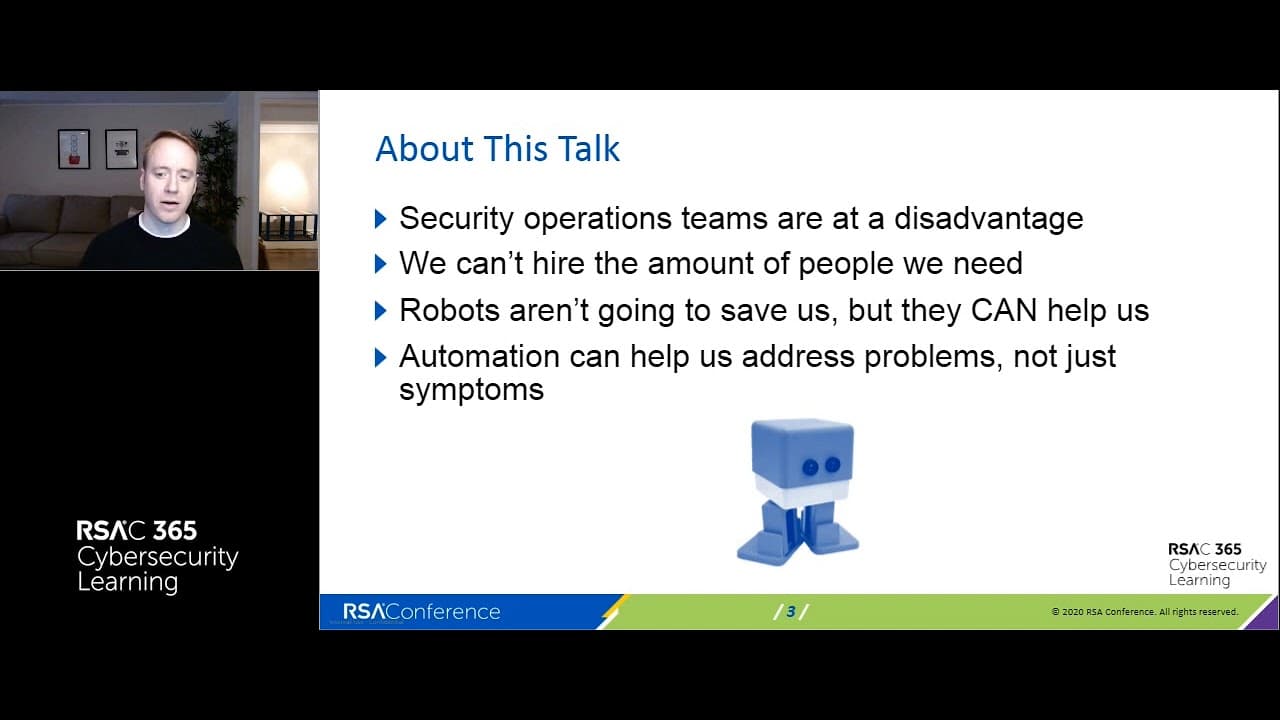
Security automation should address the underlying causes of inconsistent defense, including fractured attention, incomplete information, unclear priorities, and dependence on a few senior analysts. Automating tasks merely because they are repetitive can waste time, especially when teams lack mature, well-defined processes. Effective automation should augment human judgment, improve reliability, and increase the cost imposed on attackers.
Transcript
Again, my name is Mark Orlando, and this is Cobot Uprising Collaborative Automation for Blue Teams. I am thrilled to be here with you all today and giving this talk on a topic that I feel very passionate about, that I've spent many years thinking about and wrestling with. And I think, um, hopefully I'll be able to share a uni-unique perspective on ... Read More
Key Insights
- Security operations teams operate at a structural disadvantage because analysts are expected to perform many roles, including frontline defense, investigation, incident response, data analysis, engineering, and user support. These competing responsibilities fracture attention and make it difficult to consistently prioritize the most valuable defensive work.
- Incomplete security information produces inconsistent decisions because people fill evidentiary gaps with experience, assumptions, and biases. This may help analysts interpret isolated alerts, but it can also make investigation quality depend on who is working, how tools are configured, and which processes the team follows.
- The analyst syntax error is the point at which an investigator lacks enough information or direction to determine the next action. Analysts may then stop, switch tasks, or close an investigation too early, potentially leaving important questions unanswered and defensive work incomplete.
- Dependence on senior analysts creates organizational risk because specialized knowledge about tools, shadow IT, known false positives, and investigative paths may remain concentrated in a few individuals. If those people leave, become unavailable, or change focus, a substantial portion of the team’s capability can disappear.
- Security automation is most useful when it addresses underlying bottlenecks that prevent defenders from being effective, consistent, and reliable. Automation pursued for its own sake can consume defensive cycles, while automation designed to augment people can strengthen the team’s broader operational capability.
- Automation and orchestration work by converting manual tasks into connected playbooks or workflows. Their value depends on the relationship between maintenance effort and time saved, since creating playbooks, updating connectors, and managing automated processes can require more effort than the resulting savings justify.
- Automating repetitive work requires operational maturity because the organization must first identify which activities are wasteful, boring, or repeatable. The relevant processes must also be defined clearly enough that automation can remove work from analysts without replacing it with continuing supervision and maintenance.
- Automated threat detection is often promoted as necessary for finding sophisticated, rapidly evolving threats that defenders supposedly cannot identify unaided. The presentation does not reject automated detection, but questions whether vendor promises focus attention on dramatic symptoms instead of more fundamental weaknesses in defensive operations.
Install to Summarize YouTube Videos and Get Transcripts
Explore YouTube Video Summarizer or Get YouTube Transcript Extractor
Questions & Answers
Q: How should blue teams use security automation effectively?
Blue teams should use automation to address the underlying conditions that make defense inconsistent and inefficient. Those conditions include fractured analyst attention, incomplete information, unclear priorities, investigative roadblocks, and excessive dependence on a few experienced employees. Automation should augment human capabilities, improve reliability, and raise attacker costs. It should not be adopted merely because a task appears repetitive or because a vendor promises broad efficiency gains.
Q: Why can automation for its own sake harm security operations?
Automation for its own sake can degrade capabilities and consume defensive cycles because automated workflows still require design, maintenance, connector updates, and process management. A team might spend twenty hours per month managing playbooks that save only five hours. If automation does not resolve a meaningful bottleneck or improve consistency, its operational overhead can exceed its benefits and divert analysts from more valuable defensive work.
Q: What causes inconsistent decision-making in a security operations center?
Inconsistent decision-making arises when analysts must interpret massive volumes of incomplete information. Humans tend to fill gaps by applying personal experience, assumptions, and biases. Those methods can help create a broader picture from isolated alerts, but they also make outcomes depend on the analyst, shift, tools, and implemented processes. Security work that requires consistency and reliability can therefore become highly variable.
Q: What is the analyst syntax error in cyber defense?
The analyst syntax error describes the moment when an analyst reaches a point in an investigation or response where the available information no longer indicates what to do next. Without another answer, data source, or investigative path, the analyst may stop, move to different work, or close the investigation prematurely. The phrase highlights a workflow and support failure rather than a simple lack of individual skill.
Q: Why is relying on a senior security analyst risky?
Relying heavily on a senior analyst is risky because that person may hold critical knowledge about security tools, shadow IT, known false positives, and effective investigative paths. Other analysts may routinely depend on that individual whenever they encounter a roadblock. If the senior analyst leaves, calls in sick, or changes focus, the organization can lose a large portion of the capability created through its investments in people, processes, and technology.
Q: When are repetitive security tasks suitable for automation?
Repetitive security tasks are suitable for automation when the organization can identify them accurately and define the associated processes clearly. This requires enough operational maturity to distinguish genuinely wasteful work from tasks that still need human interpretation. The team must also ensure that automation actually removes effort from analysts instead of creating a new burden involving continuous supervision, connector maintenance, workflow updates, and exception handling.
Q: What challenges prevent SOC analysts from focusing effectively?
SOC analysts often serve as defenders, investigators, incident responders, data scientists, engineers, and user support specialists at the same time. These competing duties fracture their attention and force them to decide continually where their time and skills will have the greatest impact. When they reach security telemetry, they must also choose which alerts and data to prioritize while considering what relevant activity may be missing entirely.
Q: How should teams evaluate automated threat detection claims?
Teams should evaluate automated threat detection claims in the context of their actual defensive problems rather than accepting the premise that sophisticated and rapidly evolving threats automatically require a particular tool. Automated detection can be useful, but the presentation questions promises centered on attackers with zero-days and secret techniques. Teams should first examine whether incomplete visibility, inconsistent processes, unclear priorities, or investigative roadblocks are the more fundamental constraints.
Summary & Key Takeaways
-
Security operations teams work at a disadvantage because analysts must simultaneously act as defenders, investigators, incident responders, data scientists, engineers, and support specialists. Their divided attention, massive data volumes, and incomplete information make it difficult to decide where to focus, which evidence matters, and what actions should come next.
-
Analysts compensate for incomplete information by applying experience, assumptions, and personal biases. Although this can help construct a larger picture from scattered alerts, it also makes investigations inconsistent across shifts and individuals. Teams may stop prematurely when they lack the information or guidance needed to continue an investigation or response.
-
Automation can reduce these problems when it targets genuine bottlenecks and augments human capabilities. However, playbooks require ongoing creation, connector maintenance, and process management. Automating repetitive tasks also assumes the organization can identify wasteful work and define processes clearly enough to automate them without creating additional operational burdens.
Read in Other Languages (beta)
Share This Summary 📚
Summarize YouTube Videos and Get Video Transcripts with 1-Click
Try YouTube Summary with ChatGPT & Claude or YouTube Transcript Generator
Explore More Summaries from RSAC Cybersecurity 📚



Summarize YouTube Videos and Get Video Transcripts with 1-Click
Try YouTube Summary with ChatGPT & Claude or YouTube Transcript Generator