What Is Astronomy and How Has It Evolved Over Time?
TL;DR
Astronomy is the scientific study of celestial objects, including planets, stars, and galaxies, and has evolved from ancient observations to modern technology-driven research. It integrates various scientific disciplines and emphasizes the importance of constant questioning and evolving understanding in the pursuit of knowledge about the universe.
Transcript
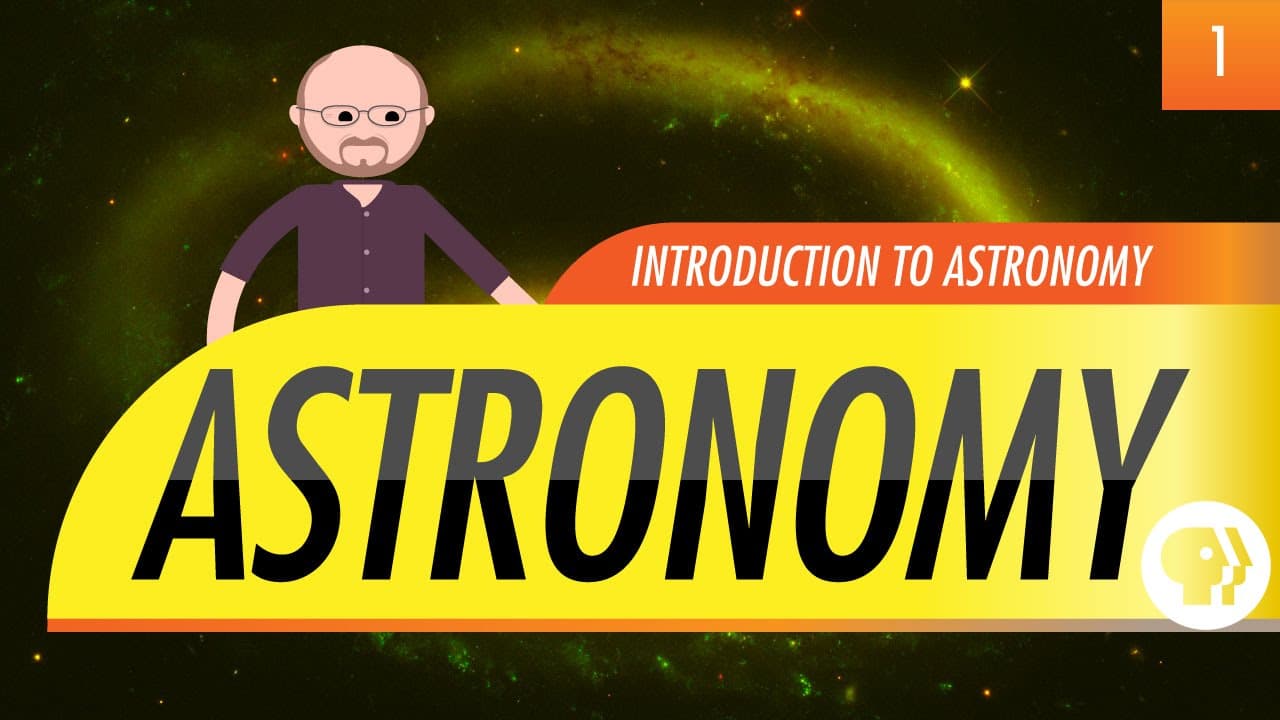
Hello, and welcome to Crash Course Astronomy! I’m your host, Phil Plait, and I’ll be taking you on a guided tour of the entire Universe. You might want to pack a lunch. Over the course of this series we’ll explore planets, stars, black holes, galaxies, subatomic particles, and even the eventual fate of the Universe itself. But before we step into s... Read More
Key Insights
- Astronomy is a broad field that includes the study of planets, stars, galaxies, and the universe's fate, integrating various scientific disciplines.
- Science is a method of acquiring knowledge, acknowledging that our understanding may be flawed and requires constant testing and honesty.
- Astronomy provides perspective on our place in the universe, highlighting the vast scales and structures beyond Earth.
- The boundaries between astronomy and other sciences like chemistry, geology, and physics are increasingly blurred as technology advances.
- Astronomy's history is deeply intertwined with astrology, which led to early observations and attempts to understand celestial patterns.
- The geocentric model of the universe, once widely accepted, was gradually replaced by heliocentric and more accurate models through scientific advancements.
- Technological innovations such as telescopes, photography, and digital detectors have revolutionized our understanding of the cosmos.
- Modern astronomy involves diverse roles, including scientists, engineers, programmers, and educators, all contributing to the field's advancement.
Install to Summarize YouTube Videos and Get Transcripts
Explore YouTube Video Summarizer or Get YouTube Transcript Extractor
Questions & Answers
Q: What is the primary focus of Crash Course Astronomy?
Crash Course Astronomy, hosted by Phil Plait, aims to provide a comprehensive overview of the universe, exploring planets, stars, galaxies, and cosmic phenomena. The series emphasizes the scientific method and the importance of questioning and refining our understanding of the cosmos through honest and rigorous inquiry.
Q: How does astronomy differ from other sciences?
While astronomy shares the scientific method with other sciences, it uniquely positions humanity within the vast universe, offering perspective on our place among celestial bodies. Astronomy's scope extends beyond traditional boundaries, integrating aspects of physics, chemistry, and geology, reflecting the interconnectedness of scientific disciplines.
Q: What role did astrology play in the development of astronomy?
Astrology, once considered a precursor to astronomy, involved observing celestial patterns to predict earthly events. Although lacking scientific rigor, astrology's focus on the skies led to systematic observations, which eventually contributed to the development of astronomy as a scientific discipline, emphasizing empirical evidence and testable hypotheses.
Q: How did technological advancements impact the field of astronomy?
Technological advancements, such as the invention of telescopes, photography, and digital detectors, revolutionized astronomy by enabling detailed observations of distant celestial objects. These innovations expanded our understanding of the universe, revealing previously unseen phenomena and allowing for precise measurements and analysis of cosmic events.
Q: What is the significance of the heliocentric model in astronomy?
The heliocentric model, proposed by Copernicus and refined by astronomers like Kepler and Newton, marked a pivotal shift from the geocentric view, placing the sun at the center of the solar system. This model provided a more accurate representation of celestial motions, laying the groundwork for modern astronomy and challenging long-held beliefs.
Q: Who are considered astronomers in modern times?
Modern astronomers encompass a diverse group of professionals, including scientists, engineers, programmers, and educators. While traditional astronomers focus on celestial observations, the field now involves interdisciplinary collaboration, with roles in data analysis, instrument development, and science communication, reflecting the complexity and breadth of contemporary astronomy.
Q: What challenges does astronomy face in understanding the universe?
Astronomy faces challenges in understanding the universe due to its vastness and complexity, with phenomena like dark matter and dark energy remaining elusive. Despite technological advancements, many questions about the universe's origin, structure, and fate persist, driving ongoing research and exploration in the quest for cosmic knowledge.
Q: How has astronomy evolved from ancient times to the present?
Astronomy has evolved from ancient sky observations and astrology to a sophisticated scientific discipline. This evolution involved significant milestones, such as the development of the heliocentric model, the invention of telescopes, and the application of advanced technologies, leading to a deeper understanding of the universe and its components.
Summary & Key Takeaways
-
Crash Course Astronomy introduces the vast field of astronomy, led by Phil Plait, covering the universe's components and scientific methods. The series will explore celestial bodies and cosmic phenomena while highlighting the importance of science's evolving nature and its quest for truth.
-
Astronomy is defined as the study of celestial objects and phenomena, with blurred boundaries between related scientific fields. Historically linked to astrology, astronomy evolved through technological advancements and scientific revolutions, leading to the modern understanding of the universe.
-
The field of astronomy has expanded to include various professions beyond traditional telescope observations, involving mathematicians, engineers, and educators. The series will explore the historical development of astronomy and its current state, emphasizing humanity's ongoing quest for cosmic knowledge.
Read in Other Languages (beta)
Share This Summary 📚
Summarize YouTube Videos and Get Video Transcripts with 1-Click
Try YouTube Summary with ChatGPT & Claude or YouTube Transcript Generator
Explore More Summaries from CrashCourse 📚





Summarize YouTube Videos and Get Video Transcripts with 1-Click
Try YouTube Summary with ChatGPT & Claude or YouTube Transcript Generator