Stanford Seminar - RowHammer, RowPress and Beyond: Can We Be Free of Bitflips (Soon)?
TL;DR
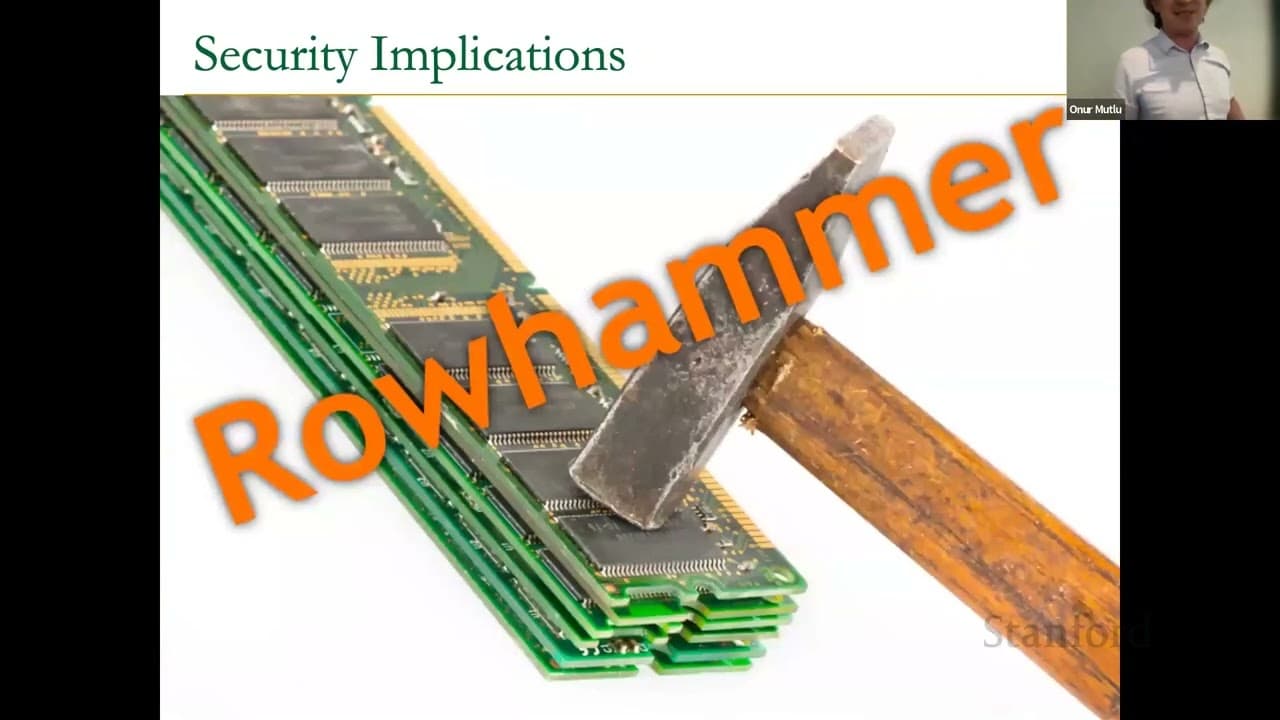
RowHammer allows attackers to predictably induce bit flips in commodity DRAM chips, creating reliability, safety, and security risks. More than 80% of the chips tested in the initial study were vulnerable, while RowPress intensifies the disturbance by holding a memory row open longer. Existing mitigations may not fully stop newer attacks, so read on to understand the mechanisms, testing methods, and remaining challenges.
Transcript
let's get started so I'm going to talk about uh row Hammer row press and Beyond and I have this title over here that probably everybody knows the answer to but maybe we can discuss that at the end uh how many people know this bridge okay where is what is it the common arrows how many people have been over it probably zero because this is what happe... Read More
Key Insights
- 🥺 Row Hammer and Row Press vulnerabilities in memory chips can lead to data corruption and security breaches, posing challenges for reliability and safety in computing systems.
- 🤨 Mitigation mechanisms, such as increased refresh rates and probabilistic row activation, have been implemented but may not provide complete protection against new attacks.
- 🎮 Understanding the underlying hardware causes and developing intelligent memory controllers are crucial for addressing the challenges of Row Hammer and Row Press.
Install to Summarize YouTube Videos and Get Transcripts
Explore YouTube Video Summarizer or Get YouTube Transcript Extractor
Questions & Answers
Q: What is RowHammer, and how does it affect DRAM chips?
RowHammer is a reliability problem that allows bit flips to be predictably induced in commodity DRAM chips. Those hardware failures can cause data corruption and develop into broader system security or safety problems.
Q: How common was RowHammer among the tested DRAM chips?
More than 80% of the chips tested when the problem was first examined were vulnerable. This result showed that the issue affected a wide range of commodity DRAM rather than an isolated chip.
Q: How does RowPress amplify the RowHammer vulnerability?
RowPress keeps a memory row open for an extended period, increasing disturbance effects on adjacent rows. It can therefore induce bit flips with fewer row activations than RowHammer requires.
Q: Why do denser DRAM chips experience more errors?
As DRAM circuits shrink, their cells become smaller and move closer together. That creates more noise and reliability problems, and a large-scale Facebook data-center study found chip density was strongly correlated with server failure rates.
Q: Why can a DRAM reliability problem become a security vulnerability?
RowHammer shows how a simple hardware failure mechanism can create a widespread system security vulnerability. Predictable bit flips can produce unforeseen consequences, connecting reliability failures with security and safety risks.
Q: How did researchers study low-level DRAM failures?
They built an FPGA-based testing infrastructure with a modifiable memory controller. It could change the commands sent to DRAM and test interface-permitted behaviors, including violations of timing parameters.
Q: What RowHammer mitigations have been implemented?
Mitigations include increased refresh rates, probabilistic row activation, and memory controllers that track row activations and refresh adjacent rows. These mechanisms aim to prevent disturbance from producing bit flips.
Q: Can current mitigations completely eliminate RowHammer-related bit flips?
No. The existing fields state that newer attacks such as Health Hammer and RowPress can bypass protections and still cause bit flips, so stronger system and architectural solutions remain necessary.
Summary & Key Takeaways
-
Row Hammer is a reliability issue in memory chips that can induce bit flips, and it affects a wide range of commodity chips.
-
Row Press amplifies the Row Hammer vulnerability by keeping a memory row open for an extended period, causing bit flips with fewer activations.
-
Industry has implemented various mitigation mechanisms, such as increased refresh rates and probabilistic row activation, but new attacks like the Health Hammer and Row Press continue to pose security risks.
Read in Other Languages (beta)
Share This Summary 📚
Summarize YouTube Videos and Get Video Transcripts with 1-Click
Try YouTube Summary with ChatGPT & Claude or YouTube Transcript Generator
Explore More Summaries from Stanford Online 📚



Summarize YouTube Videos and Get Video Transcripts with 1-Click
Try YouTube Summary with ChatGPT & Claude or YouTube Transcript Generator