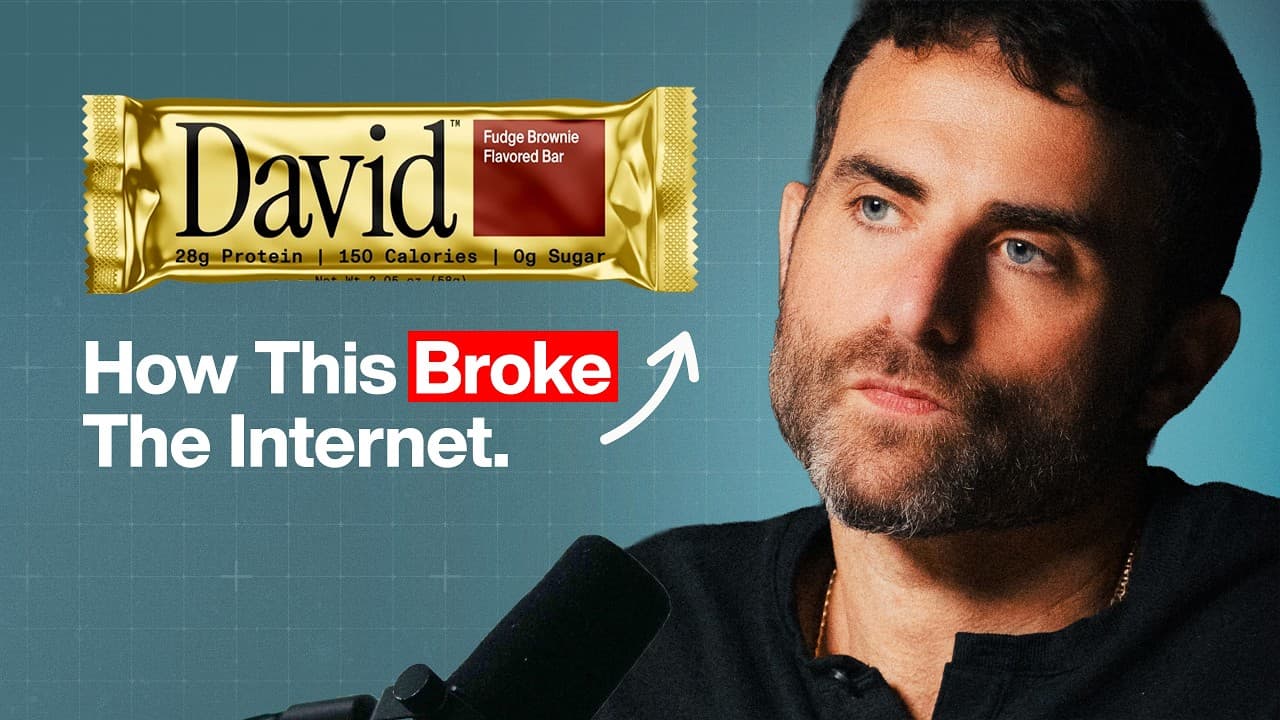
How Did Peter Rahal Scale David So Quickly?
TL;DR
David grew rapidly by pairing a differentiated 150-calorie protein product with disciplined branding, aggressive communication, and control over its most important ingredient, EPG. Peter Rahal argues that founders should pursue ideas that are not obvious but true, reduce critical supply dependencies, and create enough consumer surplus that the product feels substantially better than its measurable cost.
Transcript
just sitting there in the open. We're like, "Holy [ __ ] the product's so good, we got sued over it. It's so good, people don't believe it. It's so good. It tastes like it's 280 calories, but it only is $150." >> That's Peter Rahal. He built RX Bar to a $600 million exit and is now aggressively scaling David, a brand valued at over a billion in und... Read More
Key Insights
- David's 150-calorie claim is based on metabolic energy rather than the total energy released when the product is burned. Rahal says the lawsuit's plaintiffs used a bomb calorimeter, which does not account for how the human body absorbs ingredients such as fiber, allulose, and EPG.
- EPG is a triglyceride-based fat replacer that contains substantial physical energy but is not metabolically absorbed like conventional fat. According to Rahal, it helps David deliver the taste associated with a 280-calorie product while maintaining a stated nutritional value of 150 calories.
- The calorie lawsuit became widely visible after a content creator posted a humorous TikTok about a case that had been filed months earlier. Rahal says the viral post prompted broader media coverage, demonstrating how modern distribution can revive and amplify an older event.
- Experienced founders must communicate during public controversy instead of automatically following a lawyer's preference for silence. Rahal says his team responded quickly and used intuition, large language models, and more limited legal input to determine how the company should address the viral allegations.
- Single-source ingredient dependence is a major operational risk because problems with capacity, pricing, or production remain outside the brand's control. Rahal responded by building a relationship with the EPG company, negotiating supply protections, and eventually completing a cash-and-equity acquisition and merger.
- New ingredient businesses face a chicken-and-egg problem because large customers want low prices, proven supply, and sufficient production capacity before committing demand. Meanwhile, manufacturers cannot justify expanding capacity without committed demand, making vertical integration a practical route to commercial scale.
- David's supply agreement included change-of-control protections and most-favored-nation terms covering pricing and available inventory. These provisions were designed to preserve continued access, match better prices offered elsewhere, and give David priority when the supplier had open inventory.
- Breakout marketing ideas are not obvious but true, while conventional brand activities often consume resources without materially changing results. Rahal argues that founders should identify the mountain they intend to climb, because choosing the right long-term problem matters more than pursuing aggression for its own sake.
Install to Summarize YouTube Videos and Get Transcripts
Explore YouTube Video Summarizer or Get YouTube Transcript Extractor
Questions & Answers
Q: How did David create a 150-calorie protein product?
David used EPG, which Rahal describes as a triglyceride-based fat replacer with substantial physical energy but different metabolic absorption from conventional fat. He says this distinction allows the product to taste as though it contains roughly 280 calories while carrying a stated value of 150 calories. The formulation therefore aims to preserve the sensory contribution of fat while reducing the energy the body can metabolically use.
Q: Why was David sued over its calorie claim?
The plaintiffs tested the product with a bomb calorimeter, an instrument that burns material and measures the energy released. Rahal argues that this method measures physical energy rather than the metabolic energy used for nutrition labeling. Ingredients such as fiber, allulose, and EPG can release energy when burned without being absorbed by the body at the same caloric rate. He says the resulting lawsuit was dropped.
Q: Why did the calorie lawsuit become viral months after filing?
Rahal says the lawsuit was filed in January but did not become a major public story immediately. The attention arrived after a content creator made a humorous TikTok about the case, and that viral post led media organizations to cover it. He contrasts this environment with 2015, when a similar food-industry class action might never have attracted widespread attention.
Q: How should founders respond when a lawsuit becomes public?
Rahal's approach is to recognize that litigation can be part of operating an innovative food company, determine whether the underlying allegation is valid, and communicate quickly when misinformation spreads. He cautions experienced founders against simply accepting instructions to remain silent. His decision process now combines personal intuition, large language models, a strong internal team, and a smaller amount of legal input.
Q: Why did David acquire the company behind EPG?
David depended on a single supplier for an ingredient central to its product, creating risks around capacity, pricing, and disruptions outside its control. Rahal believed the available paths would eventually involve an acquisition, a merger, or a supplier problem. After David achieved product-market fit, the ingredient company proposed that he take it over, resulting in a cash-and-equity transaction and merger.
Q: Why is a new food ingredient difficult to scale?
A new ingredient faces a chicken-and-egg problem. Large food companies may find the technology interesting but reject it because one producer controls the supply, the price is high, and existing capacity cannot meet potential demand. The ingredient producer, however, cannot justify building more capacity without firm demand. Rahal says vertical integration can resolve this conflict by connecting product demand directly to manufacturing investment.
Q: How did David protect its access to EPG before the acquisition?
Rahal negotiated a supply agreement that preserved David's access if the ingredient company underwent a change of control. The agreement also included most-favored-nation protections for pricing and inventory. If another customer received a better price, David's terms would match it. If open inventory became available, David had the first right to that supply, reducing some dependence-related risk.
Q: What business principles does Peter Rahal recommend to founders?
Rahal recommends finding ideas that are not obvious but true, avoiding standard brand activities that consume time without moving results, and deliberately reducing critical dependencies. He also warns younger entrepreneurs against treating aggression as a strategy by itself. Because building a company can become a founder's life's work, he argues that choosing the right mountain to climb is a foundational decision.
Summary & Key Takeaways
-
Peter Rahal describes how David developed a protein product that tastes as though it contains 280 calories while listing 150 calories. A lawsuit challenged that figure using a bomb calorimeter, but Rahal says nutritional facts measure metabolic energy rather than all energy released through combustion. The case was ultimately dropped.
-
David depended on EPG, a fat replacer produced by a single supplier. Rahal recognized that relying on one source created risks involving supply, pricing, and scale. David negotiated protective supply terms and later acquired and merged with the ingredient company through a cash-and-equity transaction to support future manufacturing capacity.
-
Rahal argues that founders waste resources on conventional activities that do not materially affect results. His preferred strategy is to identify ideas that are not obvious but true, choose a worthwhile long-term problem, communicate directly during controversy, and build products whose benefits create substantial value for consumers beyond their apparent tradeoffs.
Read in Other Languages (beta)
Share This Summary 📚
Summarize YouTube Videos and Get Video Transcripts with 1-Click
Try YouTube Summary with ChatGPT & Claude or YouTube Transcript Generator
Explore More Summaries from Open Residency 📚

Summarize YouTube Videos and Get Video Transcripts with 1-Click
Try YouTube Summary with ChatGPT & Claude or YouTube Transcript Generator