How to Overcome Fear and Unlock Creative Flow
TL;DR
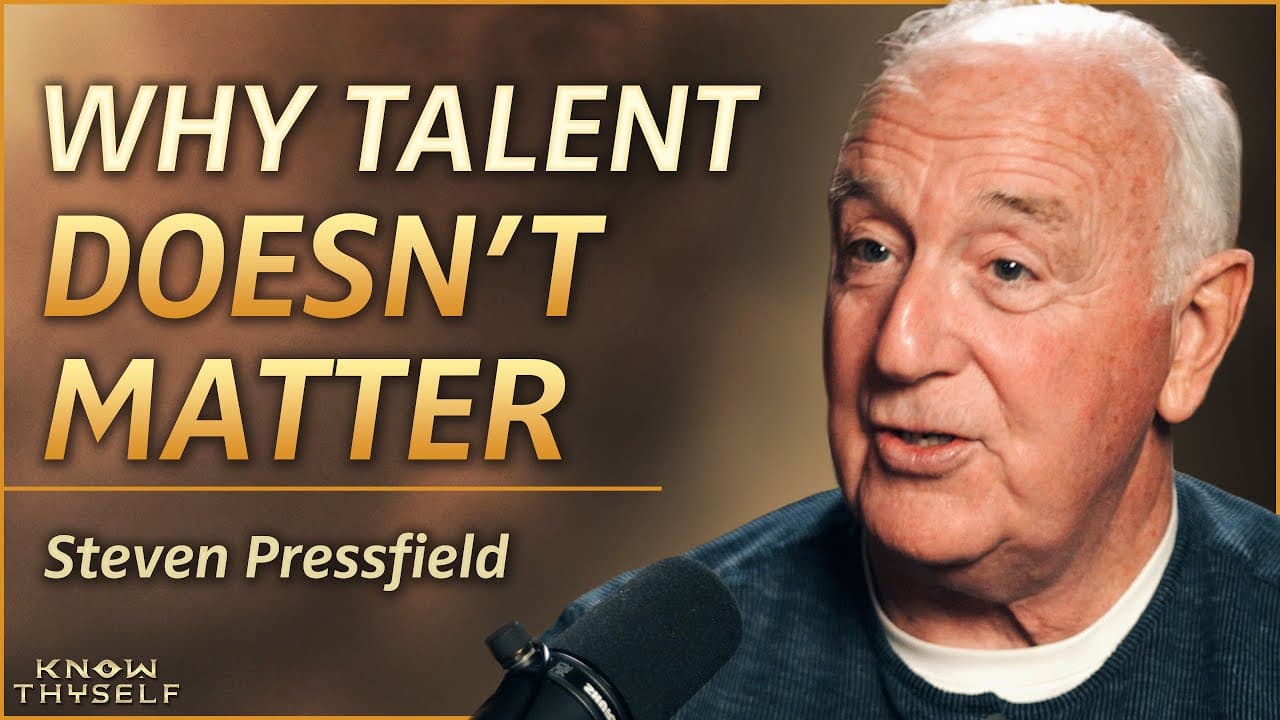
Creative potential is unlocked by treating fear and resistance as signs that meaningful work is waiting to be done, then approaching that work with professional discipline. Consistent creative practice opens a pathway to surprising ideas, reveals identity through completed work, and prevents unexpressed creativity from turning into unhappiness, depression, vice, or other destructive channels.
Transcript
we find out who we are through the works we produce and to me those Works have always surprised me for at least 30 years I was struggling as a writer kind of beating my head into the wall and getting better and learning things but never being able to actually tap into something that really felt like I'd hit something real what it really is is I've ... Read More
Key Insights
- Creative work is a means of self-discovery because creators learn who they are through what they produce. Pressfield says his own books repeatedly surprised him, revealing interests and capacities that he did not consciously know were present before the work emerged.
- Unexpressed creativity is compared to an underground river that never disappears. Pressfield believes that when this energy cannot flow through constructive creative expression, it may enter malignant channels such as depression, alienation, vice, general unhappiness, or possibly disease.
- The Muse is Pressfield's name for the mysterious source from which ideas appear. He presents it as a higher dimension that might also be called the soul, the self, or the quantum field, while emphasizing that its true nature remains unknowable.
- The artist's job is to open a pipeline between ordinary life and the source of inspiration. Pressfield also believes that the higher creative dimension is trying to reach the artist, making creativity a relationship rather than an act produced entirely by the ego.
- Resistance is the inner enemy that tells creators they are not good enough, their ideas are inadequate, or their circumstances disqualify them. A creator's first responsibility is to recognize that this discouraging voice exists and comes from within.
- Fear is a directional signal because the work a person fears most may be the work that matters most. Pressfield advises creators to ask what they are most afraid of and then seriously consider doing that very thing.
- Fear of success can exceed fear of failure because accepting genuine talent creates responsibility. If a creator admits that the ability is real, that person can no longer use uncertainty about talent as an excuse for avoiding the work.
- Professional discipline distinguishes committed creators from amateurs. Pressfield describes realizing that he had approached writing like an amateur during decades of struggle, while real writers understand that progress depends on facing resistance and consistently doing the work.
- More videos with Steven Pressfield:
Install to Summarize YouTube Videos and Get Transcripts
Explore YouTube Video Summarizer or Get YouTube Transcript Extractor
Questions & Answers
Q: How can creative work help you discover who you are?
Creative work reveals identity through the unexpected subjects, ideas, and abilities that emerge during production. Pressfield says he finds out who he is through the books he writes, including works that surprised him because he had not consciously known those interests were within him. The finished work becomes evidence of aspects of the creator that thought and self-description alone may not uncover.
Q: What happens when creativity is not expressed?
Pressfield compares creativity to an underground river that continues flowing whether or not it receives a positive outlet. When people do not bring forward what is inside them, he believes the energy can move into destructive channels such as unhappiness, depression, alienation, vice, or possibly disease. Creative expression therefore serves both artistic production and personal well-being by giving that inner force somewhere constructive to go.
Q: What is the Muse in the creative process?
The Muse is Pressfield's personification of the mysterious source from which creative ideas seem to arrive. He connects the term to the Greek conception of goddesses who inspired artists, but says the source could also be called the soul, the self, or the quantum field. The name matters less than recognizing that ideas can emerge from beyond the creator's conscious ego.
Q: How can an artist become more receptive to inspiration?
An artist becomes more receptive by opening a reliable pipeline to the source of creativity through the practice of making work. Pressfield believes the creative dimension is also trying to reach the artist, so receptivity involves getting the ego out of the way and entering the creative flow. Once that connection develops, ideas and abilities may appear that were unavailable on an earlier day.
Q: Why is fear important when choosing creative work?
Fear can indicate that a creative direction carries personal importance. Pressfield recommends asking which action or project creates the greatest fear and considering that as the work to pursue. Resistance often gathers around meaningful possibilities, so fear should not automatically be treated as proof that the creator is unqualified. It may instead identify the place where courage and commitment are most necessary.
Q: Why do creators fear success?
Creators may fear success because acknowledging real talent creates an obligation to use it. Pressfield describes the possibility of genuinely possessing talent as frightening because it places the responsibility directly on the individual. Doubting one's ability can protect a person from that burden, while accepting it removes a convenient excuse and requires the creator to attempt the work, face resistance, and share what emerges.
Q: What does resistance sound like to a creator?
Resistance sounds like an internal voice claiming that the creator is not good enough, the idea is not good enough, or personal circumstances make success impossible. It may focus on being too old, too young, too fat, or too thin. Pressfield identifies this voice as an enemy within, and he says the first task of any creative person is to acknowledge that it exists.
Q: How does a creator move from amateur to professional?
A creator begins moving from amateur to professional by recognizing resistance and treating the work as a responsibility rather than something attempted only when conditions feel favorable. Pressfield says he struggled as a writer for decades before realizing that he had been attacking the task like an amateur. The professional shift centers on facing fear, doing the work consistently, and becoming available to the creative flow.
Summary & Key Takeaways
-
Pressfield views creativity as an underground river that needs a constructive outlet. When people suppress what is within them, that energy may flow into unhappiness, depression, alienation, vice, or disease. Producing creative work gives the inner current somewhere positive to go and helps creators discover who they are.
-
Creative ideas can feel as though they arrive from a source beyond the ordinary ego. Pressfield calls this source the Muse, while acknowledging that others might call it the soul, the self, or the quantum field. The artist's responsibility is to establish a working connection with that mysterious source.
-
Fear and resistance are central obstacles to creative fulfillment, especially when they appear as self-criticism or fear of success. Pressfield argues that creators should recognize this inner enemy, pursue the work that frightens them most, and adopt a professional attitude built around doing the work rather than waiting for confidence or certainty.
Read in Other Languages (beta)
Share This Summary 📚
Summarize YouTube Videos and Get Video Transcripts with 1-Click
Try YouTube Summary with ChatGPT & Claude or YouTube Transcript Generator
Explore More Summaries from André Duqum 📚
Summarize YouTube Videos and Get Video Transcripts with 1-Click
Try YouTube Summary with ChatGPT & Claude or YouTube Transcript Generator