IVT Conjugate Poles | Z-Transform in Signals and Systems | Problem 1
TL;DR
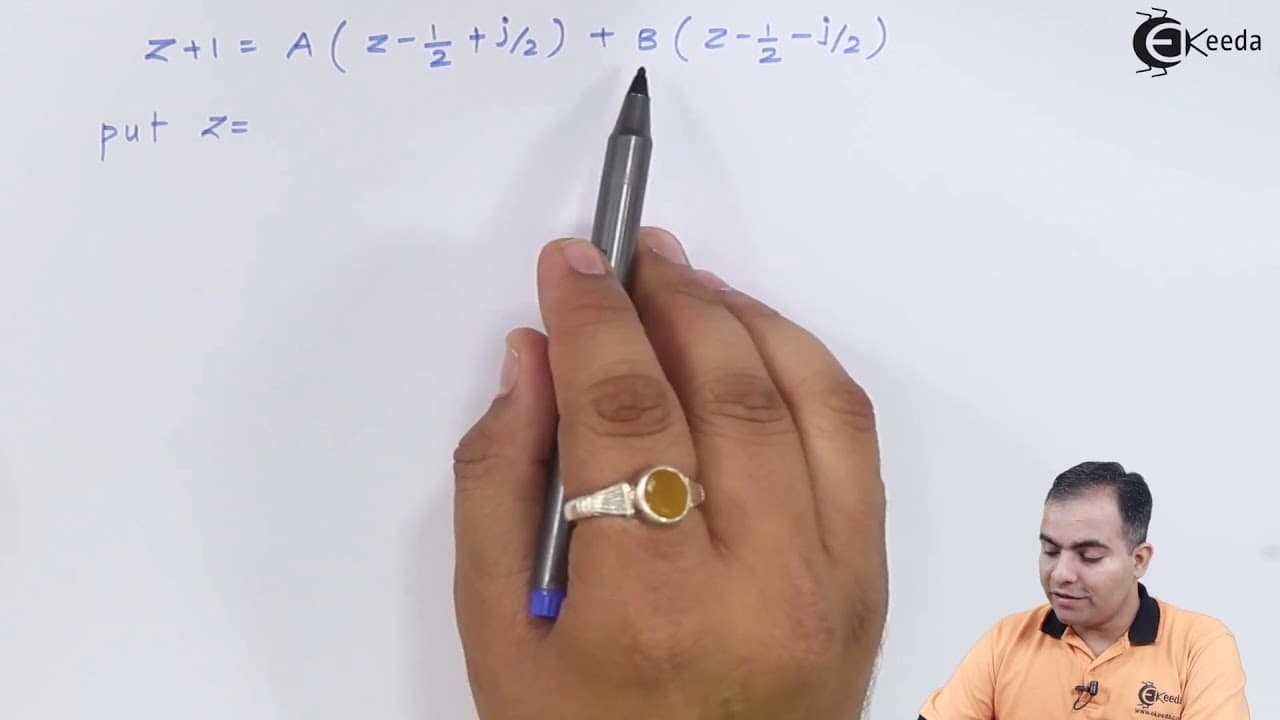
Find the inverse Z-transform of X(z) = (1 + z⁻¹)/(1 − z⁻¹ + 0.5z⁻²) by calculating its complex-conjugate poles and then applying partial fractions. With a = 1, b = −1, and c = 0.5, the quadratic formula gives the poles 1/2 + j/2 and 1/2 − j/2. Read on for the denominator conversion, pole test, and decomposition steps.
Transcript
click the bell icon to get latest videos from ekeeda hello friends and today we are going to study a new topic in which we are going to study inverse z transform of signals with the complex conjugate poles and when numerator degree is greater than denominator here we are going to study two different topics first one is signals with complex conjugat... Read More
Key Insights
- 🤪 The inverse Z-transform can be calculated using the partial fraction method for functions with complex conjugate poles.
- 🤘 Complex conjugate poles have the same real part and complex part but with opposite signs.
- 💈 The discriminant of the pole calculation formula determines whether the poles will be real or complex.
- 🖐️ Complex conjugate poles play a crucial role in solving problems involving signals with numerator degrees greater than the denominator.
Install to Summarize YouTube Videos and Get Transcripts
Explore YouTube Video Summarizer or Get YouTube Transcript Extractor
Questions & Answers
Q: How do you find the inverse Z-transform in IVT Conjugate Poles Problem 1?
Start with X(z) = (1 + z⁻¹)/(1 − z⁻¹ + 0.5z⁻²) and calculate the denominator’s poles using the quadratic formula. The poles are 1/2 + j/2 and 1/2 − j/2, after which the function is decomposed using partial fractions.
Q: What are the poles of 1 − z⁻¹ + 0.5z⁻²?
Using a = 1, b = −1, and c = 0.5 gives a discriminant of 1 − 2 = −1. Since the square root of −1 is j, the poles are 1/2 + j/2 and 1/2 − j/2.
Q: Why are these poles complex conjugates?
The two poles have the same real part, 1/2, and imaginary parts of equal magnitude, 1/2. Their imaginary signs are opposite, giving 1/2 + j/2 and 1/2 − j/2.
Q: How are the poles calculated from the denominator coefficients?
Use the quadratic formula, (−b ± √(b² − 4ac))/(2a). For this denominator, substitute a = 1, b = −1, and c = 0.5 into the formula.
Q: Why can’t the denominator be factored using simple real-number pairs?
A product such as 0.5 and 1 produces 0.5, but adding those values does not produce the required middle coefficient of −1. The resulting negative discriminant shows that the factors correspond to complex-conjugate poles.
Q: Why is the numerator and denominator multiplied by z²?
The lowest power in the denominator is z⁻². Multiplying the numerator and denominator by z² converts the expression into positive powers of z, making it easier to substitute the pole values and form the partial fractions.
Q: What does X(z) become after multiplying by z²?
The numerator becomes z(z + 1), because z multiplied by z⁻¹ equals 1. The denominator becomes z² − z + 0.5, so X(z) is written as z(z + 1)/(z² − z + 0.5).
Q: How are the partial-fraction constants set up for the two poles?
Because there are two pole positions, introduce two constants, A and B, with one term for each pole factor. Cross-multiply the terms, then substitute the pole values one at a time so that one term vanishes and the corresponding constant can be determined.
Summary & Key Takeaways
-
This video discusses two topics: signals with complex conjugate poles and signals with numerator degree greater than the denominator.
-
The first problem involves finding the inverse Z-transform of a function with a complex conjugate pole.
-
The video explains how to factorize the denominator and calculate the poles of the function.
-
The partial fraction method is used to solve for the constants in the inverse Z-transform.
Read in Other Languages (beta)
Share This Summary 📚
Summarize YouTube Videos and Get Video Transcripts with 1-Click
Try YouTube Summary with ChatGPT & Claude or YouTube Transcript Generator
Explore More Summaries from Ekeeda 📚

Summarize YouTube Videos and Get Video Transcripts with 1-Click
Try YouTube Summary with ChatGPT & Claude or YouTube Transcript Generator