How Do Major Cities Prepare for Cyberattacks?
TL;DR
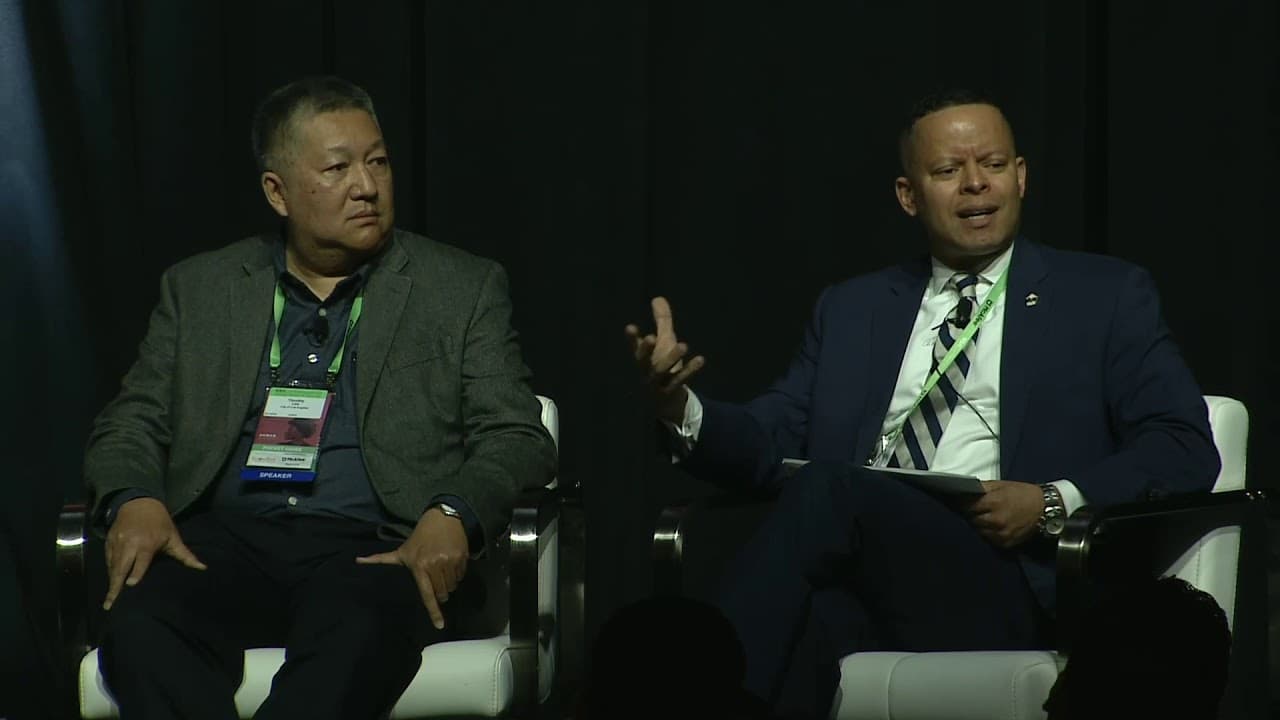
Major cities prepare for cyberattacks by combining threat intelligence sharing, workforce development, community engagement, and collaboration among government, businesses, academia, and federal partners. Los Angeles formalized this approach through the nonprofit LA Cyber Lab, while New York and Los Angeles share practices to protect increasingly connected infrastructure, public safety systems, and sensitive citizen data.
Transcript
So with that, uh, I'm going to bring on our first panel. So the session is Lessons from America's Two Largest Cities on Preparing for Cyber Attacks. So I'll let Laura come up and introduce her panelists, um, because it's easier, and I don't butcher names that way. All right. Okay. Step into my, uh, white, my white chair office here, gentlemen. Than... Read More
Key Insights
- Los Angeles protects an extensive municipal environment that includes four million residents, 50,000 city employees, a major airport, the Port of Los Angeles, public safety operations, and sensitive citizen data. Its integrated security operations center processes an average of one billion events per day.
- New York City's cybersecurity environment spans 120 agencies, 320,000 city employees, 52,000 NYPD employees, 13,000 traffic lights, and 17 critical infrastructure sectors. The city also handles about 25,000 emergency calls per day and 11.6 million calls each year.
- Connected infrastructure expands a city's attack surface because traffic lights, port equipment, transportation assets, public safety systems, and other municipal technologies increasingly depend on networked components. Protecting these environments requires cities to reconsider established safeguards and develop approaches suited to newer connected systems.
- The LA Cyber Lab is a nonprofit cybersecurity partnership designed to unite three groups: public institutions, private organizations, and academia. Its public participants include local, state, and federal partners, while private participation includes local businesses and members of the cybersecurity industry.
- Threat intelligence sharing supports three municipal objectives: situational awareness, education and training, and protection. The LA Cyber Lab treats sharing as a central initiative because it gives participating organizations a common platform for understanding threats and improving their cybersecurity capabilities.
- The Cybersecurity Academy supports internal workforce development and gives cybersecurity vendors a platform for introducing innovative technologies to participating members. This structure connects employee preparation with opportunities to examine security products that could address municipal requirements.
- Community engagement is a formal pillar of the LA Cyber Lab. The organization periodically hosts security events to promote cybersecurity awareness and inspire collaboration among local governments, businesses, academic institutions, and other organizations participating in the regional security community.
- Los Angeles developed its threat sharing program through staged institutional support. The mayor launched the LA Cyber Lab in 2017, the organization received a Department of Homeland Security grant in 2018, and a platform created with IBM launched in September 2019.
Install to Summarize YouTube Videos and Get Transcripts
Explore YouTube Video Summarizer or Get YouTube Transcript Extractor
Questions & Answers
Q: How do major cities prepare for cyberattacks?
Major cities prepare by combining threat intelligence sharing, cybersecurity workforce development, community awareness, and cooperation across organizational boundaries. The Los Angeles approach brings local, state, and federal government partners together with local businesses, cybersecurity companies, and academia. This model is intended to improve situational awareness, training, protection, and collaboration as connected municipal infrastructure expands the potential attack surface.
Q: What is the LA Cyber Lab?
The LA Cyber Lab is a nonprofit cybersecurity public-private partnership launched by the mayor of Los Angeles in 2017. It provides a platform where public institutions, private organizations, and academic participants can collaborate to improve cybersecurity. Its public sector participants include local, state, and federal partners, while its private participants include local businesses and companies from the cybersecurity industry.
Q: What are the three main initiatives of the LA Cyber Lab?
The LA Cyber Lab has three principal initiatives. The first is threat intelligence sharing for situational awareness, education and training, and protection. The second is the Cybersecurity Academy, which supports workforce development and technology introductions. The third is connecting the community through periodic security events that promote awareness and encourage cybersecurity collaboration among local governments and other participants.
Q: How does threat intelligence sharing help municipal cybersecurity?
Threat intelligence sharing helps municipal cybersecurity in three stated areas: situational awareness, education and training, and protection. Within the LA Cyber Lab, it also creates a practical activity around which public agencies, businesses, cybersecurity companies, and academic institutions can collaborate. The program therefore supports both the immediate exchange of threat information and the broader development of a cooperative security community.
Q: Why is cybersecurity difficult for Los Angeles?
Los Angeles must protect a large and varied environment that includes infrastructure for four million residents, 50,000 city employees, a major airport, the Port of Los Angeles, police operations, and highly sensitive public safety and citizen data. Its integrated security operations center averages one billion events each day, and the city blocks 3,200 attacks per day.
Q: Why is cybersecurity difficult for New York City?
New York City's municipal environment includes 120 agencies, 320,000 city employees, 52,000 NYPD employees, 13,000 traffic lights, and 17 critical infrastructure sectors. It also supports services that include approximately 25,000 emergency calls each day and one billion gallons of water flowing into the city daily. Coordinating protection across that scale creates substantial stakeholder and infrastructure challenges.
Q: How does connected infrastructure affect a city's cyber risk?
Connected infrastructure widens a city's attack surface by adding networked technology to systems such as traffic lights, ports, container operations, public safety services, and other municipal equipment. Because these assets support essential services and sensitive information, cities must consider both established protection methods and newer security approaches designed for infrastructure that is more connected than it was previously.
Q: How was Los Angeles's threat sharing platform developed?
Los Angeles developed the platform through several documented stages. The mayor launched the LA Cyber Lab in 2017. In 2018, the organization received a Department of Homeland Security grant to pilot a threat intelligence sharing platform. It then partnered with IBM and launched the first platform in September 2019, when it also hosted the first LA Cyber Lab Security Summit.
Summary & Key Takeaways
-
Los Angeles and New York face unusually broad cybersecurity responsibilities because their governments support millions of residents, large workforces, public safety operations, transportation systems, utilities, ports, and other critical infrastructure. Their high profiles and growing dependence on connected technology expand the number of systems that municipal cybersecurity programs must protect.
-
The LA Cyber Lab is a nonprofit public-private partnership that brings together government, local businesses, the cybersecurity industry, and academia. Its three principal initiatives are threat intelligence sharing, the Cybersecurity Academy for workforce and technology development, and community events intended to increase awareness and encourage collaboration among local governments and other participants.
-
Los Angeles launched the LA Cyber Lab in 2017 and received a Department of Homeland Security grant in 2018 to pilot a threat intelligence sharing platform. The city partnered with IBM and launched its first platform in September 2019, the same month it hosted the first LA Cyber Lab Security Summit.
Read in Other Languages (beta)
Share This Summary 📚
Summarize YouTube Videos and Get Video Transcripts with 1-Click
Try YouTube Summary with ChatGPT & Claude or YouTube Transcript Generator
Explore More Summaries from RSAC Cybersecurity 📚

Summarize YouTube Videos and Get Video Transcripts with 1-Click
Try YouTube Summary with ChatGPT & Claude or YouTube Transcript Generator