How Does Social Data Shape Personal Decisions?

TL;DR
Social data is information people create and share, sometimes knowingly and sometimes simply by using connected services. Although organizations can measure many variables and build equations for recommendations, business, healthcare, or access to services, human judgment still determines which outcomes receive the most weight. Those choices govern how scarce resources and opportunities are allocated.
Transcript
So last month, I gave my first book talk at Twitter, and halfway through the talk, the organizer came up to me and said, "Excuse me, there's an emergency." I said, "What? What?" "Trump hasn't tweeted for twelve minutes." Um, so, uh, that was an emergency. So before we look into the future, because I think making predictions is an important thing, I... Read More
Key Insights
- Social data is information people create and share, whether deliberately or without fully recognizing the disclosure. Asking Google Maps for directions requires revealing a current location, just as taking a taxi requires telling the driver where the trip should begin or end.
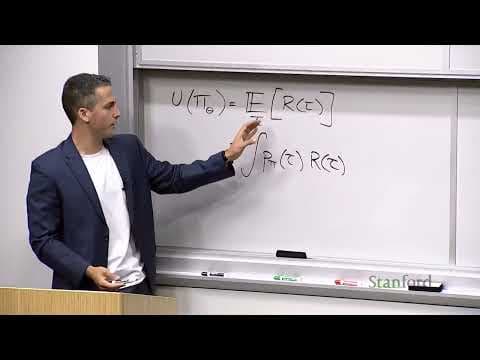
- Decision equations are collections of measurable variables whose influence depends on assigned weights. Data can reveal overlooked variables and make previously unmeasured factors quantifiable, but it cannot independently decide how much importance society or an organization should give each outcome.
- Resource allocation is a central function of decision-making. When a scarce organ must be assigned among many patients, eligibility and ranking depend on selected variables, such as the risk of immune rejection, and on judgments about how those variables should influence the result.
- Business recommendations reflect weighted trade-offs rather than purely objective answers. A company may balance the higher profit margin of one product against the greater probability that a customer will buy another, making the ranking a practical expression of organizational priorities.
- Personal decisions can also be understood as equations with competing terms. Eating chocolate may produce an immediate benefit while excessive sugar may create longer-term harm, so the choice depends partly on how strongly a person discounts expected benefits and costs over time.
- Mobile location data can be created without an explicit act of sharing. A carrier can triangulate a phone's position from base stations in places where the phone works, and avoiding that form of data creation may require turning off the device and losing its utility.
- Continuous location sharing changes ordinary social interactions by making claims verifiable. During Weigend's location-sharing experiment, students could see his movements and challenge his statement that he was almost at a restaurant because the data showed he remained about ten minutes away.
- Social credit scoring is presented as an equation of society that can affect access to resources. The seminar describes scores influencing employment prospects, office waiting times, and entry to a VIP lane at Beijing Capital Airport, extending scoring beyond the credit decisions associated with FICO.
Install to Summarize YouTube Videos and Get Transcripts
Explore YouTube Video Summarizer or Get YouTube Transcript Extractor
Questions & Answers
Q: What is social data and how is it created?
Social data is information that people create and share, whether they intend to disclose it or not. It can arise from an explicit request, such as giving Google Maps a current location to obtain directions, or from ordinary device operation. A mobile carrier, for example, can triangulate a phone's location through base stations without the user manually reporting where they are.
Q: Why does using a digital service often require sharing data?
A service may need personal information to perform the function a user requests. Google Maps needs a person's location to provide relevant directions, much as a taxi driver needs to know where to take a passenger. Refusing to provide the necessary information can prevent the service from working, which creates a practical trade-off between protecting data and receiving useful assistance.
Q: Why can data not determine the correct decision by itself?
Data can help identify relevant variables and measure factors that were previously overlooked, but it does not determine the importance assigned to each factor. The weights in a decision equation express human judgment about desired outcomes. Even when hundreds of business variables can be measured, someone must still decide how profit, purchase likelihood, and other goals should be balanced.
Q: How can an equation represent business priorities?
An equation can represent business priorities by combining many measurable terms and assigning each one a weight. At Amazon, Weigend and Jeff Bezos worked on an equation of business containing hundreds of terms. A recommendation could weigh the higher profit margin of one item against the greater likelihood that a customer will purchase another, turning strategic preferences into ranking decisions.
Q: How do decision equations apply to organ transplants?
Organ transplantation illustrates how a ranking function allocates a scarce resource. If one liver is available for a hundred people, decision-makers must choose relevant variables and determine their weights. The transcript identifies possible immune rejection as one factor and describes the MELD score as a function developed by people at the Mayo Clinic who examined this allocation problem.
Q: How can personal choices be viewed as an equation of life?
Personal choices can be framed as trade-offs among immediate and future outcomes. A piece of chocolate may feel good now, while consuming too much sugar may be harmful over the longer term. An equation of life would include these competing effects and the rate at which a person reduces the present importance of expected future benefits or costs, described as hyperbolic discounting.
Q: What did continuous location sharing reveal about social data?
Continuous location sharing showed how personal behavior becomes observable and independently verifiable. Weigend wore a GPS device that communicated his location by satellite and shared the resulting information with students for several months during a ten-week quarter. When he claimed he was almost at a restaurant, students used the location data to determine that he was still about ten minutes away.
Q: How can social credit scores affect access to society?
The social credit score described in the seminar functions as an equation of society that influences resource allocation. Weigend says a person's score could affect whether they receive a job, how long they wait at an office, and whether they can use a VIP lane at Beijing Capital Airport. He contrasts this broad role with a FICO score used in United States credit decisions.
Summary & Key Takeaways
-
Andreas Weigend traces his path from physics at Stanford to neural-network research with Dave Rumelhart, later becoming Amazon's chief scientist and founding the Social Data Lab. His career developed alongside a major shift in computing, from scarce information and punch-card systems to abundant data generated through everyday digital activity.
-
At Amazon, Weigend explored an equation of business containing hundreds of measurable terms. Measurement alone could not determine the weights assigned to profit, purchase likelihood, or other outcomes. He extends this principle to personal choices, where immediate rewards and long-term effects must be balanced through explicit or implicit judgments.
-
Social data includes information people create and share while using services, whether or not they recognize the disclosure. Navigation requires sharing a location, while mobile carriers can infer location through base-station triangulation. Such data can power useful services, but scoring systems can also influence access to jobs, credit, faster service, and other resources.
Read in Other Languages (beta)
Share This Summary 📚
Summarize YouTube Videos and Get Video Transcripts with 1-Click
Try YouTube Summary with ChatGPT & Claude or YouTube Transcript Generator
Explore More Summaries from Stanford Online 📚




Summarize YouTube Videos and Get Video Transcripts with 1-Click
Try YouTube Summary with ChatGPT & Claude or YouTube Transcript Generator