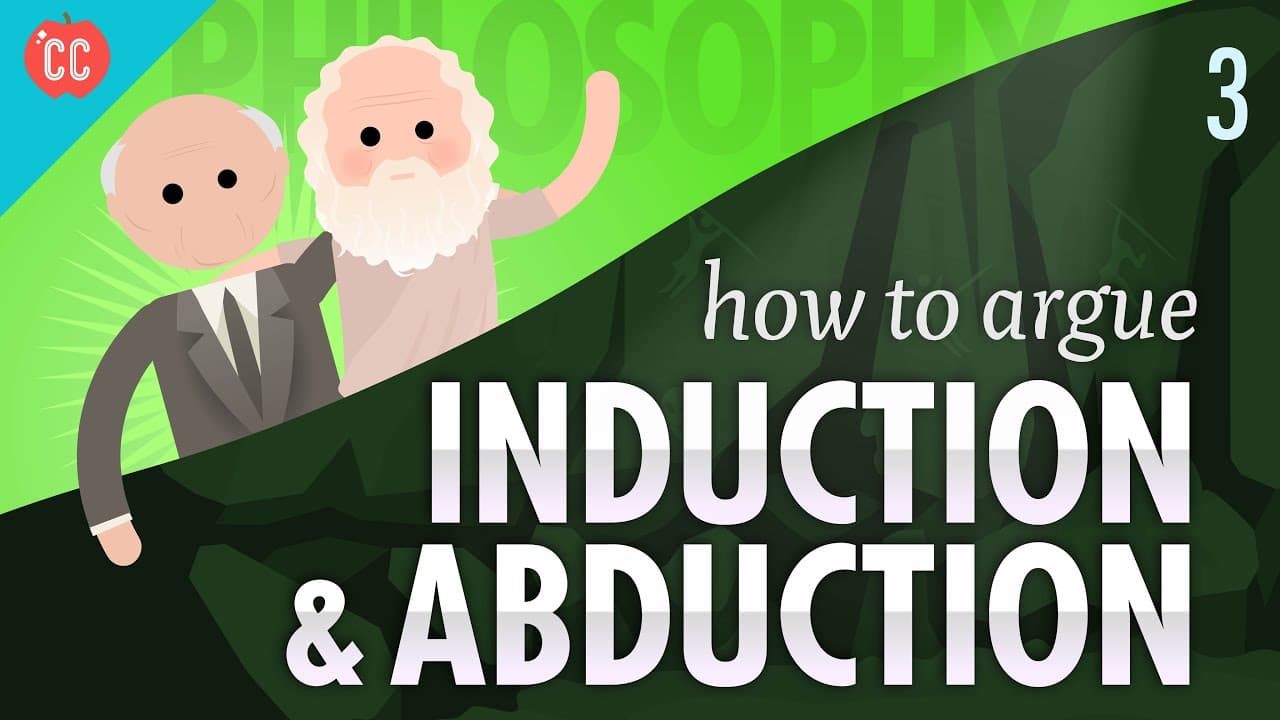
How to Use Induction and Abduction in Arguments
TL;DR
Inductive reasoning helps predict future outcomes based on past experiences, but it lacks certainty. Abductive reasoning, or inference to the best explanation, involves ruling out impossibilities to find the most plausible conclusion. Both methods are essential in forming arguments and counterarguments, as demonstrated in the Socratic method of dialogue.
Transcript
Crash Course Philosophy is brought to you by Squarespace. Squarespace: Share your passion with the world. How do you know that aspirin will take care of your headache? Why do you really want to see the new Marvel movie, even though you haven’t heard anything about it, good or bad? Your ability to do things like predict how a medication will affect ... Read More
Key Insights
- Inductive reasoning is based on the predictability of nature, suggesting the future will resemble the past.
- Unlike deduction, induction offers probability rather than certainty, which means conclusions can be false.
- Abductive reasoning involves eliminating impossible explanations to identify the most plausible one.
- The Socratic method uses dialogue and counterarguments to approach truth, not to win arguments.
- Philosophers use different reasoning styles in arguments to build stronger beliefs and reject false ones.
- Induction can fail when patterns change, highlighting the importance of considering outliers.
- Abduction is used in fields like medicine and detective work, where data is limited.
- Counterarguments are essential in philosophical discourse, requiring evidence-based reasoning.
Install to Summarize YouTube Videos and Get Transcripts
Explore YouTube Video Summarizer or Get YouTube Transcript Extractor
Questions & Answers
Q: How does inductive reasoning work?
Inductive reasoning works by using past experiences to predict future outcomes. It assumes that the future will resemble the past, allowing for educated guesses based on observed patterns. However, it does not provide certainty, only probabilities, which means conclusions drawn from inductive reasoning can be incorrect if the patterns change or if there are exceptions.
Q: What is abductive reasoning?
Abductive reasoning, also known as inference to the best explanation, involves ruling out impossible explanations to identify the most plausible one. Unlike deduction and induction, abduction does not move directly from premises to conclusion. It is used when data is limited, requiring careful consideration of available evidence to arrive at the most likely conclusion.
Q: What are the strengths and weaknesses of inductive reasoning?
The strength of inductive reasoning lies in its ability to make predictions based on past experiences, which is useful in everyday decision-making. However, its weakness is that it only offers probabilities, not certainty. This means conclusions can be false if patterns change or if there are outliers that do not fit the observed pattern.
Q: How is abductive reasoning used in practice?
Abductive reasoning is often used in fields where data is limited, such as medicine and detective work. Doctors use it to diagnose illnesses by ruling out unlikely causes based on symptoms and available evidence. Detectives apply it to solve cases by piecing together evidence to form the most plausible explanation for events, always seeking more data to refine their conclusions.
Q: What is the Socratic method?
The Socratic method is a form of dialogue that involves asking and answering questions to stimulate critical thinking and uncover underlying assumptions. It is used to approach truth through reasoned arguments and counterarguments. Philosophers engage in this method to refine their beliefs, using various reasoning styles to challenge and strengthen their conclusions.
Q: Why is inductive reasoning not always reliable?
Inductive reasoning is not always reliable because it relies on the assumption that the future will resemble the past. This assumption can be flawed if patterns change or if there are exceptions. Since inductive reasoning only offers probabilities, conclusions can be incorrect, highlighting the importance of considering outliers and remaining open to new information that may alter predictions.
Q: How do philosophers use arguments differently?
Philosophers use arguments to seek truth rather than to win debates. They engage in reasoned dialogue, presenting evidence-based arguments and counterarguments. This process, known as the Socratic method, involves critical examination of ideas to refine beliefs and reject false conclusions. Philosophers value the exchange of ideas as a means to approach a deeper understanding of truth.
Q: What role do counterarguments play in philosophical reasoning?
Counterarguments are essential in philosophical reasoning as they challenge initial arguments and encourage deeper examination of ideas. They require evidence-based reasoning and help interlocutors refine their beliefs by revealing weaknesses in arguments. Through the Socratic method, counterarguments facilitate a collaborative search for truth, where the goal is not to win but to build stronger, more accurate conclusions.
Summary & Key Takeaways
-
Inductive reasoning helps predict future outcomes based on past experiences, but it lacks certainty. It operates on probabilities rather than definitive conclusions, making it useful but fallible, as patterns can have exceptions.
-
Abductive reasoning involves ruling out impossible explanations to find the most plausible conclusion. Known as inference to the best explanation, it is crucial when data is limited, as seen in medical diagnoses and detective work.
-
The Socratic method emphasizes dialogue and counterarguments to discover truth. Philosophers use this method to refine beliefs, employing various reasoning styles to strengthen arguments and reject false conclusions.
Read in Other Languages (beta)
Share This Summary 📚
Summarize YouTube Videos and Get Video Transcripts with 1-Click
Try YouTube Summary with ChatGPT & Claude or YouTube Transcript Generator
Explore More Summaries from CrashCourse 📚

Summarize YouTube Videos and Get Video Transcripts with 1-Click
Try YouTube Summary with ChatGPT & Claude or YouTube Transcript Generator