How to Prepare for Zero-Day Security Incidents
TL;DR
Prepare for zero-day incidents by rehearsing response plans, identifying affected assets and software components, and prioritizing systems according to potential material impact. Because exploitation can begin within hours of disclosure, teams need separate playbooks and appropriate partners for supply-chain software, common protocols, infrastructure, malware, firmware, and connected devices while temporary mitigations support eventual patching or network reconfiguration.
Transcript
Hello, and welcome to this edition of our RSAC webcast series. I'm your host, Casey Zerkas, Senior Content Manager for RSA Conference. And today I am joined by Steve Winterfeld, who is the Advisory CISO at Akamai. And Steve is going to be talking to us about how to avoid having zero days ruin your weekends. Before I turn it over to Steve, I wanna r... Read More
Key Insights
- Zero-day incidents require practiced response plans because preparation helps people understand their roles before a crisis, while an unplanned drill can become chaotic. The webcast uses fire-drill experiences to illustrate why teams should rehearse procedures instead of improvising during an active vulnerability event.
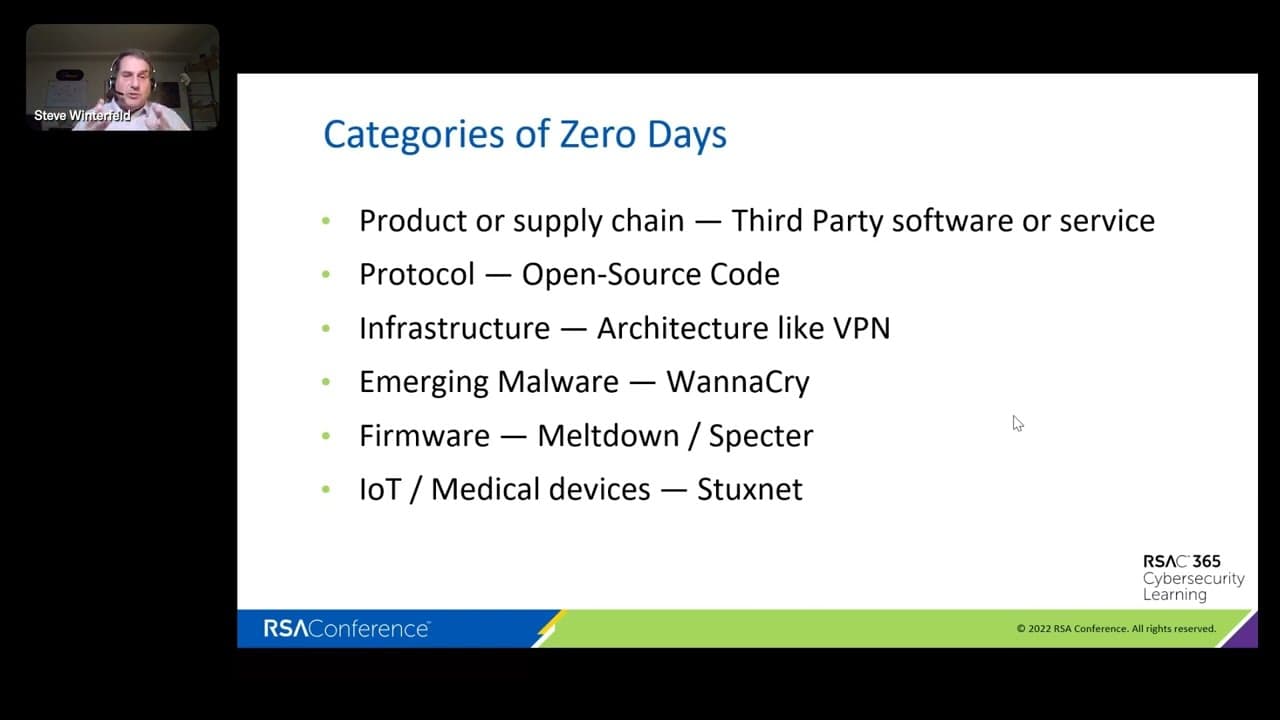
- Zero-day vulnerabilities appear across several distinct categories, including third-party products and services, open-source components, common protocols, infrastructure, emerging malware, firmware, and connected devices. Each category can require a different playbook, set of technical controls, and group of response partners.
- Supply-chain exposure can extend an incident beyond the organization that was initially compromised. A vulnerable software supplier, file-sharing service, internet provider, or managed service provider may expose its customers, making vendor management a critical part of preparedness for these second-order attacks.
- A software bill of materials helps organizations determine whether they use an affected open-source component or common capability. This visibility is particularly valuable for incidents like Log4j, because vulnerable protocols and embedded software components can be harder to locate than conventional infrastructure assets.
- Asset management helps teams identify affected infrastructure, including the relevant product and version. Vulnerability scanners may quickly provide tests that show whether emerging malware or a newly disclosed weakness could work against the organization, supporting faster assessment of actual exposure.
- The interval between public disclosure and active exploitation can be measured in hours, according to the presented Log4j experience. This compressed timeline means organizations cannot depend on having several days to patch and must prepare mitigation, detection, ownership, and escalation processes in advance.
- Firmware vulnerabilities can require different people, processes, and risk decisions from ordinary software patching. The Meltdown and Spectre example showed that mature software-patching procedures may not transfer directly, although portions of an existing patch process can still be adapted.
- Material impact should determine response priority because the same vulnerability can produce very different consequences depending on its location, data, and payload. Important impact categories include operational disruption, safety, brand damage, lost revenue, and compliance obligations such as timelines or fines.
Install to Summarize YouTube Videos and Get Transcripts
Explore YouTube Video Summarizer or Get YouTube Transcript Extractor
Questions & Answers
Q: How should organizations prepare for zero-day incidents?
Organizations should create and rehearse response plans before a vulnerability is announced, ensuring that participants understand their responsibilities and escalation paths. Preparation should address several vulnerability categories because third-party services, open-source components, infrastructure, malware, firmware, and connected devices can require different partners and procedures. Teams also need asset visibility, component inventories, monitoring, temporary mitigation options, and a process for prioritizing material business impact.
Q: What types of zero-day vulnerabilities should response plans cover?
Response plans should cover vulnerabilities in products, third-party services, and supply-chain partners, as well as open-source code, commonly used protocols, traditional infrastructure, emerging malware, firmware, and Internet of Things or medical devices. These categories should not be treated as identical. They can involve different owners, inventories, monitoring methods, patching practices, technical limitations, and risk postures, so each may need a tailored playbook.
Q: Why is vendor management important during a zero-day response?
Vendor management matters because a vulnerability or compromise may begin with software, a hosted service, a file-sharing provider, an internet provider, or a managed service provider. The effects can then spread to customers in a second-order attack. A response therefore needs contacts and procedures for critical partners, not only internal technical teams, so the organization can assess dependencies, exposure, and available mitigations quickly.
Q: How does a software bill of materials help with Log4j-like vulnerabilities?
A software bill of materials provides a repository for determining where an affected component or capability is used. During an event like Log4j, the essential early question is whether the organization uses the component and where it appears. This component-level visibility is important because open-source libraries and common protocols can be harder to find than familiar infrastructure already recorded through conventional asset-management processes.
Q: Why must zero-day response move quickly after disclosure?
Zero-day response must move quickly because the time between public announcement and operational exploitation can be only hours, as described for Log4j. Criminal organizations may also purchase zero days and use them immediately. Organizations therefore need prepared procedures for locating exposure, testing vulnerability, deploying temporary mitigations, monitoring attacks, escalating decisions, and coordinating patches or network reconfiguration rather than assuming they will have several days.
Q: How should organizations prioritize systems affected by a zero day?
Organizations should prioritize affected systems according to potential material impact rather than vulnerability presence alone. Teams should determine where the vulnerable component exists, what data is involved, and what payload or attacker business model may apply, such as ransomware or data exfiltration. They should then assess possible effects on operations, safety, brand trust, revenue, and compliance requirements, including associated timelines or fines.
Q: Why do firmware vulnerabilities need a separate response process?
Firmware vulnerabilities can involve different teams, patching methods, risks, and operational decisions from ordinary software vulnerabilities. The Meltdown and Spectre example showed that organizations with mature software-patching processes did not necessarily have equally mature firmware procedures. Existing patch workflows may provide useful foundations, but teams still need to identify the responsible people, evaluate uncertainty about exploitability, and adapt deployment and risk-management practices.
Q: How should teams protect IoT and medical devices during a zero-day event?
Teams should first ensure that Internet of Things and medical devices are included in asset awareness and network monitoring, because these systems may be missing from conventional infrastructure inventories. Their protocols can be unique, and traditional monitoring or management approaches may not work. Many also cannot run ordinary endpoint protection, so organizations should adapt concepts used for serverless environments or infrastructure as code and emphasize appropriate network-level visibility.
Summary & Key Takeaways
-
Zero-day preparation should resemble an effective fire drill: teams need practiced plans, clear responsibilities, and familiarity with response procedures before an emergency occurs. Different vulnerability categories involve different technologies and stakeholders, so treating every event as a generic malware problem can leave important systems, partners, and operational dependencies outside the response process.
-
Organizations need visibility into where vulnerable components exist. Asset management can help locate affected infrastructure, while a software bill of materials can reveal uses of open-source code or common components such as Log4j. Vendor management is especially important when products, service providers, file-sharing platforms, internet providers, or managed service providers create indirect exposure.
-
Response priorities should depend on potential material impact, not merely the existence of a vulnerability. Teams should assess the affected data and possible payload, then consider consequences for operations, safety, brand trust, revenue, and compliance. Temporary mitigation, network reconfiguration, monitoring, and eventual patching should be coordinated according to those business risks.
Read in Other Languages (beta)
Share This Summary 📚
Summarize YouTube Videos and Get Video Transcripts with 1-Click
Try YouTube Summary with ChatGPT & Claude or YouTube Transcript Generator
Explore More Summaries from RSAC Cybersecurity 📚




Summarize YouTube Videos and Get Video Transcripts with 1-Click
Try YouTube Summary with ChatGPT & Claude or YouTube Transcript Generator