10 Best YouTube Videos to Practice English Listening and Speaking

Aug 06, 2026
12 min read
81 views
Last updated: August 2026
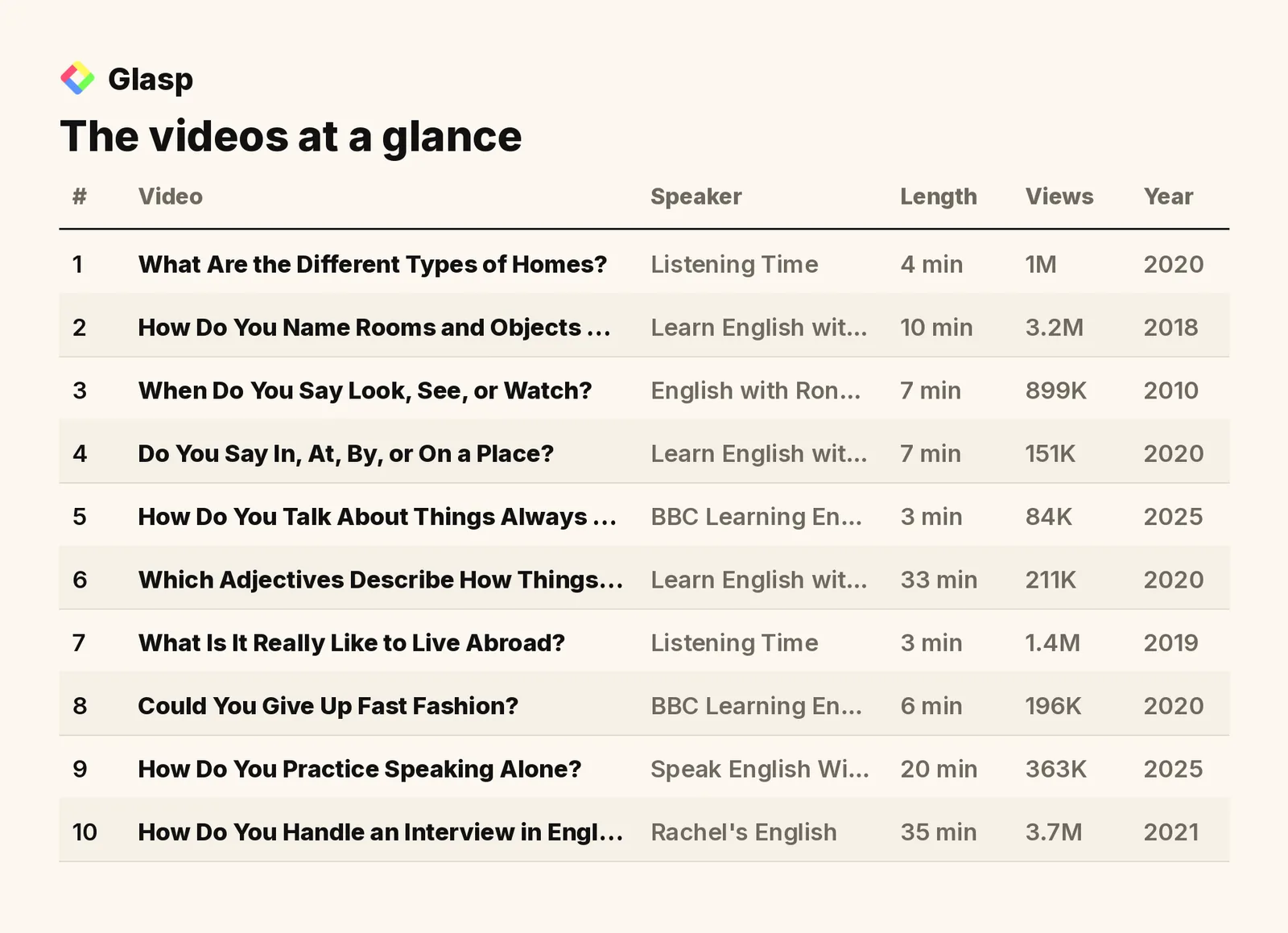
This is a list of ten YouTube videos for practicing English listening and speaking, ordered as a path rather than by popularity. It is for learners who read English comfortably but freeze when they have to open their mouth and say something.
The full set runs about 128 minutes, a little over two hours, and moves from A1 listening about homes to a full mock job interview. Every video comes from a channel that has taught this material for years: Listening Time, Bob the Canadian, engVid, BBC Learning English, Speak English With Vanessa, and Rachel's English.
The videos on this list, in the order to watch them, are:
What Are the Different Types of Homes? (Listening Time)
How Do You Name Rooms and Objects at Home? (Learn English with Bob the Canadian)
When Do You Say Look, See, or Watch? (English with Ronnie, engVid)
Do You Say In, At, By, or On a Place? (Learn English with Bob the Canadian)
How Do You Talk About Things Always True? (BBC Learning English, Georgie)
Which Adjectives Describe How Things Feel? (Learn English with Bob the Canadian)
What Is It Really Like to Live Abroad? (Listening Time)
Could You Give Up Fast Fashion? (BBC Learning English)
How Do You Practice Speaking Alone? (Speak English With Vanessa)
How Do You Handle an Interview in English? (Rachel's English)
Total: 10 videos, 128 minutes of watch time (2 hours 8 minutes), and 11.2M combined views.
1. What Are the Different Types of Homes?
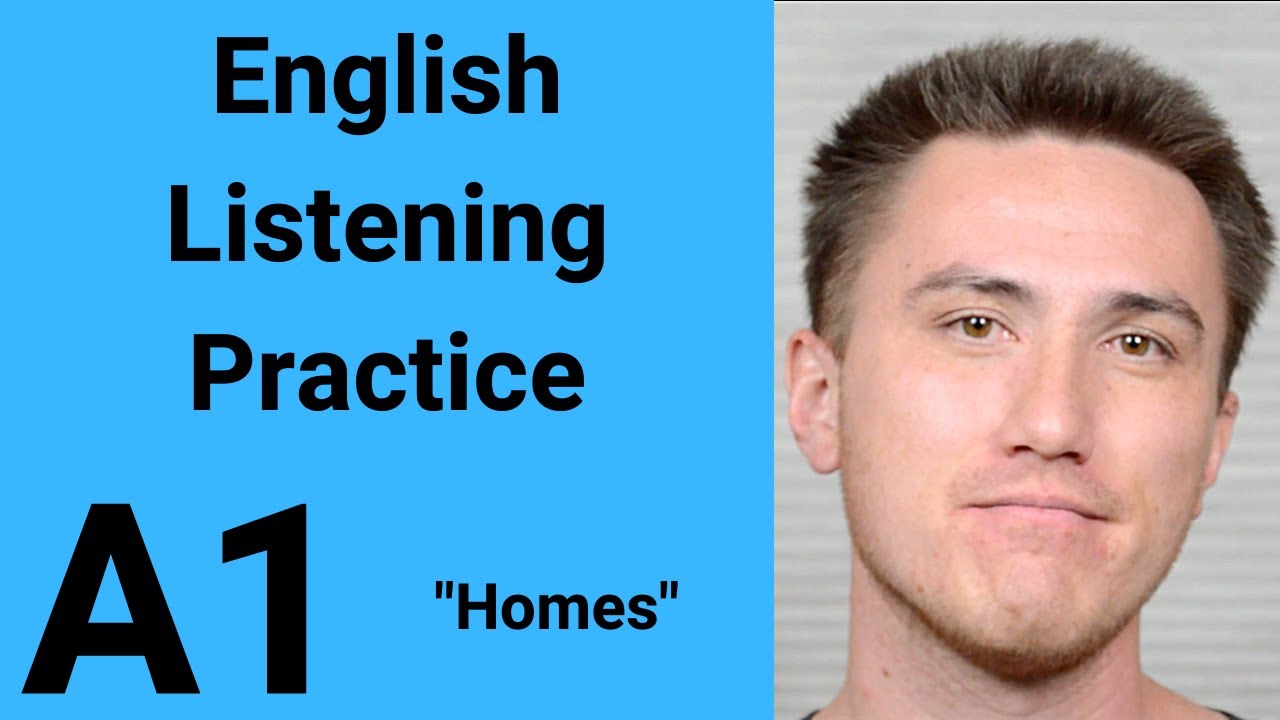
"A1 English Listening Practice - Homes" · Listening Time · 4 min · 1M views · 2020
In short: Homes include houses, apartments, condos, and townhouses, with apartments common in big cities and houses more common in the countryside.
Start here because the topic is familiar and the speech is slow enough to follow without subtitles. It answers a question you will actually be asked, where do you live, and gives you the words to answer it in more than three syllables.
Key takeaways
Apartments are common in big cities, while houses are more common in the countryside, which shapes how people describe where they live.
Apartments are usually smaller and cheaper than houses, and they lack backyards but often have balconies instead.
Condos resemble apartments but are often bought rather than rented, while townhouses are smaller and cheaper than regular houses.
Prices of houses and apartments can be expensive, especially in big cities like those in California, according to the lesson.
Watch on YouTube · Read the summary and Q&A
2. How Do You Name Rooms and Objects at Home?
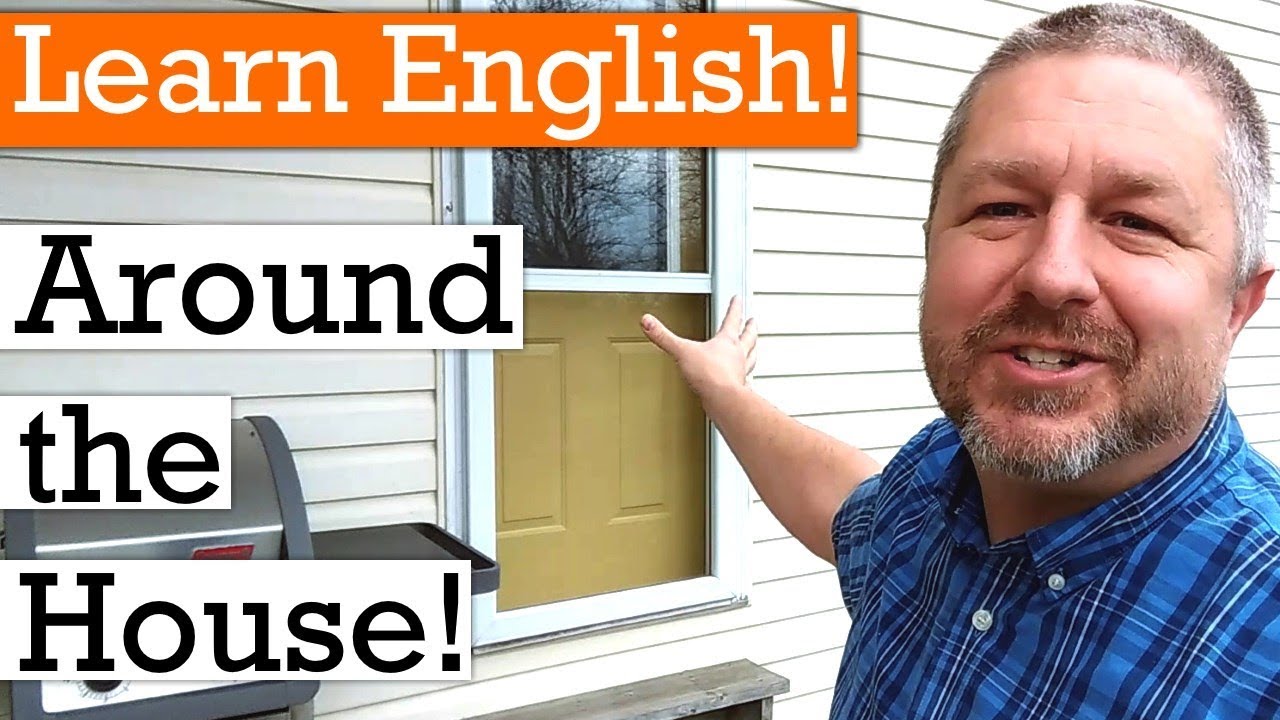
"Let's Learn English Around the House and Home | English Video with Subtitles" · Learn English with Bob the Canadian · 10 min · 3.2M views · 2018
In short: Common house words include entranceway, kitchen, living room, dining room, bathroom, bedroom, hallway, basement, garage, and patio.
Once you can follow a description of a home, you need the nouns to produce one yourself. Bob walks room by room through a real house, so the vocabulary arrives attached to a place you can picture.
Key takeaways
Room names covered include entranceway, kitchen, living room, dining room, bathroom, bedroom, hallway, basement, garage, and patio.
Household objects such as a fridge, utensil drawer, dresser, furnace, and garage door opener are explained along with phrases for their uses.
The lesson covers the common features and purposes of each room, so learners can say what a room is for, not just name it.
Canadian home structures and room designations give learners a concrete setting for practicing household vocabulary in real situations.
Watch on YouTube · Read the summary and Q&A
3. When Do You Say Look, See, or Watch?

"English Vocabulary - Look / See / Watch" · English with Ronnie, engVid · 7 min · 899K views · 2010
In short: Look is a command directing attention, see is a quick glance, and watch describes longer observation such as movies or people.
This is the first repair job on the list. Three verbs that translate to one word in many languages cause hesitation mid-sentence, and Ronnie separates them by how long the action lasts.
Key takeaways
Look, see, and watch differ mainly by the time span of the action, which is why learners mix them up.
Look works as a command or demand in English and takes the preposition at before an object, as in look at that.
See describes a quick glance, while watch describes longer observation such as movies, videos, or people watching.
Movies and videos create exceptions in past tense usage, where both see and watch can appear depending on the situation.
Watch on YouTube · Read the summary and Q&A
4. Do You Say In, At, By, or On a Place?

"How to Use the Prepositions IN, AT, BY and ON When Talking About a Place - An English Grammar Lesson" · Learn English with Bob the Canadian · 7 min · 151K views · 2020
In short: In means physically inside a place, on means contact with a top surface, and at or by means being close to a place.
Prepositions of place are the small words that stall a sentence you already know how to build. This lesson draws a clear line between in, on, at, and by, with a brief mention of under.
Key takeaways
The preposition in indicates being physically inside a place, such as in a tree or in a van.
On generally marks physical contact with the top surface of something, and it is not commonly used with trees or stores.
At and by both refer to meeting someone close to a place, with by typically denoting outside proximity.
The lesson also mentions under briefly, rounding out the basic set of prepositions used to describe where something is.
Watch on YouTube · Read the summary and Q&A
5. How Do You Talk About Things Always True?

"The zero conditional - Grammar: Conditionals with Georgie" · BBC Learning English, Georgie · 3 min · 84K views · 2025
In short: The zero conditional uses present simple in both clauses to state facts, rules, and habits, as in if you heat water, it boils.
Three minutes for one structure you can reuse every day. It gives you a reliable frame for talking about your routines and your rules, which is most of what small talk consists of.
Key takeaways
The zero conditional uses the present simple tense in both the if-clause and the main clause.
Scientific facts are the classic example, as in if you heat water, it boils, showing a fixed cause and effect relationship.
Personal truths also fit the pattern, such as feeling groggy after a poor night of sleep or playing guitar after work to avoid stress.
Rules and laws can be expressed this way, and adverbs like usually and generally help frame a statement as a personal truth.
Watch on YouTube · Read the summary and Q&A
6. Which Adjectives Describe How Things Feel?

"Let's Learn English! Topic: Describing Things 🏍️ (Lesson Only Version-No Viewer Questions)" · Learn English with Bob the Canadian · 33 min · 211K views · 2020
In short: Adjectives like pungent, earthy, juicy, lukewarm, vibrant, translucent, greasy, and mammoth describe smell, temperature, color, texture, and size.
By this point you can name things and place them. This lesson is about making them specific, replacing good and big with words that carry real information.
Key takeaways
Sensory adjectives such as pungent, earthy, juicy, and scrumptious give learners more precise ways to describe smell and taste.
Temperature words including freezing, lukewarm, and boiling let speakers describe how something feels without repeating hot and cold.
Color and light adjectives such as vibrant and translucent expand description beyond basic color names like red and blue.
Size and texture words including mammoth, narrow, greasy, steep, and rough add variety when describing objects and surfaces.
Watch on YouTube · Read the summary and Q&A
7. What Is It Really Like to Live Abroad?

"B2 English Listening Practice - Living Abroad" · Listening Time · 3 min · 1.4M views · 2019
In short: Living abroad brings new experiences, ideas, and cultures, but also distance from loved ones and the work of adapting to a different culture.
This is the step up in level, from A1 to B2, on a topic most learners have an opinion about. Three minutes is short enough to replay twice and shadow the second time.
Key takeaways
Living abroad provides opportunities for new experiences, ideas, and cultures, which is why many learners consider it.
Learning the language of the new country before moving can greatly enhance the experience of living there.
Being far away from loved ones is a significant challenge, and not every person adapts fully to the new country or culture.
Moving abroad requires careful planning and adjustment, and the mix of fear and excitement about starting a new life is common.
Watch on YouTube · Read the summary and Q&A
8. Could You Give Up Fast Fashion?

"Could you give up fast fashion? 6 Minute English" · BBC Learning English · 6 min · 196K views · 2020
In short: Yes, by buying second-hand or vintage clothes, making do with what you own, and mending items instead of replacing them.
Opinion topics are where speakers stall, because you need vocabulary and a position at the same time. This episode hands you both, along with figures you can quote in a discussion.
Key takeaways
The programme reports that 234 million clothing items were sent to UK landfill in 2017.
The global fashion industry is responsible for 1.2 billion tonnes of carbon emissions, according to the programme.
Outsourcing clothing production to developing countries has lowered prices in developed countries, feeding the pace of fast fashion.
Social media, particularly Instagram, fuels the habit of buying new clothes to avoid being seen in the same outfit twice.
Watch on YouTube · Read the summary and Q&A
9. How Do You Practice Speaking Alone?

"English SPEAKING Practice: 10 Conversations for Daily Life" · Speak English With Vanessa · 20 min · 363K views · 2025
In short: Listen to a modeled conversation, then answer the same questions aloud during each pause, working through ten everyday topics.
This is the video that makes you talk. Vanessa and Dan model a conversation, then she asks you the same questions and leaves silence for your answer, which removes the excuse of having no partner.
Key takeaways
The lesson models ten real-life conversations between Vanessa and Dan, then pauses so the learner answers the same questions aloud.
Conversation topics include relationships, entertainment, budgeting, school, shopping, difficult feelings, and home renovations, covering most everyday small talk.
A free PDF provides the sample conversations plus space for learners to write their own personal answers.
Downloadable audio of the sample conversations supports speaking practice during daily activities away from a screen.
Watch on YouTube · Read the summary and Q&A
10. How Do You Handle an Interview in English?
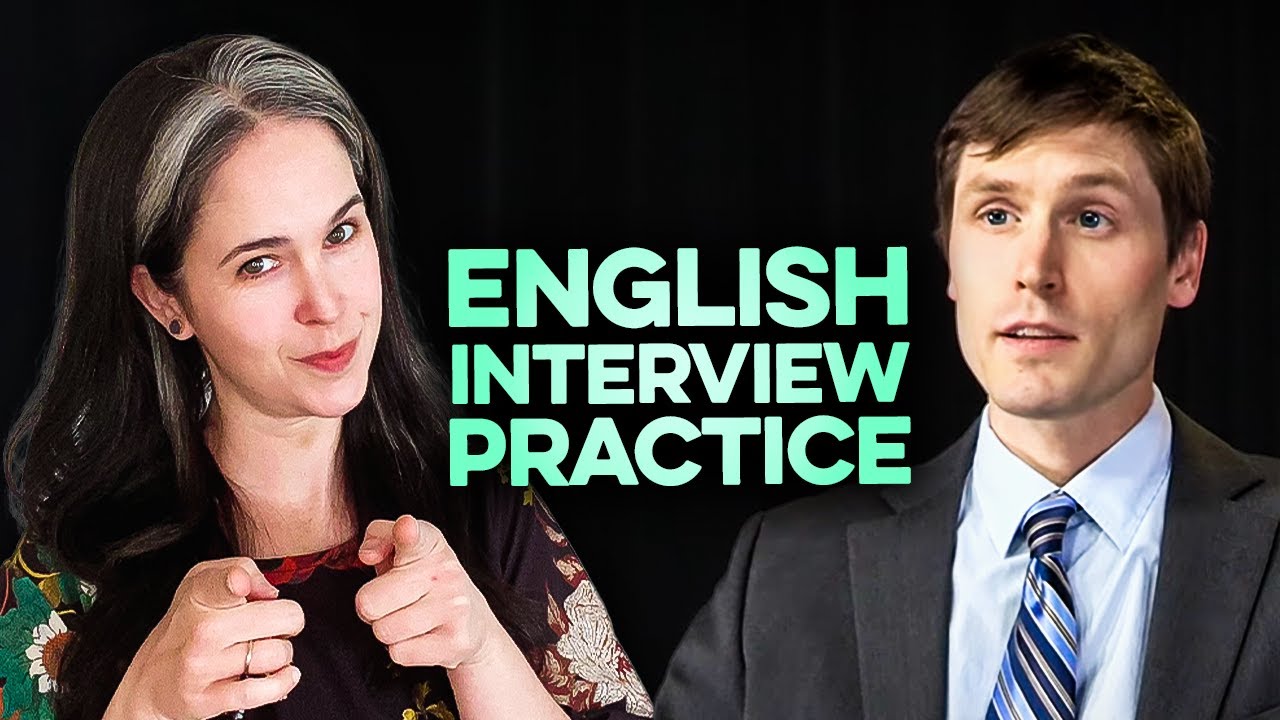
"English Job Interview Dos & Dont's! | English Conversation Practice" · Rachel's English · 35 min · 3.7M views · 2021
In short: Prepare answers to common questions, balance professionalism with friendliness, mind your body language, and ask insightful questions at the end.
The list ends with the highest pressure situation most learners face, speaking English when something is at stake. Mock interview examples show what a good answer sounds like, not just what to avoid.
Key takeaways
Effective interview preparation significantly reduces anxiety, which matters most for non-native English speakers answering questions in a second language.
Practicing common interview questions makes responses more natural during the interview and improves language and communication skills overall.
Candidates should balance professionalism and friendliness, because building rapport with the interviewer influences how they are perceived.
Mock interviews with friends or recording yourself provide feedback and practice, and body language conveys enthusiasm and confidence.
Watch on YouTube · Read the summary and Q&A
Frequently asked questions
How can I practice speaking English if I have no one to talk to?
Use lessons built with pauses, such as Vanessa's ten daily conversations, where you hear a model dialogue and then answer the same question aloud into the silence.
What is the difference between look, see, and watch?
Look is a command that directs attention and takes at before an object, see means a quick glance, and watch means a longer observation such as a movie.
Which English listening level should I start with?
Start with A1 material on a familiar topic like types of homes, then move to B2 topics such as living abroad once you can follow the easier ones comfortably.
How long does it take to work through this list?
The ten videos total about 128 minutes, so the full path takes a little over two hours, or about fifteen minutes a day for two weeks.
How do I prepare for a job interview in English?
Practice common questions out loud or in a mock interview, balance professionalism with friendliness, watch your body language, and prepare insightful questions to ask at the end.
Who is this list of YouTube videos best for?
This collection suits English learners who want to build everyday listening and speaking skills, starting from home and daily-life vocabulary such as types of homes, rooms, and objects, then moving toward practical situations like living abroad and handling an interview in English.
Where should I start if I am a beginner?
Beginners should start with the everyday vocabulary sections on types of homes and naming rooms and objects, because those words describe things you see around you daily and give you something concrete to talk about before moving on to grammar points and longer real-life topics.
Do I need to study grammar to improve my speaking?
Some grammar is worth knowing, since the list covers confusable verbs like look, see, and watch, place prepositions such as in, at, by, and on, the tense used for things that are always true, and adjectives that describe how things feel. These are all points that come up constantly in ordinary conversation.
What should I do after finishing these videos?
Once you have worked through the vocabulary and grammar sections, put them to use in the real-life topics: describe what living abroad is actually like, give your opinion on giving up fast fashion, practice speaking on your own, and rehearse answering questions in an English interview.
How to use this list
Watch these in the order listed. The sequence moves from following simple speech, to naming what is around you, to fixing the small words that stall a sentence, to describing and discussing, and finally to speaking aloud under pressure, so each video assumes the one before it. If you only have a few minutes today, start with the A1 lesson on types of homes, because it is four minutes long and it proves you can follow a whole English explanation without subtitles. When you reach Vanessa's conversations, stop pausing the video to think and answer in the gap she leaves, even if the answer comes out badly, since the point of the list is to get you talking rather than to get you agreeing.
💡 Want summaries and transcripts for any YouTube video? Try YouTube Summary with ChatGPT & Claude.