English Vocabulary - Look / See / Watch
TL;DR
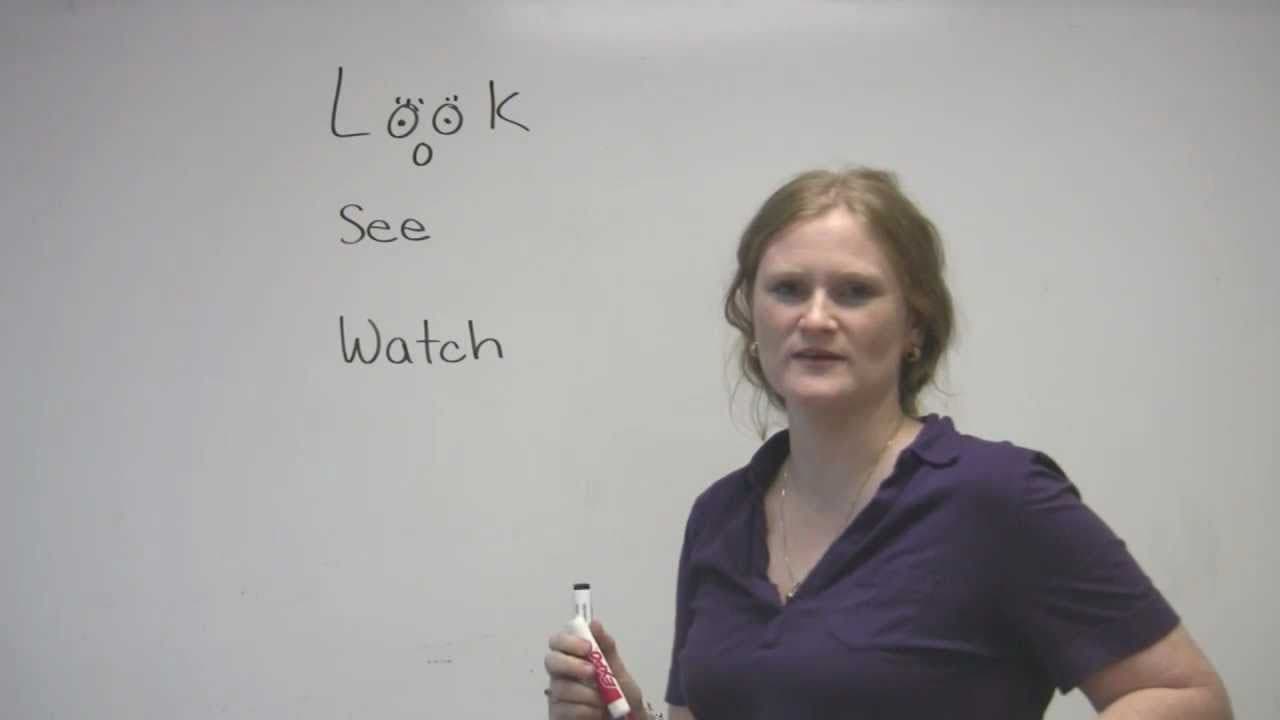
Use “look” as a command that normally takes “at,” “see” for a quick glance, and “watch” for an action that continues longer. For example, you look at clothes, see a fast-moving car, and watch TV, movies, or people. Past-tense movie and video usage is an exception because you can say you “saw” them, so read on for examples that clarify each choice.
Transcript
Hello there, my name is Rani and today we're going to talk about three, three words in English that are very confusing and the reason why these words are confusing is because in most languages they like to keep it simple and they like to use one word for all three of these words we have in English. English is not easy, English is difficult and they... Read More
Key Insights
- 👀 Look, see, and watch have distinct usage based on the time span of the action.
- 👀 Look is a command or demand in English, while see is a quick glance.
- 👀 Watch is used for longer observations like movies or people watching.
- 👀 Objects require "at" with look commands, while see is used for quick glances.
- 🎥 Movies and videos have exceptions in the past tense usage with see and watch.
- 👀 The differences between look, see, and watch can help in proper English communication.
- ❓ English language nuances like these can be tricky but essential to grasp for fluency.
Install to Summarize YouTube Videos and Get Transcripts
Explore YouTube Video Summarizer or Get YouTube Transcript Extractor
Questions & Answers
Q: What is the difference between “look,” “see,” and “watch” in English?
“Look” and “see” generally describe short actions, while “watch” describes an action that takes longer. Use “look” to direct attention, “see” for a quick glance, and “watch” when observing something such as TV, a movie, or people over time.
Q: When should you use “look” in English?
Use “look” when telling someone to direct their attention toward something or someone. It functions as a command or demand in examples such as “Look at me” and “Look at her.”
Q: Why does “look” usually need the word “at”?
When “look” directs attention toward an object, person, or animal, it needs “at.” Examples from the lesson include “Look at me,” “Look at her,” and “Look at it.”
Q: When should you use “see” instead of “look” or “watch”?
Use “see” when something is noticed briefly or passes through your view quickly. A fast-moving car or a deer running by can prompt “Did you see that?” because there is only time for a quick glance.
Q: When should you use “watch” in English?
Use “watch” when the observation continues for a longer time. You can watch TV, watch a movie, or watch people passing by in a mall or on a city street.
Q: Should you say “look at the clothes” or “watch the clothes” while shopping?
Say that you are “looking at the clothes.” The clothes are not moving or performing an action for you to observe over a long period, so “watching the clothes” is not the appropriate choice in this example.
Q: Can you say “I saw a movie” instead of “I watched a movie”?
Yes. Movies and videos are exceptions: although you can say that you watched a movie, in the past you can also say, “I saw a movie” or that you saw a video.
Q: Can you say “I saw TV” in English?
No, the lesson says never to use “I saw TV.” Use “watch” with TV, while “saw” can be used in the past for a movie or video.
Summary & Key Takeaways
-
English has three confusing words - look, see, and watch - each with different time spans of action.
-
Look and see are for short actions, while watch is for longer actions like movies or people watching.
-
Look is a command that requires adding "at" for objects, while see is a quick glance, and watch is for longer observation.
Read in Other Languages (beta)
Share This Summary 📚
Summarize YouTube Videos and Get Video Transcripts with 1-Click
Try YouTube Summary with ChatGPT & Claude or YouTube Transcript Generator
Explore More Summaries from English with Ronnie · EnglishLessons4U with engVid 📚
Summarize YouTube Videos and Get Video Transcripts with 1-Click
Try YouTube Summary with ChatGPT & Claude or YouTube Transcript Generator