10 Best TED-Ed Lessons of All Time

Sep 15, 2026
17 min read
4 views
Last updated: September 2026
This is a ten-lesson sequence from TED-Ed, ordered as a path rather than a ranking. It is for curious learners who want to move from logic and open questions to health, language, and everyday decisions.
The full set runs just under an hour. It brings together enduring lessons from Alex Gendler on riddles, Mia Nacamulli on water and food, and the TED-Ed channel on questions that still have no known answers.
The videos on this list, in the order to watch them, are:
How Can Prisoners Use Hats to Escape Alien Capture? (Alex Gendler)
Questions No One Knows the Answers to (Full Version) (TED-Ed)
What Is Depression and How Is It Different from Sadness? (Helen M. Farrell)
What Is the Infinite Hotel Paradox and How Does It Work? (Jeff Dekofsky)
What Are Eye Floaters and Why Do They Occur? (Michael Mauser)
How Can You Solve the Bridge Riddle Under Pressure? (Alex Gendler)
What Happens If You Don't Drink Enough Water? (Mia Nacamulli)
What Are the Key Signs of Deception in Language? (Noah Zandan)
How Does Food Impact Your Brain Health and Mood? (Mia Nacamulli)
How Do Cigarettes Harm the Body and What Are the Benefits of Quitting? (Krishna Sudhir)
Total: 10 videos, 56 minutes of watch time (0 hours 56 minutes), and 229.4M combined views.
1. How Can Prisoners Use Hats to Escape Alien Capture?
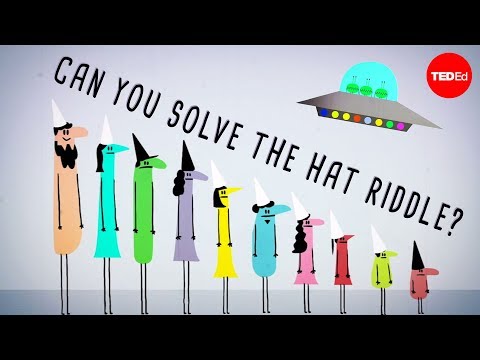
"Can you solve the prisoner hat riddle? - Alex Gendler" · Alex Gendler · 5 min · 29M views · 2015
In short: A shared code based on whether the number of black hats is odd or even lets at least nine of ten prisoners identify their own hats correctly.
Start here because the riddle establishes the sequence's basic method: turn incomplete information into a solvable problem through coordination. Ten captives must prove to alien captors that they are logical and cooperative, even though each person can see only the hats ahead. Gendler's solution argues that a group can overcome those individual limits when everyone agrees on what a single public signal will mean before the test begins.
The tallest captive can see every hat in front and says “black” if the number of black hats is odd or “white” if it is even. That first answer may not identify the speaker's own hat, but it gives the other nine a parity reference. Each later captive compares the hats they can see with the announced parity and the answers already given, allowing at least nine correct guesses, the number needed for the group to survive.
Key takeaways
The tallest captive begins because that person can see everyone else's hat and can announce the observed parity.
“Black” represents an odd number of black hats, while “white” represents an even number.
Each later captive combines the parity signal, visible hats, and previous answers to deduce a hat color.
The plan guarantees at least nine correct answers, which is enough to save the group.
Watch on YouTube · Read the summary and Q&A
2. Questions No One Knows the Answers to (Full Version)
"Questions No One Knows the Answers to (Full Version)" · TED-Ed · 12 min · 29M views · 2012
In short: Questions about the number of universes, extraterrestrial life, and consciousness remain unsettled, but pursuing them moves knowledge forward.
After a riddle with a definite solution, this lesson widens the path to questions that no agreed strategy can yet close. It asks learners to sit with uncertainty about the universe, God, extraterrestrial life, and consciousness instead of treating every question like a school exercise with a known answer. The lesson's central argument is that unanswered questions are not failures of learning; they are part of what propels the search for knowledge.
The scale of the uncertainty is concrete. The observable universe contains billions of galaxies and stars, while theories such as string theory suggest a multiverse with as many as 10^500 universes, potentially governed by different laws and properties. At the same time, the apparent likelihood of life-supporting planets has produced no convincing evidence of extraterrestrial life. Proposed explanations range from rare intelligent life to a superintelligent civilization enforcing radio silence.
Key takeaways
There is no agreement on how many universes exist, and some theories suggest as many as 10^500.
Billions of galaxies and stars make the universe far larger than ordinary experience can convey.
No convincing evidence of extraterrestrial life has been found despite the likelihood of many potentially habitable planets.
Whether robots or artificial intelligence can become conscious remains uncertain.
Watch on YouTube · Read the summary and Q&A
3. What Is Depression and How Is It Different from Sadness?
"What is depression? - Helen M. Farrell" · Helen M. Farrell · 4 min · 25M views · 2015
In short: Clinical depression is a persistent medical disorder with behavioral and physical effects, not the same thing as temporary sadness.
The third lesson brings careful questioning from the universe into a distinction that affects daily life. Farrell separates feeling depressed after a setback from clinical depression, which persists, interferes with ordinary functioning, and has defined symptoms. This position matters because the sequence now moves from accepting what is unknown to naming what can be recognized. The lesson also argues that open discussion reduces stigma and can make it easier for people to seek treatment.
Depression is the leading cause of disability worldwide, and close to 10% of adults in the United States struggle with it. Psychiatric guidelines describe a diagnosis when at least five symptoms are present, including low mood, loss of interest, appetite or sleep changes, worthlessness, poor concentration, low energy, restlessness or slowness, and recurrent thoughts of suicide. The disorder lasts at least two consecutive weeks, and treatments include medication, therapy, ECT, and TMS.
Key takeaways
Clinical depression persists for at least two consecutive weeks and interferes with daily life.
A diagnosis can involve at least five symptoms, including low mood, lost interest, sleep changes, low energy, or suicidal thoughts.
Depression is associated with changes in the frontal lobes, hippocampal volume, neurotransmitters, sleep cycles, and hormones.
Medication and therapy can help, while ECT and TMS are options in more severe cases.
Watch on YouTube · Read the summary and Q&A
4. What Is the Infinite Hotel Paradox and How Does It Work?
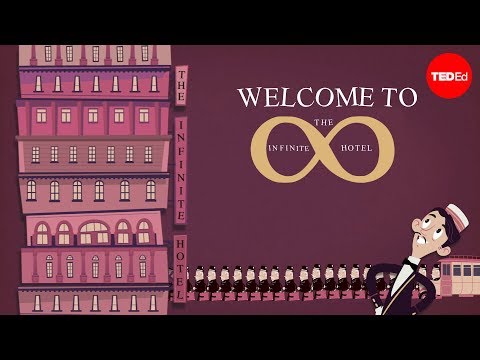
"The Infinite Hotel Paradox - Jeff Dekofsky" · Jeff Dekofsky · 6 min · 24M views · 2014
In short: Hilbert's fully occupied hotel can still take new guests because countably infinite sets can be rearranged without running out of rooms.
With the difference between ambiguity and diagnosis in place, the fourth lesson returns to abstract reasoning with a concept that resists finite intuition. Dekofsky uses David Hilbert's hotel to show why infinity cannot be managed like an extremely large number. The hotel has infinitely many rooms and is completely full, yet the manager can still create openings. The paradox argues that different infinities require structured mathematical strategies rather than ordinary ideas about capacity.
To admit one new arrival, the manager can move each current guest to another room, leaving a place open without evicting anyone. The problem becomes harder when infinitely many buses carry infinitely many passengers. Prime numbers then provide unique room assignments that do not overlap. These strategies work for countable infinity, such as the natural numbers, but the Q&A notes that higher orders of infinity, such as the real numbers, cannot be organized in the same way.
Key takeaways
A hotel with infinitely many occupied rooms can still accommodate another guest by shifting its current guests.
Prime numbers provide unique room assignments for passengers arriving on infinitely many buses.
Structured accommodation strategies work for countable infinity, including the natural numbers.
Higher orders of infinity, such as the real numbers, create a different and less manageable problem.
Watch on YouTube · Read the summary and Q&A
5. What Are Eye Floaters and Why Do They Occur?
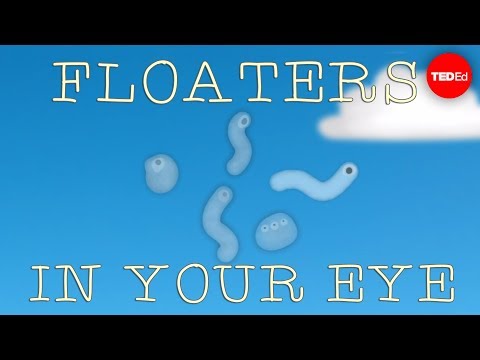
"What are those floaty things in your eye? - Michael Mauser" · Michael Mauser · 4 min · 22M views · 2014
In short: Eye floaters are small objects suspended inside the eye that move with it and cast visible shadows on the retina.
The sequence now brings a strange idea from an infinite hotel into something you may notice in your own field of vision. Mauser explains that the drifting worms or blobs are not outside objects but effects produced inside the eye. This lesson belongs here because it turns abstract limits on intuition into a biological example of perception. It argues that what you see depends on structures and activity within the visual system as well as the external scene.
Floaters are bits of tissue or protein suspended in the gel-like vitreous humor, so they drift and change shape as the eye moves. Their shadows become easier to notice against a uniform bright surface such as snow, a blank computer screen, or a clear sky. A related effect, the blue field entoptic phenomenon, comes from white blood cells moving through capillaries and creates small moving windows of light rather than shadows. Abnormally numerous or large floaters may indicate a serious eye condition.
Key takeaways
Floaters are objects inside the eyeball that cast shadows on the retina rather than bugs in the outside world.
They move and change shape because they are suspended in the eye's vitreous humor.
Bright, uniform backgrounds make floaters easier to distinguish.
The blue field entoptic phenomenon comes from white blood cells moving through capillaries and is not the same as a floater's shadow.
Watch on YouTube · Read the summary and Q&A
6. How Can You Solve the Bridge Riddle Under Pressure?

"Can you solve the bridge riddle? - Alex Gendler" · Alex Gendler · 4 min · 22M views · 2015
In short: Pairing the slowest people and assigning lantern returns to the fastest lets the entire group cross the bridge before the zombies arrive.
This second Gendler riddle returns to a problem with a definite answer, but now every move consumes scarce time. A group fleeing mutant zombies must cross a rope bridge that holds only two people, in darkness, with one necessary lantern and different crossing speeds. Placed after the perception lesson, it asks you to convert visible constraints into an efficient schedule. Its argument is that the order of actions matters as much as the actions themselves.
The successful plan sends the fastest individuals on the return trips with the lantern, because those trips add time without advancing another slow traveler. It also sends the slowest members across together so their long crossing times overlap instead of being paid separately. Every pair still needs the lantern, and no more than two people can occupy the bridge at once. By coordinating those limits, the full group reaches safety and cuts the ropes just before the zombies arrive.
Key takeaways
The bridge can hold only two people at a time, and every crossing requires the lantern.
Different crossing speeds make a simple sequence of individual trips too costly in time.
The fastest people should handle lantern returns to minimize time lost on those trips.
Pairing the slowest people lets the group overlap their crossing time and escape successfully.
Watch on YouTube · Read the summary and Q&A
7. What Happens If You Don't Drink Enough Water?

"What would happen if you didn’t drink water? - Mia Nacamulli" · Mia Nacamulli · 5 min · 21M views · 2016
In short: Too little water impairs energy, mood, and cognition, while too much can dangerously dilute sodium, so intake must stay balanced.
After optimizing a fictional escape, the list applies the same concern for balance and limits to the body. Nacamulli explains why water supports joints, temperature regulation, the brain, and the spinal cord, then shows that both deficiency and excess carry risks. The lesson sits here because it turns problem-solving toward a daily input with measurable effects. Its central claim is not a universal number of glasses, but intake adjusted to the person and environment.
The average human body is 55% to 60% water, and it loses 2 to 3 liters each day through sweat, urine, and breathing. Guidance in the lesson ranges from 2.5 to 3.7 liters daily for men and 2 to 2.7 liters for women, adjusted for weight, activity, and surroundings. Water-rich foods and even caffeinated drinks contribute. Dehydration can lower energy and impair mood and cognition, while excessive intake can cause hyponatremia by diluting sodium and swelling cells.
Key takeaways
Water cushions joints, regulates temperature, and nourishes the brain and spinal cord.
People lose 2 to 3 liters of water daily through sweat, urine, and breathing.
Daily needs vary with weight, activity, and environment rather than following one rule for everyone.
Over-hydration can dilute sodium and cause cells to swell, a condition known as hyponatremia.
Watch on YouTube · Read the summary and Q&A
8. What Are the Key Signs of Deception in Language?
"The language of lying - Noah Zandan" · Noah Zandan · 6 min · 21M views · 2014
In short: Deceptive language often contains fewer self-references, more negativity, simpler explanations, and more convoluted sentence structures.
The eighth lesson moves from managing your own physical signals to reading signals in other people's words. Zandan starts from the limits of traditional detection tools and turns instead to recurring linguistic patterns in false narratives. It belongs after the health lessons because the sequence is now shifting from the body's internal evidence to social evidence. The argument is cautious but useful: language analysis can identify signs of possible deception even when no single phrase proves a lie.
People hear anywhere from 10 to 200 lies a day, yet polygraphs can be fooled with preparation and are not always admissible in court. Linguistic text analysis finds that liars often refer to themselves less and use third-person phrasing to distance themselves from false claims. Their guilt may produce a more negative tone. They also tend to offer simple explanations to avoid inconsistencies, even while using convoluted sentence structures, giving listeners several patterns to examine together.
Key takeaways
Polygraphs are unreliable because preparation can defeat them, and they are not always admissible in court.
Liars often use fewer self-references and more third-person language to create distance from a falsehood.
Guilt can contribute to a more negative tone in deceptive statements.
Simple explanations and convoluted sentence structures are both recurring signs identified through linguistic analysis.
Watch on YouTube · Read the summary and Q&A
9. How Does Food Impact Your Brain Health and Mood?
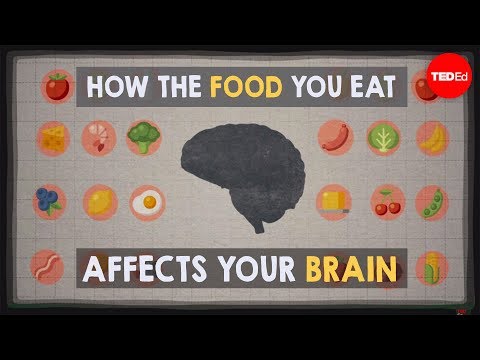
"How the food you eat affects your brain - Mia Nacamulli" · Mia Nacamulli · 5 min · 19M views · 2016
In short: Fats, amino acids, micronutrients, and carbohydrates affect the brain's structure, energy, neurotransmitters, mood, and attention.
Having examined clues in spoken language, the ninth lesson asks what the brain itself receives from food. Nacamulli breaks a dehydrated brain into fats, proteins, amino acids, micronutrients, and glucose, then connects each component to functioning and development. This position turns the list back inward before its final health decision. The lesson argues that a balanced mix of essential fats, protein building blocks, protective micronutrients, and steadier carbohydrates supports both cognition and mood.
Omega-3 and omega-6 fats help create and maintain cell membranes and may prevent degenerative brain conditions, while trans and saturated fats may be harmful. Proteins and amino acids influence neurotransmitter production, affecting mood, behavior, and cognition. Antioxidants from fruits and vegetables protect against free radicals, while vitamins B6, B12, folic acid, iron, copper, zinc, and sodium support brain function. Glucose is the brain's primary energy source, but high-glycemic foods can produce rapid spikes and drops that affect attention and mood.
Key takeaways
Omega-3 and omega-6 fats are essential to building and maintaining brain-cell membranes.
Proteins and amino acids influence neurotransmitter production, mood, behavior, and cognitive function.
Antioxidants, vitamins, and trace minerals protect the brain and support its development and function.
High-glycemic carbohydrates can cause rapid glucose rises and falls that affect attention and mood.
Watch on YouTube · Read the summary and Q&A
10. How Do Cigarettes Harm the Body and What Are the Benefits of Quitting?
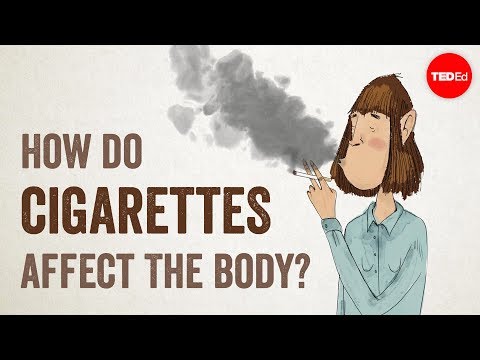
"How do cigarettes affect the body? - Krishna Sudhir" · Krishna Sudhir · 5 min · 18M views · 2018
In short: Cigarette smoke delivers thousands of damaging chemicals, but stopping allows heart, lung, and long-term disease risks to improve.
The sequence closes with a lesson that joins biological explanation to a concrete change in behavior. Sudhir follows cigarette smoke through the body, showing how its chemicals affect teeth, gums, lungs, blood vessels, DNA repair, and reproduction. This final position makes the path actionable: after learning how to reason, recognize uncertainty, and understand bodily inputs, the viewer sees both the mechanics of harm and the body's capacity to recover after smoking stops.
Each inhalation exposes tissue to more than 5,000 chemicals, while tar begins coating and damaging the teeth and gums. Nicotine triggers dopamine release, reinforces addiction, constricts blood vessels, and damages their endothelial linings. Smoking raises the risks of heart disease and cancer, but quitting brings immediate and long-term improvements in heart rate, blood pressure, lung function, and cancer risk. Nicotine replacement therapy, counseling, support groups, cognitive behavioral therapy, and exercise can help manage withdrawal and support cessation.
Key takeaways
Cigarette smoke brings more than 5,000 chemicals into contact with the body's tissues.
Nicotine drives addiction through dopamine release and contributes to blood-vessel and DNA-repair damage.
Quitting improves heart function and lung health while reducing cancer and heart-disease risks over time.
Nicotine replacement, counseling, support groups, cognitive behavioral therapy, and exercise can support quitting.
Watch on YouTube · Read the summary and Q&A
Frequently asked questions
What are the best TED-Ed lessons of all time?
Three of the strongest starting points are Alex Gendler's prisoner hat riddle, TED-Ed's “Questions No One Knows the Answers to,” and Helen M. Farrell's explanation of depression. Together they show the range of the list: formal logic, open scientific questions, and a clear distinction between a temporary feeling and a persistent medical disorder.
How long does it take to watch all ten TED-Ed lessons?
The ten videos run for 56 minutes in total, so the full sequence fits into less than an hour. “Questions No One Knows the Answers to” is the longest at 12 minutes. The lessons on depression, eye floaters, and the bridge riddle are the shortest at 4 minutes each.
How does the prisoner hat strategy guarantee nine correct answers?
The tallest prisoner uses the first answer to report whether the visible number of black hats is odd or even. That answer may not correctly name the first prisoner's hat, but it gives everyone else a shared reference. Each later prisoner combines that parity, the hats still visible, and the answers already spoken to deduce a color.
How is clinical depression different from ordinary sadness?
Temporary sadness can follow events such as a bad grade, job loss, argument, or rainy day. Clinical depression is a medical disorder that persists for at least two consecutive weeks and interferes with daily life. Its symptoms can include low mood, loss of interest, sleep or appetite changes, poor concentration, low energy, worthlessness, and thoughts of suicide.
How much water does a person need each day?
The lesson gives a range rather than one eight-glass rule: 2.5 to 3.7 liters for men and 2 to 2.7 liters for women. Actual needs vary with weight, activity, and environment. Fruits, vegetables, other water-rich foods, and beverages including caffeinated drinks can also contribute to total hydration.
Can language reveal that someone is lying?
Language can provide signs of possible deception, though the lesson does not present one phrase as proof. Liars often use fewer self-references, more third-person wording, a more negative tone, and simpler explanations, sometimes inside convoluted sentences. Looking for several patterns together offers an alternative to tools such as polygraphs, which can be fooled.
How does food affect mood and attention?
Proteins and amino acids influence neurotransmitter production, which affects mood, behavior, and cognition. The brain also depends on glucose from carbohydrates for energy. High-glycemic foods can create quick spikes and drops in glucose that affect mood and attention, while essential fats, antioxidants, vitamins, and minerals support broader brain health and function.
Which TED-Ed lesson should I watch first?
Start with Alex Gendler's prisoner hat riddle. In five minutes, it establishes the shared method behind the sequence: identify the constraints, decide what information a signal can carry, and coordinate individual actions around one rule. Its parity solution also gives you a complete answer before the next lesson turns to questions that remain unresolved.
Are older TED-Ed lessons still worth watching?
Yes. The oldest selection, “Questions No One Knows the Answers to,” is from 2012, and six more lessons are from 2014 or 2015. Their central subjects include infinity, perception, depression, logical coordination, and deceptive language. The explanations and examples in this list still provide clear introductions to those ideas.
How to use this list
Watch the lessons in order: begin with a cooperative logic problem, open out to uncertainty, then move through mental health, infinity, perception, optimization, hydration, language, nutrition, and smoking. If you only have twenty minutes, start with Alex Gendler's prisoner hat riddle and continue through the lesson on depression; those first three videos take 21 minutes and establish logic, uncertainty, and careful definition. If you want the single video that turns a constrained problem into a precise group strategy, choose the prisoner hat riddle.
Related lists
💡 Want summaries and transcripts for any YouTube video? Try YouTube Summary with ChatGPT & Claude.