How Do Economic Incentives Shape Everyday Choices?
TL;DR
Economic outcomes depend on incentives, trade-offs, prices, profits, and losses, not merely on good intentions. To evaluate any policy or personal decision, ask what behavior it rewards, what alternative is sacrificed, what scarcity a price reflects, how supply will respond, and whether profit or loss signals that resources are being used productively.
Transcript
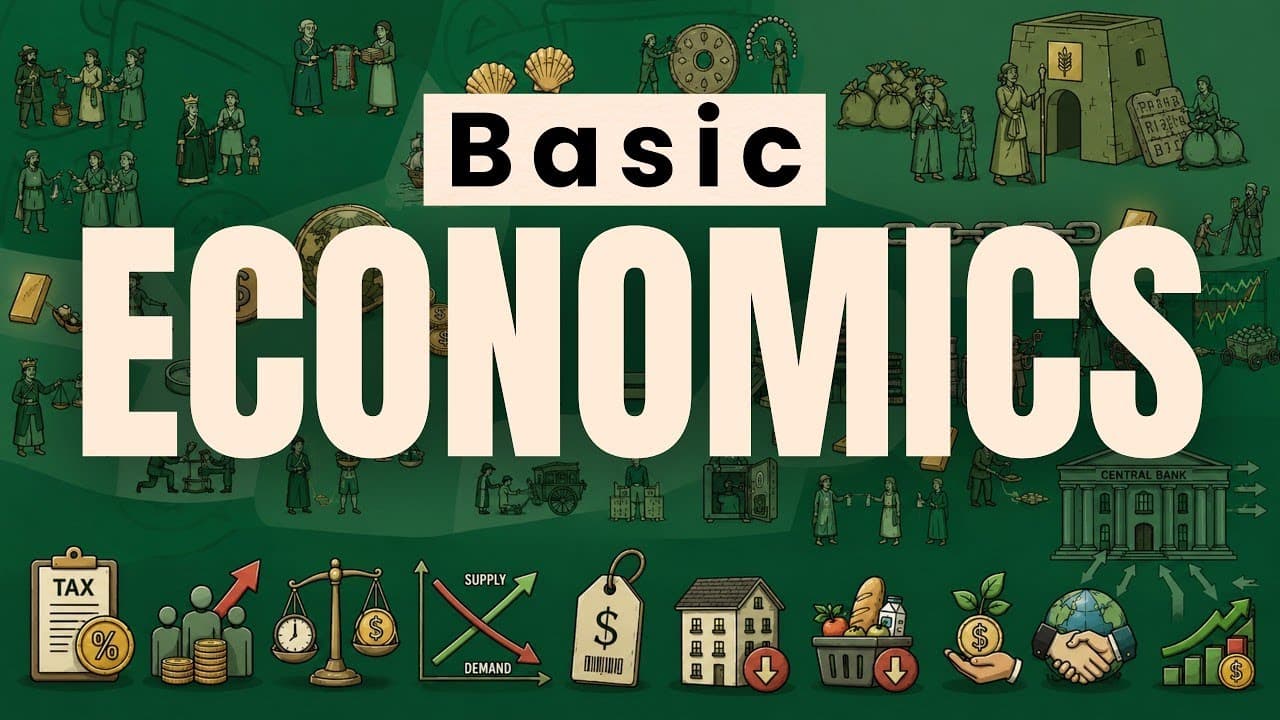
I just spent the last two weeks reading a 700page book by Thomas Soul, a Stanford economist. It's called Basic Economics. The economy seems confusing and complicated. But it's not. Most people never learn how it actually works, so they keep getting fooled. By the end of this video, you will understand why taxing the rich hurts the poor people the m... Read More
Key Insights
- Incentives are more predictive than intentions because people change their behavior in response to rewards and penalties. Maryland expected higher millionaire taxes to add $106 million annually, but after the millionaire count fell from about 8,000 to 6,000, total tax revenue reportedly declined by $257 million.
- Opportunity cost is the value of what must be surrendered whenever a limited resource is used. Money, working hours, attention, energy, and employees cannot be assigned everywhere simultaneously, so a sound decision considers the best forgone alternative rather than looking only at its immediate price.
- A $50,000 BMW can carry a much larger opportunity cost than its purchase price. The transcript argues that buying a $20,000 Toyota Corolla and investing the remaining $30,000 could make that difference worth almost $60,000 after 10 years and almost $250,000 after 30 years.
- Prices are decentralized messages about demand and scarcity. When pizza becomes scarce, its price rises and encourages suppliers to produce more. When excess pizza exists, its price falls and suppliers slow production, coordinating changing decisions without a single person directing the entire system.
- A price ceiling can increase demand while weakening supply and maintenance. The rent-control example argues that cheaper apartments encourage people to occupy more housing, while restricted rental income discourages landlords from repairing buildings or continuing to operate them, contributing to shortages and abandoned properties.
- A price floor can create a surplus by guaranteeing producers more than ordinary demand supports. In the India example, a high guaranteed wheat price encouraged excess production, leaving the government to purchase 11 million tons that accumulated in warehouses and eventually rotted.
- Profits and losses are feedback signals that guide the use of resources. Profit indicates that people value an activity and encourages expansion, while persistent loss suggests that engineers, steel, electricity, trucks, time, and energy could serve people better in a different activity.
- A wage is a price connected to the value created by a worker. The lemonade-stand example begins by asking how much Maria can be paid and answers that the amount depends on how much additional lemonade her work helps the business produce and sell.
Install to Summarize YouTube Videos and Get Transcripts
Explore YouTube Video Summarizer or Get YouTube Transcript Extractor
Questions & Answers
Q: How do incentives affect the results of economic policies?
Incentives affect results by rewarding or discouraging particular behavior, regardless of what policymakers intended. The transcript uses Maryland's millionaire tax as an example: officials expected $106 million in additional annual revenue, but the millionaire population reportedly fell from about 8,000 to 6,000. The state then lost $257 million in total tax revenue as wealthy residents moved elsewhere.
Q: What is opportunity cost in everyday decision-making?
Opportunity cost is what a person gives up by choosing one use for a limited resource instead of another. Spending $10 on Starbucks means that same $10 cannot fund a burger or movie ticket. The principle also applies to time, energy, attention, and hiring because each resource can be used only once. Good decisions therefore compare alternatives, not merely affordability.
Q: What is the opportunity cost of buying an expensive car?
The opportunity cost includes both the extra purchase expense and the future growth that money could have produced. The transcript compares a $50,000 BMW with a $20,000 Toyota Corolla. Investing the $30,000 difference could make it worth almost $60,000 after 10 years and almost $250,000 after 30 years, according to the example presented.
Q: How do prices coordinate supply and demand?
Prices communicate changing information about scarcity and demand without requiring one central planner to collect every detail. When pizza is scarce, a higher price encourages suppliers to make more. When too much pizza exists, a lower price encourages them to reduce production. Similar signals coordinate food, materials, labor, and transportation across cities and remote towns as conditions continually change.
Q: Why can rent control create housing shortages?
Rent control holds rents below the level that unrestricted supply and demand would produce. The transcript argues that lower rents increase the number of people wanting apartments while reducing landlords' incentive to repair roofs, maintain buildings, or continue operating properties. Some landlords may eventually abandon buildings, leaving empty apartments even while other people cannot find housing.
Q: What happens when governments set food prices too low?
Setting food prices too low can make selling unprofitable, causing suppliers to withdraw goods from the market. The transcript describes Zimbabwe during an inflation crisis, when stores emptied within hours after prices were artificially restricted. Farmers stopped bringing food to market because controlled prices meant losing money, so crops reportedly rotted on farms while people lacked food.
Q: Why can guaranteed high prices create wasteful surpluses?
A guaranteed high price encourages producers to supply more because they know they will be paid regardless of ordinary demand. The transcript says India guaranteed farmers a high wheat price in the early 2000s, prompting excess production. The government then had to buy the wheat, and 11 million tons accumulated in warehouses and rotted while people elsewhere were starving.
Q: How do profits and losses guide economic resources?
Profits indicate that people value what is being supplied, encouraging producers to continue or expand. Losses indicate that resources are being used for something people do not want enough to support. When an unprofitable company closes, its engineers, steel, electricity, and trucks become available for other uses. Bailouts can weaken this signal by sustaining continued resource waste.
Summary & Key Takeaways
-
People respond to incentives rather than intentions, so policies must be judged by the behavior they reward. The Maryland example argues that higher taxes encouraged millionaires to leave, reducing total revenue. The broader lesson is to examine what a rule motivates people to do in government, business, relationships, and daily life.
-
Every choice has an opportunity cost because money, time, energy, and attention can each be used only once. A purchase costs not only its price but also the future value of the alternative forgone. Thinking in trade-offs changes the central question from whether something is affordable to what must be sacrificed.
-
Prices coordinate supply and demand by communicating scarcity across a complex economy. Controls that force prices too low can produce shortages and discourage supply, while guaranteed high prices can create wasteful surpluses. Profits encourage useful production, and losses redirect workers, materials, electricity, and other resources toward activities people value more.
Read in Other Languages (beta)
Share This Summary 📚
Summarize YouTube Videos and Get Video Transcripts with 1-Click
Try YouTube Summary with ChatGPT & Claude or YouTube Transcript Generator
Explore More Summaries from LITTLE BIT BETTER 📚



Summarize YouTube Videos and Get Video Transcripts with 1-Click
Try YouTube Summary with ChatGPT & Claude or YouTube Transcript Generator