13. From Hij Integrals to H Matrices I
TL;DR
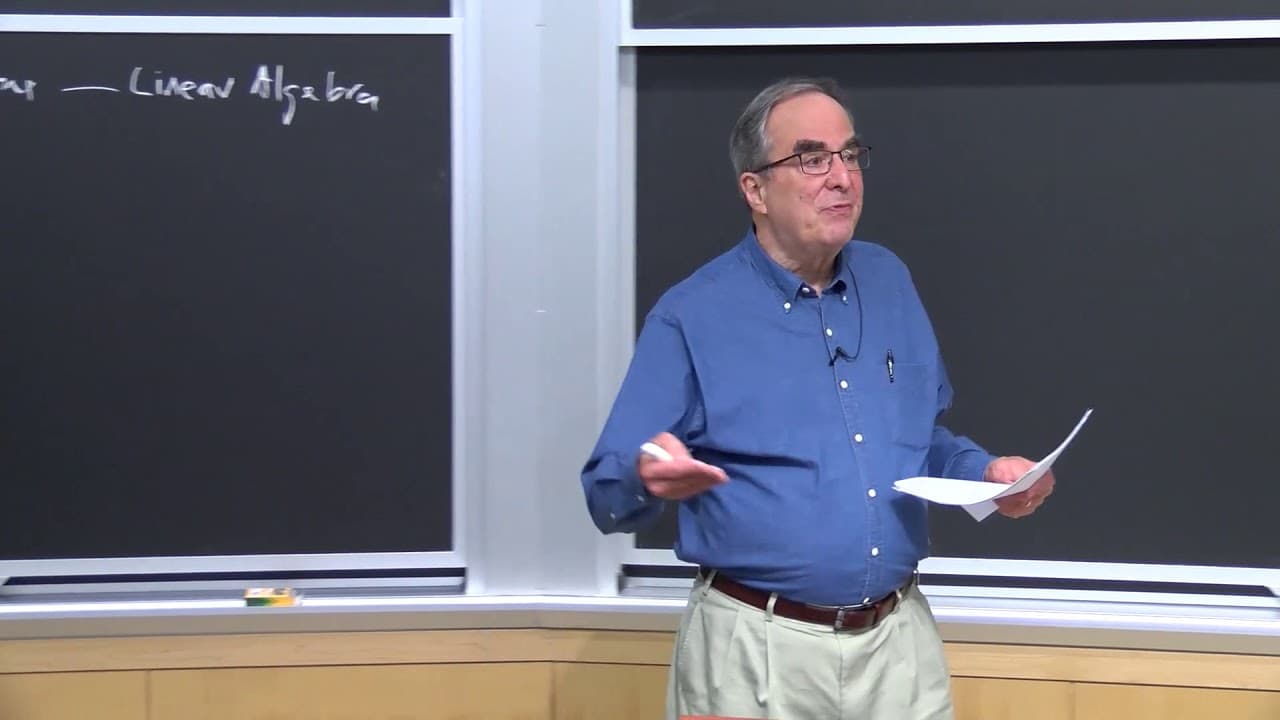
This lecture introduces the transition from the Schrodinger picture to the Heisenberg picture in quantum mechanics, focusing on the two-level problem and the use of matrix notation.
Transcript
The following content is provided under a Creative Commons license. Your support will help MIT OpenCourseWare continue to offer high quality educational resources for free. To make a donation or view additional materials from hundreds of MIT courses, visit MIT OpenCourseWare at ocw.mit.edu. ROBERT FIELD: OK. So, today is the first of a pair of lect... Read More
Key Insights
- 🖼️ Transitioning from the Schrodinger picture to the Heisenberg picture in quantum mechanics helps simplify problem-solving and programming.
- 🛟 The two-level problem serves as a basis for introducing the matrix approach and understanding the importance of eigenvalues and eigenvectors.
- 👋 Matrix notation eliminates the need for wave functions in certain cases, making calculations more efficient.
Install to Summarize YouTube Videos and Get Transcripts
Explore YouTube Video Summarizer or Get YouTube Transcript Extractor
Questions & Answers
Q: What is the main purpose of transitioning from the Schrodinger picture to the Heisenberg picture?
The transition allows for a better understanding of the problem structure and simplifies the programming of computers to solve quantum mechanics problems.
Q: How is the two-level problem approached in this lecture?
The two-level problem is first solved using the Schrodinger picture and then described in the matrix picture, introducing the use of matrix elements and notation.
Q: What are the advantages of using matrix notation in quantum mechanics?
Matrix notation simplifies the representation of problems, allows for easy calculation with computers, and eliminates the need to deal with wave functions in certain cases.
Q: What is nondegenerate perturbation theory, and why is it valuable?
Nondegenerate perturbation theory is an approximation technique used to solve complex problems in quantum mechanics. It simplifies problem-solving by avoiding the need to solve complicated differential equations and allows for the application of simple mathematical operations.
Summary & Key Takeaways
-
The lecture discusses the transition from the Schrodinger picture to the Heisenberg picture in quantum mechanics, which is essential for understanding the structure of a problem and programming computers to solve it.
-
The two-level problem, an exactly-solved problem, is used as a starting point to introduce the algebraic and matrix approaches.
-
The lecture emphasizes the importance of matrix notation and finding eigenvalues and eigenvectors using unitary transformations.
-
Nondegenerate perturbation theory is introduced as a powerful tool for solving complex problems.
Read in Other Languages (beta)
Share This Summary 📚
Summarize YouTube Videos and Get Video Transcripts with 1-Click
Try YouTube Summary with ChatGPT & Claude or YouTube Transcript Generator
Explore More Summaries from MIT OpenCourseWare 📚


Summarize YouTube Videos and Get Video Transcripts with 1-Click
Try YouTube Summary with ChatGPT & Claude or YouTube Transcript Generator