Experimental Physics I: Final Presentation: Rutherford Scattering Detection through Gold Foil
TL;DR
The experiment investigates the angular dependency of the scattering rate of alpha particles through gold foil and concludes that the Rutherford model accurately predicts the scattering effects.
Transcript
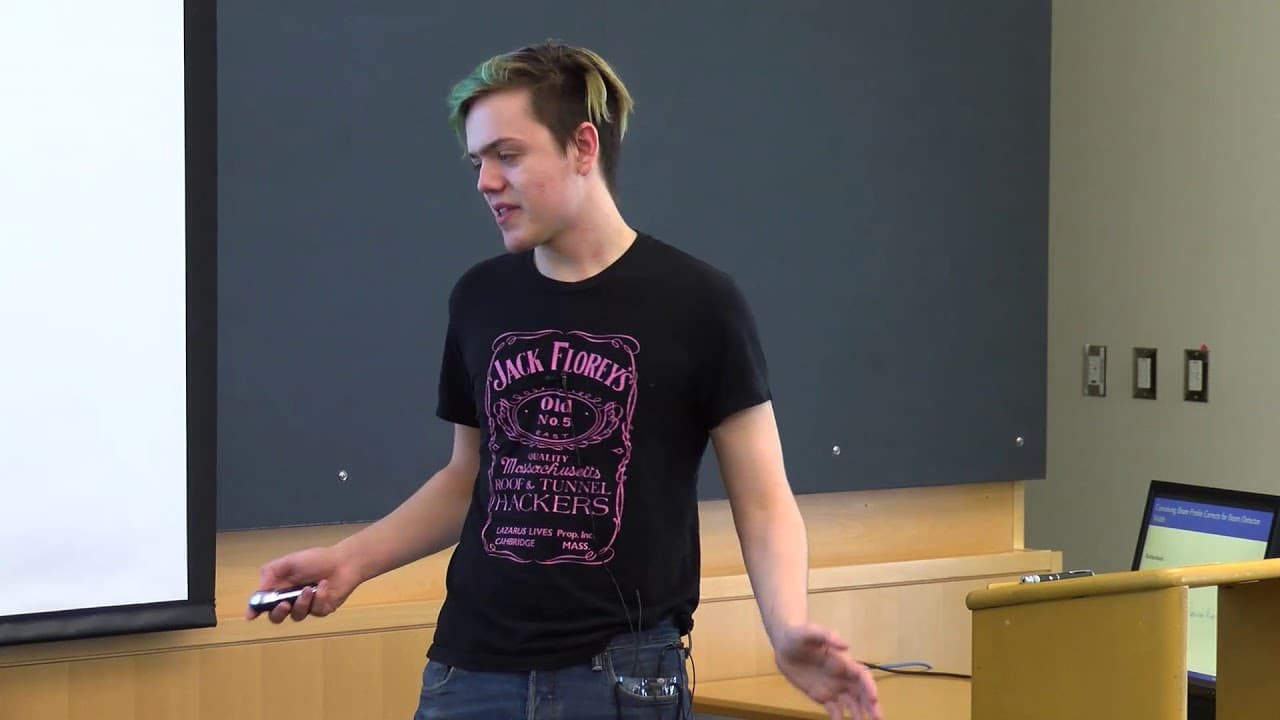
HENRY SHACKLETON: Be a long 15 minutes. There you go. All right, hello everybody. My name's Henry and today, I'll be presenting my findings on an experiment that I conducted with my lab partner Adin over there. Thank you, Adin During our experiment, we determined the angular dependency of the scattering rate of alpha particles through gold foil. Us... Read More
Key Insights
- 💪 The Plum Pudding Model predicted minimal scattering, while the Rutherford model predicted stronger scattering at larger angles.
- ☠️ The experiment used an alpha particle howitzer, gold foil, and a state detector to collect data on scattering rates.
- 🎁 The experiment concluded that the Rutherford model presented a more accurate description of the scattering effects observed in the experiment.
Install to Summarize YouTube Videos and Get Transcripts
Explore YouTube Video Summarizer or Get YouTube Transcript Extractor
Questions & Answers
Q: What was the predominant theory of the atom in the early 19th century?
The Plum Pudding Model proposed by JJ Thomson, which suggested that atoms consisted of a soup of positive charge with negatively charged electrons randomly distributed within it.
Q: How did Rutherford's model differ from the Plum Pudding Model?
Rutherford's model proposed that atoms had a densely packed, positively charged nucleus at the center with electrons orbiting around it, whereas the Plum Pudding Model did not have a distinct nucleus.
Q: How did the experiment measure scattering rates?
The experiment used an alpha particle howitzer, which emitted alpha particles at a constant energy. These particles were directed at a gold foil, and the scattering angle was measured by a state detector.
Q: Which model, Rutherford or Thomson, better predicted the experimental data?
The experimental data aligned more closely with the predictions of the Rutherford model, indicating that it more accurately described the scattering effects.
Summary & Key Takeaways
-
The experiment focused on comparing two historical models of the atom: JJ Thomson's Plum Pudding Model and Rutherford's model.
-
The Plum Pudding Model predicted minimal scattering, while the Rutherford model predicted stronger scattering at larger angles.
-
The experiment collected data on scattering rates at various angles and found that the data aligned with the predictions of the Rutherford model.
Read in Other Languages (beta)
Share This Summary 📚
Summarize YouTube Videos and Get Video Transcripts with 1-Click
Try YouTube Summary with ChatGPT & Claude or YouTube Transcript Generator
Explore More Summaries from MIT OpenCourseWare 📚



Summarize YouTube Videos and Get Video Transcripts with 1-Click
Try YouTube Summary with ChatGPT & Claude or YouTube Transcript Generator