What Is the Scalar Product and How Is It Used?
TL;DR
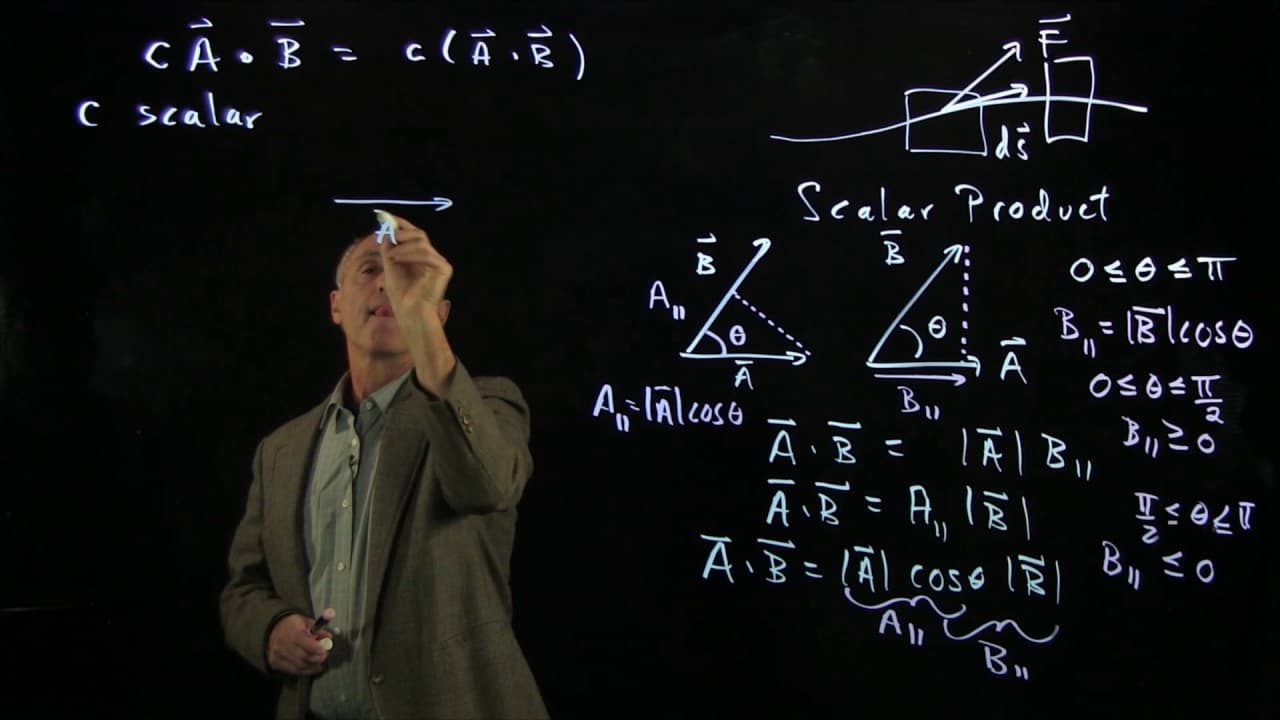
The scalar product, or dot product, quantifies how much one vector projects in the direction of another and is defined as the magnitude of one vector times the cosine of the angle between them. It's essential for analyzing work in multidimensional motion and satisfies key properties like scalar multiplication and vector addition.
Transcript
We now would like to generalize our concept of work to the motion of an object that goes in more than one dimension. And so, if we have our object here. And we're applying a force. And the object is moving. And let's say the path is a little bit more complicated. So our object, a little bit later, has moved. And we're going to call that displacemen... Read More
Key Insights
- 🫥 Work in multidimensional motion requires the use of the scalar product and dot product.
- 🫡 The scalar product determines the parallel component of one vector with respect to another vector.
- 🫥 The dot product represents the parallel components of two vectors and has geometric interpretations.
- 🫥 The dot product satisfies two important rules: scalar multiplication and vector addition properties.
Install to Summarize YouTube Videos and Get Transcripts
Explore YouTube Video Summarizer or Get YouTube Transcript Extractor
Questions & Answers
Q: What is the purpose of generalizing the concept of work to handle multidimensional motion?
Generalizing the concept of work to handle multidimensional motion allows us to calculate the work done on an object that moves in more than one direction, taking into account its displacement in different dimensions.
Q: How is the scalar product of two vectors defined?
The scalar product of two vectors is defined as the magnitude of one vector multiplied by the amount of the other vector that is parallel to the first vector. It can be positive or negative, depending on the angle between the vectors.
Q: What is the geometric interpretation of the dot product?
Geometrically, the dot product represents the parallel components of two vectors. It is equal to the magnitude of one vector multiplied by the cosine of the angle between the vectors.
Q: What are the two crucial rules for dot products?
The first rule states that multiplying a vector by a scalar and then taking the dot product is equivalent to multiplying the dot product by the scalar. The second rule states that vector addition distributes over vector multiplication by the dot product.
Summary & Key Takeaways
-
The video introduces the concept of work in motion and the need to generalize it to handle multidimensional motion.
-
The scalar product is defined as the magnitude of one vector multiplied by the amount of another vector that is parallel to the first vector.
-
The dot product is defined as the magnitude of one vector multiplied by the cosine of the angle between two vectors.
Read in Other Languages (beta)
Share This Summary 📚
Summarize YouTube Videos and Get Video Transcripts with 1-Click
Try YouTube Summary with ChatGPT & Claude or YouTube Transcript Generator
Explore More Summaries from MIT OpenCourseWare 📚


Summarize YouTube Videos and Get Video Transcripts with 1-Click
Try YouTube Summary with ChatGPT & Claude or YouTube Transcript Generator