How to Solve the Eight Queens Puzzle Algorithmically
TL;DR
The eight queens puzzle can be solved by placing eight queens on a chessboard so that no two queens threaten each other, using an exhaustive enumeration algorithm. This involves checking three key rules: no two queens in the same row, column, or diagonal. A matrix data structure can represent the board, though more efficient options exist.
Transcript
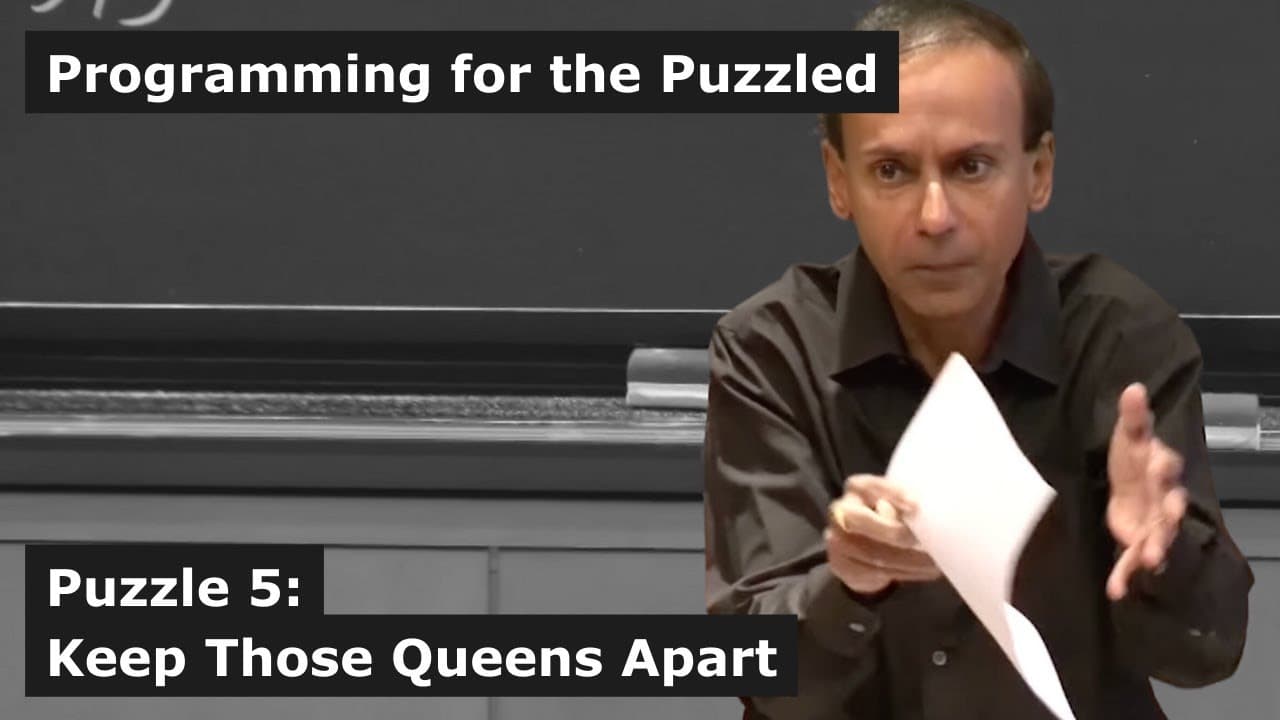
SRINI DEVADAS: So today, we're going to look at that classic puzzle. It's called the eight queens puzzle, and it's very easy to describe. I'll write down the rules, if you happen not to know chess and how a queen moves on a chess board, in a moment. But before I get into that, I just wanted to mention that the programming paradigms that we're going... Read More
Key Insights
- 👀 The eight queens problem can be solved using an exhaustive enumeration algorithm that looks at all possible combinations.
- 🤨 The problem can be generalized to solve for a varying number of rows and columns on the board.
- ❓ A matrix data structure is commonly used to represent the chessboard, but more efficient data structures can be employed.
- 👑 Checking for conflicts involves three rules: no two queens in the same column, row, or diagonal.
Install to Summarize YouTube Videos and Get Transcripts
Explore YouTube Video Summarizer or Get YouTube Transcript Extractor
Questions & Answers
Q: What is the eight queens problem?
The eight queens problem involves placing eight queens on a chessboard in a way that no queen can attack another queen.
Q: What programming paradigm is used to solve the eight queens problem?
The programming paradigm used is exhaustive enumeration, where all possible combinations are explored to determine if there is a solution.
Q: How can the size of the board be varied?
The size of the board can be varied by changing the number of rows and columns, allowing for different variations of the problem.
Q: Can the eight queens problem be solved using a different data structure?
Yes, while a matrix data structure is commonly used, other data structures can be employed to solve the problem more efficiently.
Q: How many solutions are there to the eight queens problem?
There are multiple solutions to the eight queens problem, and the exact number depends on factors such as symmetries and rotations that are considered.
Summary & Key Takeaways
-
The eight queens problem requires placing eight queens on a chessboard in such a way that they can't attack each other.
-
The problem can be solved using an exhaustive enumeration algorithm that looks at all possible combinations.
-
The solution involves using a matrix data structure to represent the chessboard and checking for conflicts using three rules: no two queens in the same column, row, or diagonal.
Read in Other Languages (beta)
Share This Summary 📚
Summarize YouTube Videos and Get Video Transcripts with 1-Click
Try YouTube Summary with ChatGPT & Claude or YouTube Transcript Generator
Explore More Summaries from MIT OpenCourseWare 📚


Summarize YouTube Videos and Get Video Transcripts with 1-Click
Try YouTube Summary with ChatGPT & Claude or YouTube Transcript Generator