How to Solve Homogeneous Linear Systems Ax=0
TL;DR
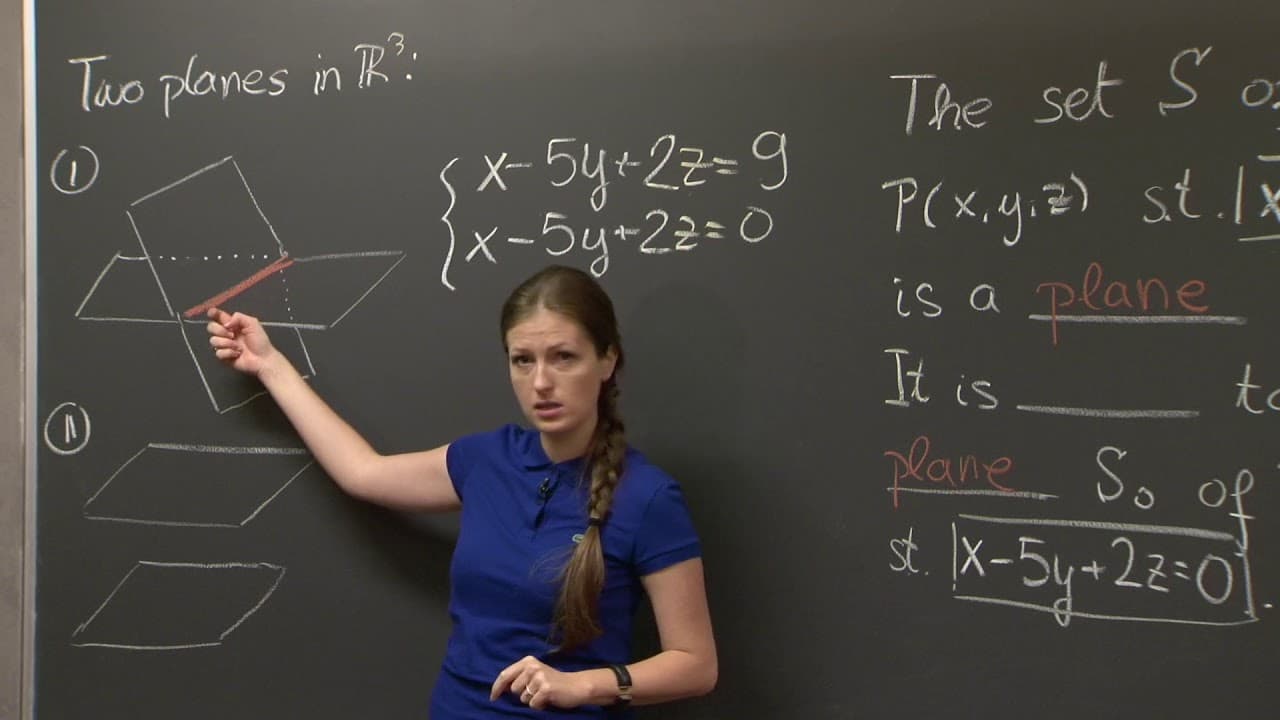
To solve the homogeneous linear system Ax=0, identify the relationship between the equations of two planes represented by sets S and S0. In this case, they correspond to x - 5y + 2z = 9 and x - 5y + 2z = 0, which are parallel planes. The general solution can be expressed as a combination of free variables that parameterizes all points in the solution space.
Transcript
MARTINA BALAGOVIC: Hi. Welcome back. Today's problem is about solving homogeneous linear systems, Ax equals 0, but it's also an introduction to the next lecture and next recitation section, which are going to be about solving non-homogeneous linear systems, Ax equals b. The problem is fill the blanks type. And it says the set S of all points with... Read More
Key Insights
- ☺️ Solving a homogeneous linear system involves finding solutions where all variables satisfy the equation x - 5y + 2z = 0.
- 🫥 Two planes in R^3 can either intersect along a line or be parallel.
- 😥 The specific form of all points in the plane S is obtained by adding the direction vector to any point in the plane S_0.
- 🥶 Homogeneous linear systems can be solved by parameterizing the free variables and finding particular solutions.
- 😫 The set of all solutions to a homogeneous linear system forms a vector space.
- ✈️ The concept of parallel planes and direction vectors is important in understanding the relationship between homogeneous and non-homogeneous linear systems.
- 🚱 Solving the homogeneous linear system is a necessary step in solving non-homogeneous linear systems.
Install to Summarize YouTube Videos and Get Transcripts
Explore YouTube Video Summarizer or Get YouTube Transcript Extractor
Questions & Answers
Q: What is the difference between a homogeneous and non-homogeneous linear system?
A homogeneous linear system has a constant term of 0 in all equations, while a non-homogeneous linear system has non-zero constant terms.
Q: How can we determine the position of two planes in R^3?
Two planes in R^3 can either intersect along a line or be parallel.
Q: How can we find the line of intersection between two planes?
By setting the equations of both planes equal to each other and solving the resulting system of equations.
Q: How do we express all points in the plane S?
All points in the plane S can be expressed as the sum of a specific point P_0 and a linear combination of the direction vector connecting S_0 to S.
Summary & Key Takeaways
-
The problem involves solving a homogeneous linear system and understanding its relation to a non-homogeneous linear system.
-
The set S consists of all points that satisfy the equation x - 5y + 2z = 9, while S_0 consists of points that satisfy x - 5y + 2z = 0.
-
Two planes can either intersect along a line or be parallel, and in this case, S and S_0 are parallel planes.
Read in Other Languages (beta)
Share This Summary 📚
Summarize YouTube Videos and Get Video Transcripts with 1-Click
Try YouTube Summary with ChatGPT & Claude or YouTube Transcript Generator
Explore More Summaries from MIT OpenCourseWare 📚


Summarize YouTube Videos and Get Video Transcripts with 1-Click
Try YouTube Summary with ChatGPT & Claude or YouTube Transcript Generator