What Are Sets and How Do They Work in Mathematics?
TL;DR
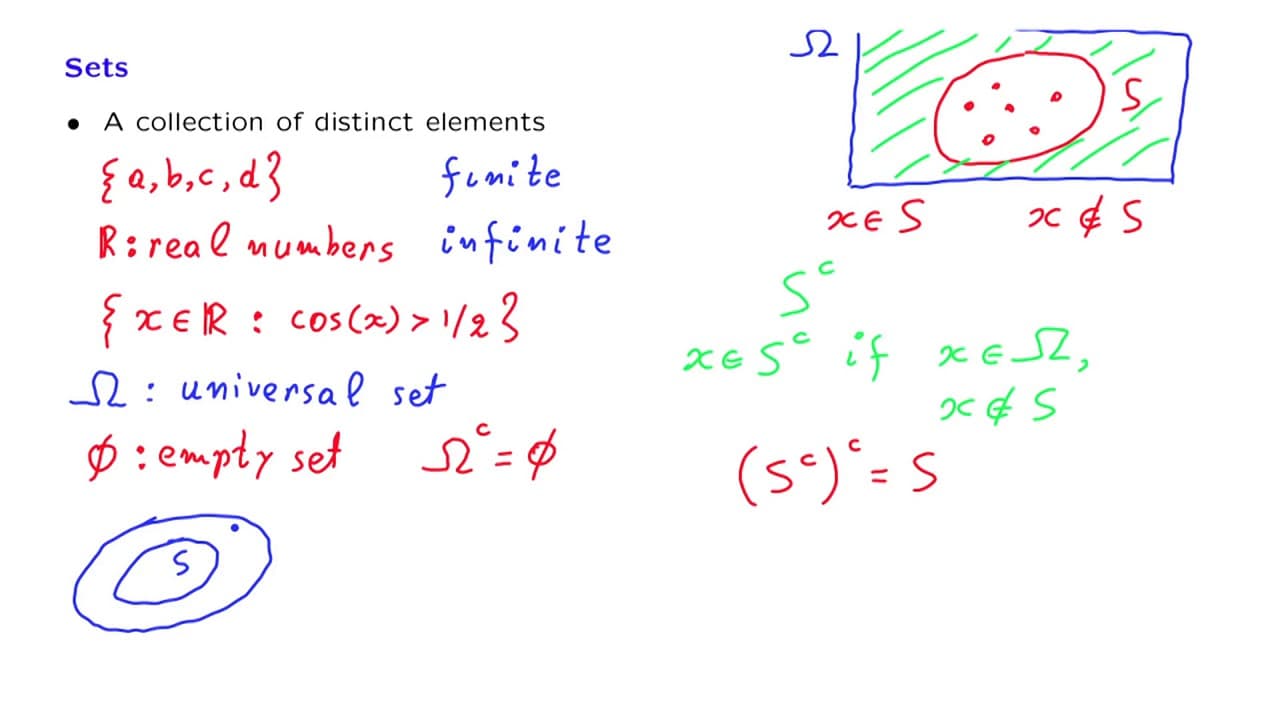
Sets are collections of distinct elements that can be either finite or infinite, specified by listing elements or by stating properties they must satisfy. Key operations include union, intersection, and complement, which follow rules such as associativity and distributivity, while the empty set contains no elements, and universal sets encompass all possible elements being considered.
Transcript
In this segment, we will talk about sets. I'm pretty sure that most of what I will say is material that you have seen before. Nevertheless, it is useful to do a review of some of the concepts, the definitions, and also of the notation that we will be using. So what is a set? A set is just a collection of distinct elements. So we have some elements,... Read More
Key Insights
- 😫 Sets are collections of distinct elements, and they can be finite or infinite.
- 😫 Sets can be specified by listing their elements or by defining a property that the elements must satisfy.
- 😫 Set operations include union, intersection, and complement.
- 😫 The complement of a set consists of all elements that belong to the universal set but not to the set itself.
- 😫 The empty set is a set that contains no elements.
- 🎅 Sets can be compared using subset notation, where S is a subset of T if every element in S is also an element in T.
- 😫 Set operations satisfy properties such as associativity, distributivity, and identity.
Install to Summarize YouTube Videos and Get Transcripts
Explore YouTube Video Summarizer or Get YouTube Transcript Extractor
Questions & Answers
Q: What is a set?
A set is a collection of distinct elements that can be finite or infinite. It can be specified by listing its elements or by defining a property that the elements must satisfy.
Q: How do we indicate that an element belongs to a set?
We use the notation "x belongs to S" or "x is an element of S" to indicate that x is a member of the set S. If x is not an element of S, we use the notation "x does not belong to S".
Q: What is the complement of a set?
The complement of a set S is the collection of all elements that belong to the universal set but do not belong to S. It is denoted as S' or S̅ and is defined as the set of elements x that belong to the universal set but not to S.
Q: What are some basic properties of set operations?
Set operations satisfy properties such as associativity, distributivity, and identity. For example, the union of sets is commutative, meaning that the order of the sets does not affect the result. The intersection of sets is also commutative. The union of a set with the universal set returns the universal set, and the intersection of a set with the universal set returns the set itself.
Summary & Key Takeaways
-
Sets are collections of distinct elements that can be finite or infinite.
-
Sets can be specified by listing their elements or by defining a property that the elements must satisfy.
-
Set operations include union, intersection, and complement, and they satisfy certain properties such as associativity and distributivity.
Read in Other Languages (beta)
Share This Summary 📚
Summarize YouTube Videos and Get Video Transcripts with 1-Click
Try YouTube Summary with ChatGPT & Claude or YouTube Transcript Generator
Explore More Summaries from MIT OpenCourseWare 📚


Summarize YouTube Videos and Get Video Transcripts with 1-Click
Try YouTube Summary with ChatGPT & Claude or YouTube Transcript Generator