What Is the Current Status of Higgs Boson Research?
TL;DR
The Higgs boson has been successfully detected, with its mass confirmed at approximately 125 GeV through decay measurements involving photons and Z bosons. While various coupling strengths to standard particles have been measured, the coupling to lighter quarks, electrons, and the Higgs boson itself remains unestablished, indicating ongoing research is necessary to fully understand its properties.
Transcript
MARKUS KLUTE: Welcome back to 8.701. So in this lecture, we have a very brief view at the current status of Higgs boson research. And I have to tell you that we could spend an entire week discussing this. I just give you the high-level overview, maybe the 30,000 feet kind of overview of what we know about the Higgs boson. On the Canvas page, you'll... Read More
Key Insights
- 📳 The discovery of the Higgs boson has been confirmed through measurements of various decay modes.
- 💆 Precise mass measurements support the existence of a Higgs boson with a mass of approximately 125 GeV.
- 🙂 Coupling strengths to bosons and fermions have been gauged, but further measurements are needed for lighter quark masses and the electron.
- 💆 The Higgs boson's coupling to itself remains unmeasured, which is crucial for confirming its role in giving mass to particles.
- 👨🔬 There is ongoing research to explore the possibility of additional Higgs bosons and to investigate decays into nonstandard model particles.
Install to Summarize YouTube Videos and Get Transcripts
Explore YouTube Video Summarizer or Get YouTube Transcript Extractor
Questions & Answers
Q: How was the Higgs boson discovered?
The Higgs boson was observed in decays to photons and Z bosons, with detectors able to measure the energy or momenta of particles. By subtracting backgrounds, a peak consistent with the Higgs boson was identified.
Q: What is the mass of the Higgs boson?
Measurements from ATLAS and CMS experiments indicate a Higgs boson mass of around 125 GeV, obtained through the reconstruction of decay final states.
Q: How have the couplings of the Higgs boson to fermions been measured?
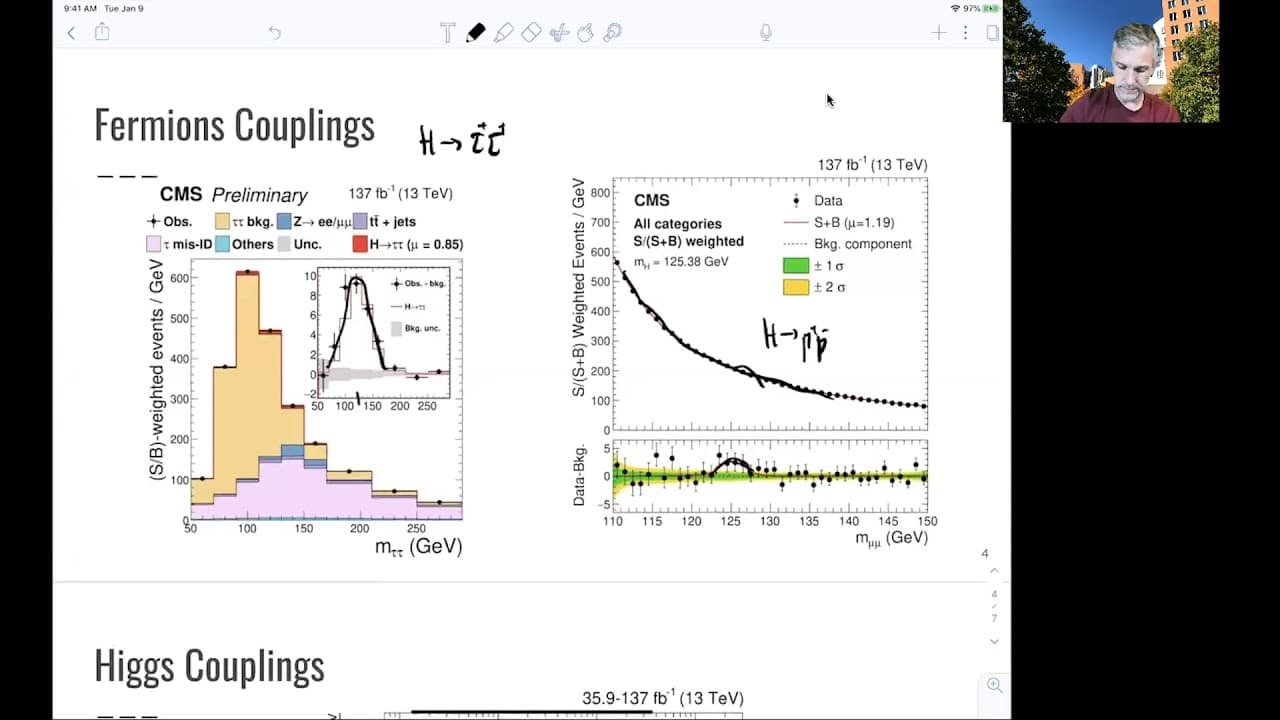
Coupling strengths to fermions such as taus and muons have been measured by analyzing final states where these particles are produced. Background subtraction reveals a peak consistent with the Higgs boson at 125 GeV.
Q: Has the coupling of the Higgs boson to itself been measured?
No, the coupling of the Higgs boson to itself has not yet been measured. This measurement would provide further evidence for the Higgs mechanism and its role in generating mass.
Summary & Key Takeaways
-
The Higgs boson has been detected in decays to photons and Z bosons, with precise measurements of energy/momentum allowing for mass reconstruction.
-
Measurements from ATLAS and CMS experiments confirm the mass of the Higgs boson to be approximately 125 GeV.
-
Coupling strengths of the Higgs boson to bosons and fermions have been measured, but the coupling to light quarks, electrons, and itself has not yet been determined.
Read in Other Languages (beta)
Share This Summary 📚
Summarize YouTube Videos and Get Video Transcripts with 1-Click
Try YouTube Summary with ChatGPT & Claude or YouTube Transcript Generator
Explore More Summaries from MIT OpenCourseWare 📚


Summarize YouTube Videos and Get Video Transcripts with 1-Click
Try YouTube Summary with ChatGPT & Claude or YouTube Transcript Generator