What Is Maximum Likelihood Estimation and How Is It Used?
TL;DR
Maximum likelihood estimation (MLE) is a statistical method for estimating unknown parameters by maximizing the likelihood function based on observed data. In examples, MLE is demonstrated with a binomial random variable to estimate probabilities and with normally distributed variables to estimate mean and variance. The MLE results often align with familiar sample statistics, making it a vital tool in statistics.
Transcript
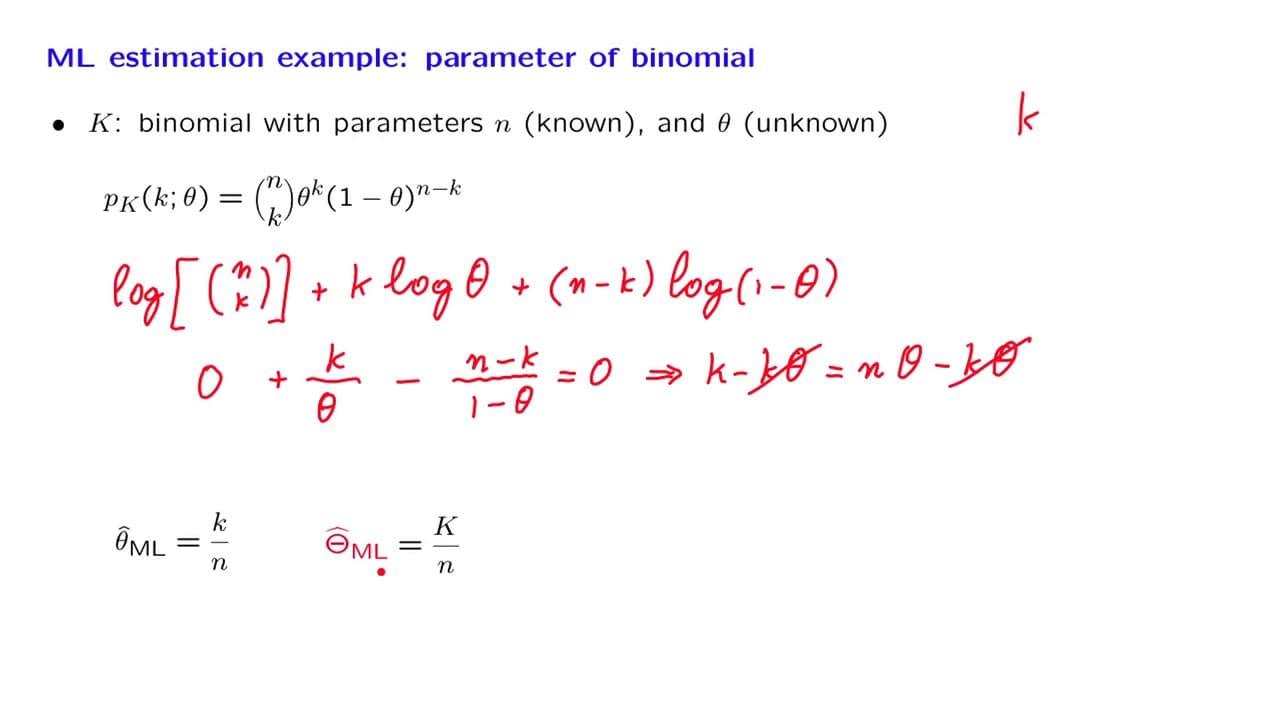
In this segment, we will go through two examples of maximum likelihood estimation, just in order to get a feel for the procedure involved and the calculations that one has to go through. Our first example will be very simple. We have a binomial random variable with parameters n and theta. So think of having a coin that you flip n times, and theta i... Read More
Key Insights
- 🔨 Maximum likelihood estimation is a powerful tool for estimating unknown parameters in statistics.
- 🖐️ The likelihood function plays a crucial role in maximum likelihood estimation, as it represents the probability of obtaining the observed data.
- 🫡 The maximum likelihood estimate is obtained by maximizing the likelihood function with respect to the parameters of interest.
- 👻 The simplicity of the examples provided allows for easy interpretation and understanding of the maximum likelihood estimation method.
- ❓ Maximum likelihood estimation can provide estimates that coincide with commonly used sample statistics.
- ❓ The calculations involved in maximum likelihood estimation can vary in complexity depending on the statistical model and data.
- 🧡 Maximum likelihood estimation can be applied to a wide range of statistical models, not limited to the examples discussed.
Install to Summarize YouTube Videos and Get Transcripts
Explore YouTube Video Summarizer or Get YouTube Transcript Extractor
Questions & Answers
Q: What is maximum likelihood estimation?
Maximum likelihood estimation is a statistical method used to estimate unknown parameters by maximizing the likelihood function, which is the probability of obtaining the observed data given the parameter values.
Q: How does maximum likelihood estimation work in the context of a binomial random variable?
In the case of a binomial random variable, the likelihood function is derived by calculating the probability of obtaining a specific number of successes (heads) in a series of coin flips. The maximum likelihood estimate for the parameter (probability of heads) is obtained by maximizing this likelihood function.
Q: Can maximum likelihood estimation be applied to normally distributed random variables?
Yes, maximum likelihood estimation can be applied to normally distributed random variables. In this case, the likelihood function is derived from the product of the probability density functions of the individual observations. The maximum likelihood estimates for the mean and variance are obtained by optimizing the likelihood function with respect to these parameters.
Q: How are the maximum likelihood estimates related to sample statistics?
In both examples, the maximum likelihood estimates coincide with commonly used sample statistics. In the case of the binomial random variable, the estimate for the probability of heads is equal to the observed proportion of heads. In the case of normally distributed random variables, the estimate for the mean is equal to the sample mean, and the estimate for the variance is a variation of the sample variance formula.
Summary & Key Takeaways
-
Maximum likelihood estimation is a procedure used to estimate unknown parameters in statistical models.
-
In the first example, a binomial random variable is used to demonstrate the maximum likelihood estimation process.
-
The second example involves estimating the mean and variance of a set of normally distributed random variables.
Read in Other Languages (beta)
Share This Summary 📚
Summarize YouTube Videos and Get Video Transcripts with 1-Click
Try YouTube Summary with ChatGPT & Claude or YouTube Transcript Generator
Explore More Summaries from MIT OpenCourseWare 📚
Summarize YouTube Videos and Get Video Transcripts with 1-Click
Try YouTube Summary with ChatGPT & Claude or YouTube Transcript Generator