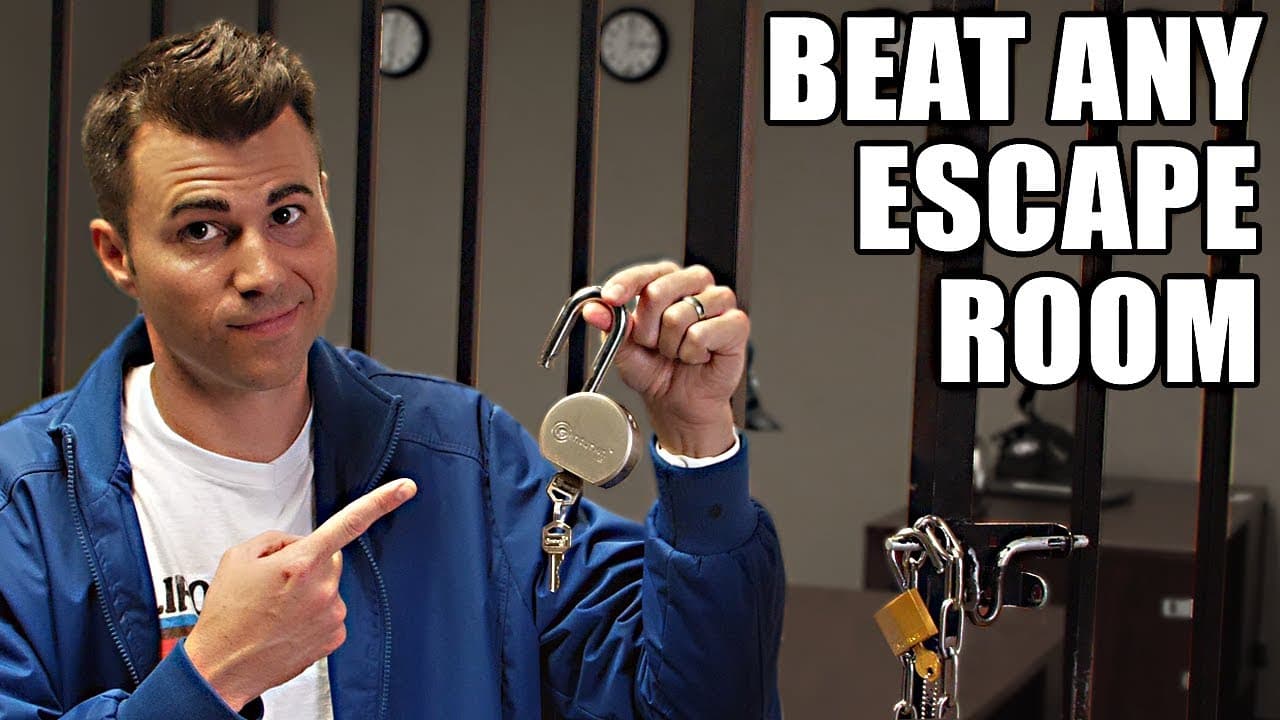
How to Beat Any Escape Room with Proven Tactics

TL;DR
Start by splitting up to search, gathering every discovered item in one place, and working backward from the lock or obstacle blocking progress. Keep solutions simple, communicate active tasks through a project manager, recognize common locks and codes, and ask another teammate to retry a promising combination before abandoning it.
Transcript
- [Mark Rober] I bet there's cash. - [Player] Oh! - [Mark Rober] Oh dude, we crushed the record. This is an escape room. It's basically where you and some friends are placed in a room and you have to solve a series of puzzles and locks to get out in exactly one hour. And today I'm gonna give you 10 proven tips to dominate any type of escape room. A... Read More
Key Insights
- Thinking simply is a core escape-room strategy because a well-designed room should be solvable by an average person within one hour using information found inside it. If a proposed solution requires complicated outside knowledge, the team may be overanalyzing or may not have uncovered every necessary clue yet.
- Searching in parallel is the best opening move because every teammate can inspect a different area immediately. Useful hiding places include beneath tables or rugs, inside hollowed books, in clothing pockets, and behind doors, while ceiling lights and power outlets generally should not be disassembled.
- Organizing clues in one shared location makes relationships and missing pieces easier to recognize. Similar objects should be grouped together, no player should carry an unknown item around, and used clues should enter a discard pile so the team does not repeatedly solve completed tasks.
- Working backward from the immediate obstacle reduces wasted effort by identifying the exact input currently required. A lock needing three letters and two numbers gives the team a focused search target and makes unrelated objects or deliberately placed red herrings less likely to consume valuable time.
- Poor communication is the primary reason teams fail, according to Dr. Scott Nicholson. A project manager can counter this problem by tracking active tasks, announcing required combinations, directing attention toward unusual clues, and monitoring who is working on each puzzle without becoming absorbed in solving one.
- Common lock types reveal the form of the answer teams must find. Key locks, ordered number or letter combinations, dial locks, directional locks, and lock boxes all behave differently, so knowing their input rules helps players interpret clues and operate each mechanism correctly under pressure.
- A promising lock code should be tested by another teammate before the group abandons it. Game pressure can cause simple operating mistakes, and this retry tactic helped the featured team on three occasions. If only one digit remains unknown, testing the remaining 10 options can finish the combination.
- Recognizable code patterns tell players which decoding system to seek. Dots and dashes suggest Morse code, grid-like symbols may indicate pigpen cipher, six-dot groups point toward braille, and numbers from one to 26 can correspond to alphabet letters when no separate decoder key is provided.
Install to Summarize YouTube Videos and Get Transcripts
Explore YouTube Video Summarizer or Get YouTube Transcript Extractor
Questions & Answers
Q: How should a team start an escape room?
A team should immediately split up and search different parts of the room. Players should check sensible hiding places such as beneath tables and rugs, inside hollowed books, in clothing pockets, and behind doors. Every discovered clue or object should then be brought to one shared location so the entire group can see it and identify possible connections.
Q: How can players avoid overthinking escape-room puzzles?
Players should remember that a well-designed escape room is intended to be completed by an average person within one hour using information available inside the room. They should test simple, theme-consistent interpretations before pursuing complicated theories. If no straightforward solution appears, some required information may still be hidden, so the team should move on and return later.
Q: How should escape-room clues and objects be organized?
All active clues and objects should be placed in a central location, with similar items grouped together so patterns become visible. Team members should not carry objects without telling others. After a clue or item has been used, it should enter a discard pile, and a key should remain in the lock it opened to prevent duplicated effort.
Q: How does working backward help solve escape-room puzzles?
Working backward starts with the obstacle preventing further progress and identifies exactly what input it requires. For example, a lock that accepts three letters and two numbers tells the team what kind of answer to seek. This focused approach narrows the search, connects relevant clues to specific locks, and reduces time spent pursuing unrelated objects or red herrings.
Q: What does an escape-room project manager do?
The project manager maintains an overview of the room instead of becoming deeply involved in one puzzle. Teammates report discovered locks, unusual objects, and possible clues to that person. The manager announces required inputs, tracks active tasks, notes who is working on each problem, and redirects attention when necessary so information continues flowing throughout the team.
Q: What common lock types should escape-room players recognize?
Players should recognize standard key locks, ordered number or letter combination locks, three-number dial locks, directional locks, and lock boxes. Directional locks may accept from two to 30 inputs and can be cleared by squeezing down three times. Some lock boxes accept two to 10 numbers, use each number once, and do not require a particular order.
Q: What should players do when a likely lock code does not work?
When a code appears correct but the lock stays closed, another teammate should try entering or operating it before the group rejects the solution. Pressure can lead to mechanical mistakes even when the reasoning is sound, and this technique helped the featured team on three separate occasions. If only the final digit is missing, players can test the 10 possible options.
Q: How can players recognize common escape-room codes?
Players can identify likely decoding methods from the visual structure of a clue. Dots and dashes indicate Morse code and may appear as writing, flashing lights, or long and short sounds. Symbols resembling hieroglyphics may use pigpen cipher, six-dot groups suggest braille, and numbers ranging from one to 26 may map directly to alphabet letters.
Summary & Key Takeaways
-
Successful escape-room teams search in parallel, collect discovered objects centrally, and separate used items from active clues. They avoid unnecessary disassembly and distinguish designed clues from ordinary labels or fixtures by considering the room’s theme. This organization reveals relationships among objects while preventing teammates from unknowingly repeating completed work or hiding information.
-
Puzzle solving becomes more efficient when players work backward from the immediate obstacle. A lock’s required input, such as letters, numbers, or directions, narrows the relevant search. Teams should favor simple explanations, postpone puzzles that lack enough information, and remain cautious about red herrings that consume time without advancing the room’s main sequence.
-
Communication is supported by assigning a project manager who tracks locks, clues, active tasks, and each player’s work without becoming buried in one puzzle. Familiarity with common lock mechanisms and code formats reduces confusion. Written clues and recurring patterns also deserve attention, while the room guide can help when progress completely stalls.
Read in Other Languages (beta)
Share This Summary 📚
Summarize YouTube Videos and Get Video Transcripts with 1-Click
Try YouTube Summary with ChatGPT & Claude or YouTube Transcript Generator
Explore More Summaries from Mark Rober 📚



Summarize YouTube Videos and Get Video Transcripts with 1-Click
Try YouTube Summary with ChatGPT & Claude or YouTube Transcript Generator