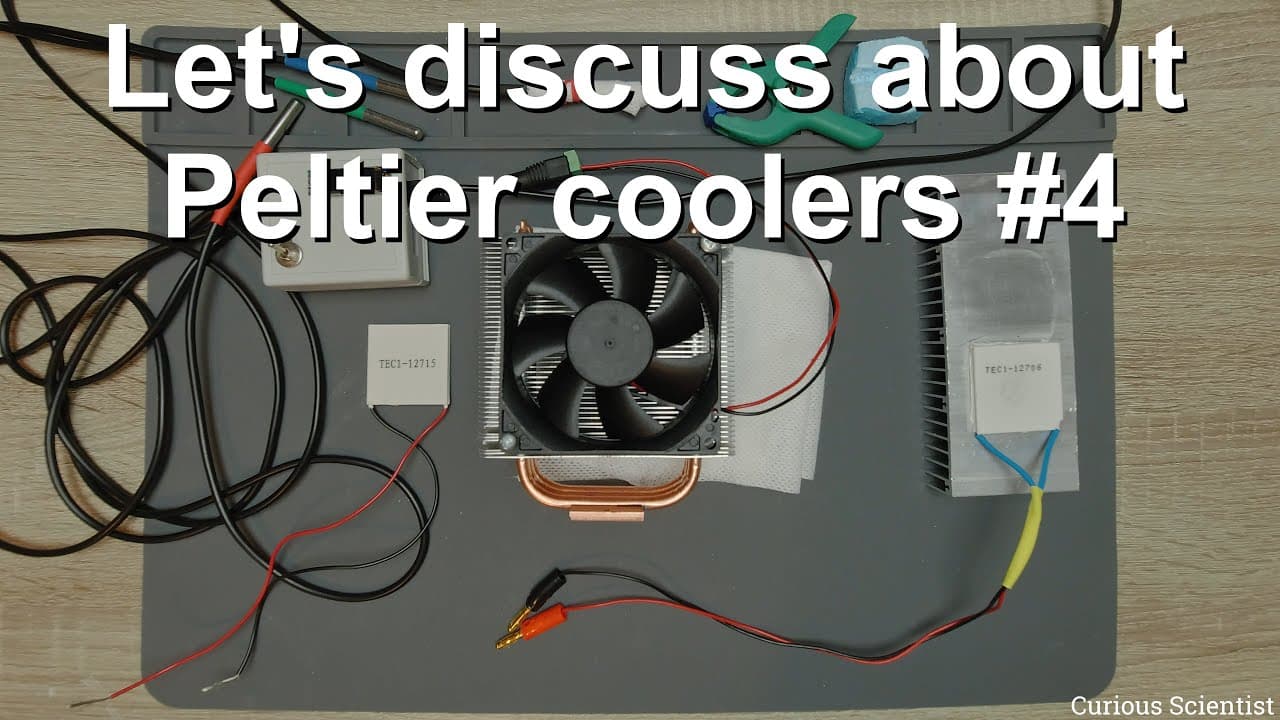
Let's discuss about Peltier coolers #4 - Cooling the hot side - Part 2
TL;DR
The video explains how to effectively enhance cooling in patio coolers using evaporative methods.
Transcript
welcome everyone in this video i want to return to an already discussed topic which is the cooling of the hot side of the patio cooler and why i want to return is because i want to talk about some things in a bit more detail so you can have a bit better knowledge and i can also like uh explain things in a bit better way so if you've been following ... Read More
Key Insights
- 😘 The confusion about patio coolers often stems from misconceptions regarding their temperature capabilities; low temperatures on the cold side may not indicate effective cooling.
- 😎 A balance must be struck between temperature difference and cooling capacity; optimizing both parameters leads to efficient cooling.
- 😅 Evaporative cooling can lower the hot side’s temperature, which can consequently enhance cold side performance when properly implemented.
- 😎 Ensuring the airflow around the cooling fins is continuous helps to prevent saturation of humidity, which can halt effective evaporation.
- 🥵 The surface area for evaporation is crucial; increasing water surface area leads to faster evaporation rates and more efficient heat absorption.
- 😎 Running a fan in conjunction with mist or humid air can dramatically improve cooling effectiveness by reducing the ambient temperature around cooling surfaces.
- 😎 Simple tricks such as using misters or high-surface area setups can significantly enhance the cooling performance of basic cooling systems.
Install to Summarize YouTube Videos and Get Transcripts
Explore YouTube Video Summarizer or Get YouTube Transcript Extractor
Questions & Answers
Q: What is the main function of the cold side of a patio cooler?
The cold side of a patio cooler is designed to cool something down below ambient temperature by transferring heat away from a heat source. When current is applied, it absorbs heat, creating a temperature differential between the cold and hot sides, which facilitates the cooling process.
Q: What are the two critical parameters to consider in patio cooler performance?
The two critical parameters are temperature difference (dt) and cooling capacity (qc). The dt represents the difference in temperature between the cold and hot sides, while the qc measures the amount of heat that can be transferred from the cold side to the hot side. They are inversely related, meaning high efficiency in one usually leads to lower performance in the other.
Q: How does evaporative cooling improve the efficiency of a patio cooler?
Evaporative cooling enhances efficiency by allowing water to absorb heat as it evaporates, which lowers the temperature of the hot side. This reduced temperature can improve the cold side’s efficiency by maintaining a more optimal temperature difference while enabling better heat transfer from the cold side.
Q: What factors contribute to effective evaporation in cooling systems?
Effective evaporation is influenced by several factors: increasing the evaporation surface area, maximizing airflow to replace saturated air around evaporation surfaces, and ensuring the intake air is low in humidity. Each of these contributes to a more efficient evaporative cooling process and a cooler overall system.
Summary & Key Takeaways
-
The video revisits the cooling mechanisms of patio coolers, specifically emphasizing the roles of the cold and hot sides during operation and clarifying common misconceptions about their temperature capabilities.
-
It highlights critical parameters that determine cooling performance, namely temperature difference (dt) and cooling capacity (qc), asserting that trade-offs exist between achieving low temperatures and efficient heat transfer.
-
The video introduces evaporative cooling as a technique to maintain lower temperatures on the hot side, explaining variables such as humidity, airflow, and surface area that affect the evaporation rate and overall system cooling efficiency.
Read in Other Languages (beta)
Share This Summary 📚
Summarize YouTube Videos and Get Video Transcripts with 1-Click
Try YouTube Summary with ChatGPT & Claude or YouTube Transcript Generator
Explore More Summaries from Curious Scientist 📚


![Building a Peltier cooler-based cooling box - First iteration, improvements [Part 2/6] thumbnail](/_next/image?url=https%3A%2F%2Fi.ytimg.com%2Fvi%2F0YlNw0EGnzI%2Fhqdefault.jpg&w=750&q=75)
Summarize YouTube Videos and Get Video Transcripts with 1-Click
Try YouTube Summary with ChatGPT & Claude or YouTube Transcript Generator