How to run a 1000-player Minecraft civilization experiment
TL;DR
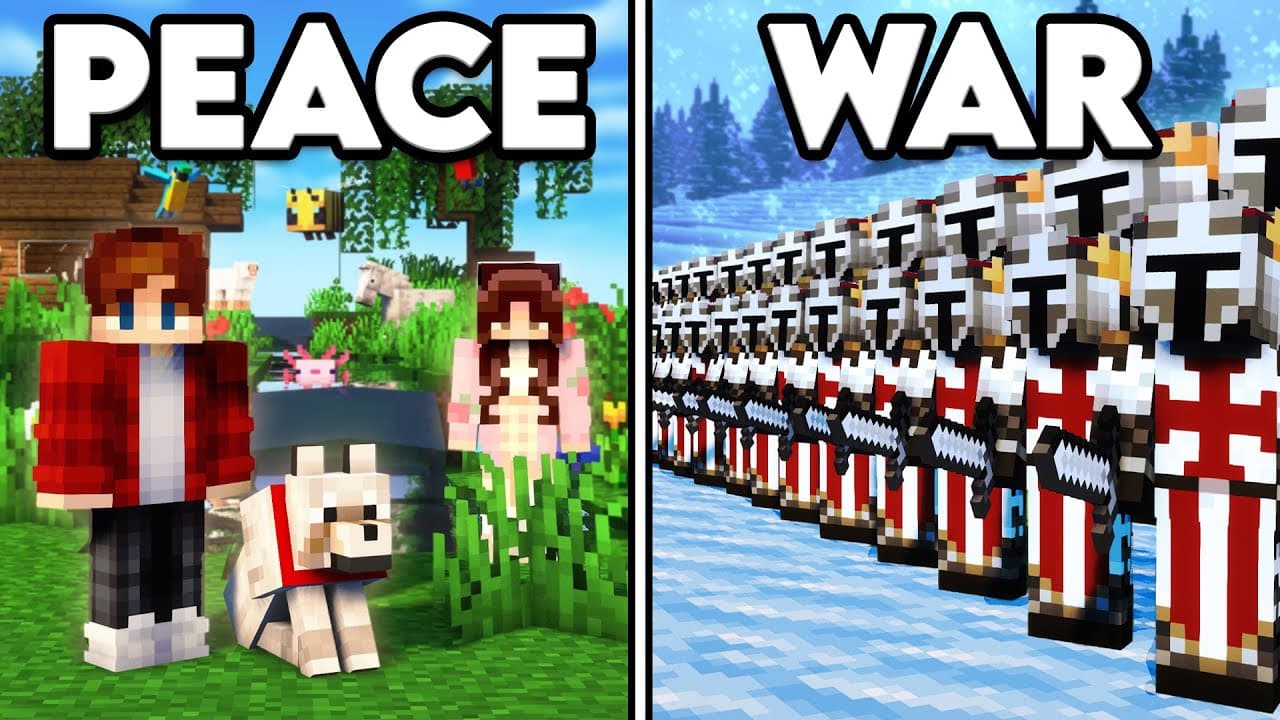
A thousand players were placed on four separate islands to form independent civilizations with no guidance. The project shows how democracy, dictatorship, and conflict emerge from limited resources, while leaders negotiate, form alliances, and battle for control. The result is a sprawling, evolving narrative of cooperation and competition.
Transcript
in the biggest social experiment ever done in Minecraft I scattered 1,000 people across four massive Islands to simulate a realistic civilization the players were given no help or guidance and just like in real life if you die you remain Dead Forever no now each player has the freedom to do whatever they want gather resources join a society become ... Read More
Key Insights
- The project creates four distinct political ecosystems on Plains, Desert, Snow, and Jungle islands, illustrating how environment shapes governance and strategy.
- Each island develops its own leadership and rules, showing how centralization versus distributed decision making affects stability and growth.
- Resource scarcity and access to trees or water dramatically influence settlement locations and economic development.
- Powdered snow on the Snow Island turns into a deadly hazard, highlighting how terrain features alter risk and settlement planning.
- The Desert island features a ruler style centered on authority and order, while other islands experiment with democratic processes and alliances.
- Communication constraints across islands complicate diplomacy and war planning, revealing how information flow affects alliance building.
- Conflict emerges both as open warfare and political maneuvering, from territorial disputes to loyalty shifts and leadership coups.
- The experiment demonstrates how large group dynamics scale with time, producing evolving power structures and shifting loyalties.
Install to Summarize YouTube Videos and Get Transcripts
Explore YouTube Video Summarizer or Get YouTube Transcript Extractor
Questions & Answers
Q: How does the four island setup affect governance and diplomacy?
The four island setup creates parallel political laboratories where different governance models can emerge side by side. Plaines develop democratic processes while Desert island enforces a strong ruler approach, Snow island explores imperial unification attempts and Jungle island devolves into factional chaos. Diplomacy becomes a function of location, resource access, and perceived security, driving alliances and rivalries across the sea boundaries.
Q: What roles do resource availability and terrain play in settlement choices?
Resource availability and terrain are primary drivers of where settlements form. Trees on Jungle and Desert access influence building and weapon/tool production, plains offer resilience and farming potential, and snow terrain imposes survival challenges that push communities toward centralized planning or empire building. The scarcity of food and wood shapes economic networks and settlement density.
Q: How do leadership changes affect the course of the game?
Leadership changes inject volatility into the system, triggering shifts in policy, alliances, and priorities. New leaders may pursue expansion, reform, or consolidation, altering resource distribution and security dynamics. These transitions create plotting opportunities for rivals and test the resilience of civilizations under pressure.
Q: What kinds of conflicts arise besides open battles?
Conflicts include political maneuvering, betrayals, alliances forming and dissolving, leadership challenges, and resource disputes. Territorial claims and influence over trade nodes create friction even without direct combat, while propaganda, public performances, and religious or cultural pledges influence loyalty and social cohesion within and between islands.
Q: How does communication range affect diplomacy and coordination?
Limited chat visibility forces factions to rely on trusted intermediaries and coded signals, slowing response times and increasing chances of miscommunication. This constraint mimics real world information bottlenecks, making careful negotiation and explicit guarantees essential for stable alliances and timely responses to threats.
Q: What is the most surprising behavior observed among players?
One surprising behavior is the emergence of coordinated political structures within chaotic environments, such as the Snow Island empire with a centralized leadership plan. Another is the willingness of some players to form culturally cohesive communities around rituals, jokes, and shared goals, even amid competition and danger.
Q: How does the event balance freedom with safety constraints like banning RDM?
The balance allows players significant autonomy to explore, build, and lead while restricting sure fire shortcuts to chaos such as random killing. This fosters strategic planning, alliance building, and governance experiments, while preserving a baseline of predictability that makes the evolving narrative legible and compelling for spectators.
Q: What lessons does this Minecraft experiment offer about real world nation building?
The experiment demonstrates that resource distribution, geography, leadership styles, and communication networks strongly influence political outcomes. It shows how coalitions form and dissolve, how power can centralize or fragment, and how communities adapt to risk, scarcity, and competition while pursuing collective goals and personal ambitions. It offers a simplified lens on complex dynamics.
Summary & Key Takeaways
-
A large scale Minecraft experiment spreads players across four biomes to simulate nation building under real constraints. The activity highlights how leadership, resource competition, and geography shape political dynamics and social structures. Observers can track how alliances form and how conflicts arise over time.
-
The event emphasizes the emergence of distinct governance styles and strategic priorities on each island. Democracy and centralized authority compete for influence, with war and diplomacy influencing resource flow and settlement stability. The footage documents both cooperation and turmoil as the game progresses.
-
The video captures the tension between limited information and collective decision making. As players die or migrate, communities reorganize, new leaders rise, and power shifts occur. The narrative arc centers on persistence, strategy, and adaptation rather than single decisive moments.
Read in Other Languages (beta)
Share This Summary 📚
Summarize YouTube Videos and Get Video Transcripts with 1-Click
Try YouTube Summary with ChatGPT & Claude or YouTube Transcript Generator
Explore More Summaries from ish 📚
Summarize YouTube Videos and Get Video Transcripts with 1-Click
Try YouTube Summary with ChatGPT & Claude or YouTube Transcript Generator