How Does Wealth Shape a Minecraft Civilization?
TL;DR
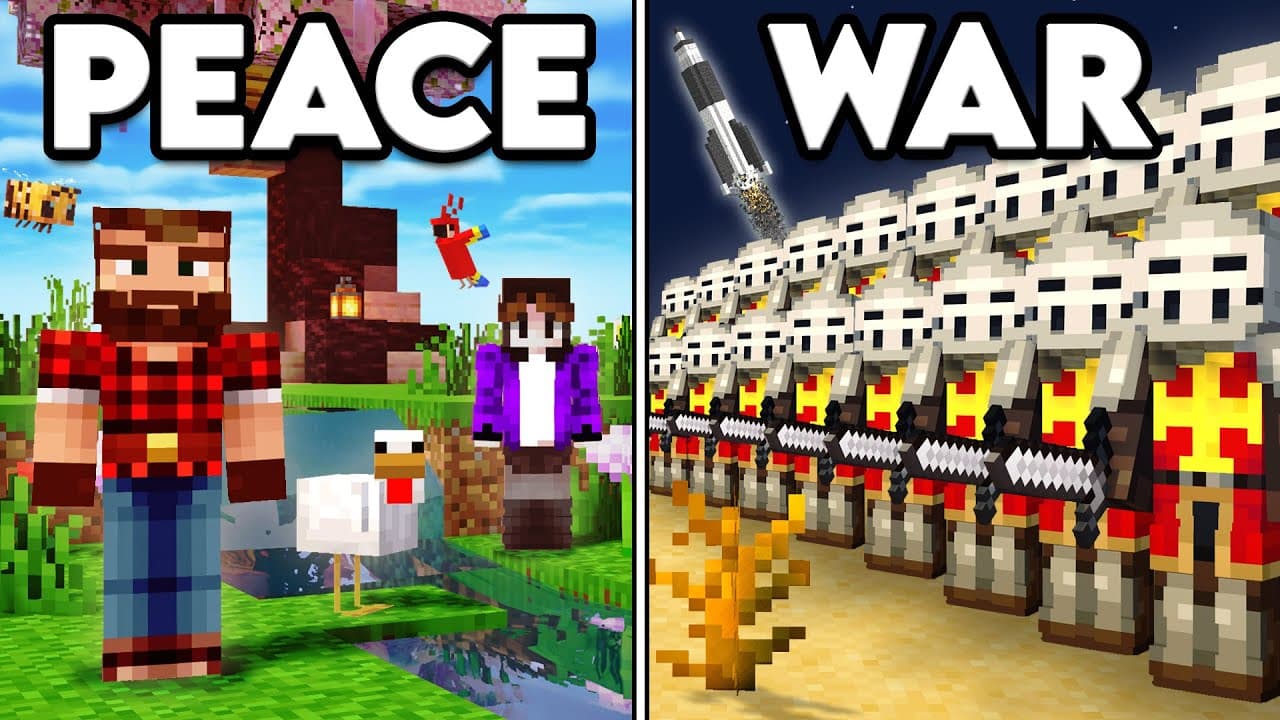
Resource inequality immediately shaped survival, politics, and conflict among players divided between two Minecraft islands. The barren island struggled with boiling water, scarce wood, lava, hunger, and violence, yet developed resilient communities, Westhelm, a mafia, and a volcano kingdom, while the prosperous island rapidly formed wealthy civilizations whose competing ambitions created tensions despite abundant resources.
Transcript
In the biggest social experiment in Minecraft history, I scattered 1,000 people across two massive islands to simulate a realistic civilization. The players were given no help or guidance. And just like in real life, if you die, you remain dead forever. Now, each player has the freedom to do whatever they want. farm for food, become a dictator, and... Read More
Key Insights
- Resource inequality is the experiment's central condition: Island One received barren, hazardous terrain, while Island Two received plentiful trees, normal water, and accessible resources. Players selected their islands without being told which environment they would receive, making their starting positions a matter of chance.
- Wood is the first major survival bottleneck on Island One because players need it to craft tools and begin developing settlements. The island contains one large tree, but boiling water surrounds it, forcing residents to accept serious danger before they can access a basic material.
- Island Two is able to develop faster because abundant trees support toolmaking and underground mining. Players quickly discover diamonds, establish businesses, and organize large settlements, demonstrating how accessible starting resources can accelerate economic activity, construction, and political consolidation.
- Community support is a response to scarcity on Island One. Remy the Rats operates a small restaurant and bread line for hungry residents, while Shood gains attention by giving away food, surviving an assassination attempt, and using his popularity to establish the empire of Westhelm.
- Political legitimacy is built through reputation and shared hope in Westhelm. After surviving an assassination attempt, Shood becomes a celebrated leader, is made emperor, selects a capital, and plans a coliseum despite continuing shortages of food and resources among his people.
- Violence is partly driven by scarcity on Island One, where attempted robbery and murder become ways to obtain food or materials. Lingolini responds to an assassination attempt by placing a hit on the suspected attacker, showing how insecurity encourages retaliation and organized protection.
- The Commonwealth is Island Two's largest described political organization, formed when five nearby groups combine into one nation. Its five leaders govern over 150 citizens and pursue beauty, respect, and power, even when their resource extraction creates conflict with neighboring communities.
- Geography is used as both identity and defense around Island One's volcano. Lingolini's mafia allies with Queen Cynica's larger nation, Infernace, whose members regard the volcano as sacred and plan to exploit its height and flowing lava against possible invaders.
Install to Summarize YouTube Videos and Get Transcripts
Explore YouTube Video Summarizer or Get YouTube Transcript Extractor
Questions & Answers
Q: How were players divided between the rich and poor islands?
Players chose randomly between Island One and Island Two before the first day, but they were not told that the environments would be dramatically unequal. Island One was a barren wasteland, while Island Two had green terrain, plentiful trees, and normal water. The description adds that players selected an island without knowing its traits, so their starting advantages were not informed choices.
Q: Why was survival difficult on Island One?
Island One offered very few usable resources and contained several environmental hazards. Its water was heated by a volcano and killed many players, its snow biome was described as uninhabitable, and its only large tree was surrounded by boiling water. Players who mined underground also encountered a giant lava layer stretching beneath the island, which caused additional deaths and obstructed access to hoped-for minerals.
Q: How did Island Two become prosperous so quickly?
Island Two began with green terrain, abundant trees, safe water, and accessible underground resources. Plentiful wood allowed residents to craft tools quickly and begin mining, with one player reporting that many diamonds had already been found. These favorable conditions also supported businesses, organized labor, large settlements, and ambitious political organizations during the opening days of the experiment.
Q: How did Shood become the emperor of Westhelm?
Shood became known on Island One as a rising leader who gave his own food to other people, although some residents suspected that his generosity served political ambitions. After he survived an assassination attempt, the attention strengthened his reputation and made him a legendary figure. He then used that influence to establish Westhelm, whose residents made him emperor and began planning a capital and coliseum.
Q: What civilizations formed on Island Two?
Two major civilizations described on Island Two were the Cass Coalition and the Commonwealth. Call Me Cass led the coalition, which included pirates, bankers, Canadian cartels, bakery owners, and workers. The Commonwealth formed when five nearby groups unified under a government with five leaders. It grew to over 150 citizens and sought to become the island's most beautiful, respected, and powerful nation.
Q: Why did the Cass Coalition conflict with the Commonwealth?
The conflict began when a group associated with the Commonwealth extracted sand from a beach beside the Cass Coalition. Cass objected to the destruction of the shoreline, but the workers dismissed her concern because they belonged to a much larger nation. Later, the coalition feared an attack when boats approached, although the apparent invasion force was actually a group of lost immigrants.
Q: What role did Lingolini's mafia play on Island One?
Lingolini recruited about 20 people into an Italian mafia based near the volcano, with the stated goals of making friends and becoming rich. The group secretly found Netherite and later faced violence when Lingolini survived an assassination attempt. He placed a hit on the suspected attacker and allied with Infernace, agreeing that the two groups would protect each other if an invasion occurred.
Q: What rules shaped the Minecraft civilization experiment?
Players generally had freedom to farm, govern, trade, build societies, or pursue power, and death was permanent within the event. The description says organizers also imposed limitations to improve the experience, including banning random killing, disabling most enchantments, removing unrealistic items such as ender pearls, and closing other dimensions such as the Nether. Each session lasted around 2–3 hours, with players logging in together.
Summary & Key Takeaways
-
One thousand Minecraft players were randomly divided between two islands without knowing that their environments differed dramatically. Death was permanent, guidance was absent, and players could pursue farming, leadership, commerce, or political control. The experiment tested how civilizations would develop when one population enjoyed abundance while the other confronted extreme scarcity.
-
Island One was a barren and dangerous wasteland with boiling water, a volcano, scarce food, and only one large tree surrounded by hazardous water. Its underground resources were obstructed by a vast lava layer. Despite these conditions, residents formed restaurants, Westhelm, Nevermore, an Italian mafia, and the volcano nation Infernace.
-
Island Two offered trees, safe water, minerals, and conditions that supported rapid development. The Cass Coalition united varied occupations and groups, while the Commonwealth combined five nations under five leaders and attracted over 150 citizens. Although materially prosperous, the island experienced labor complaints, territorial disputes, political ambition, and fears of invasion.
Read in Other Languages (beta)
Share This Summary 📚
Summarize YouTube Videos and Get Video Transcripts with 1-Click
Try YouTube Summary with ChatGPT & Claude or YouTube Transcript Generator
Explore More Summaries from ish 📚
Summarize YouTube Videos and Get Video Transcripts with 1-Click
Try YouTube Summary with ChatGPT & Claude or YouTube Transcript Generator