How to Build a Profitable SaaS From Scratch
TL;DR
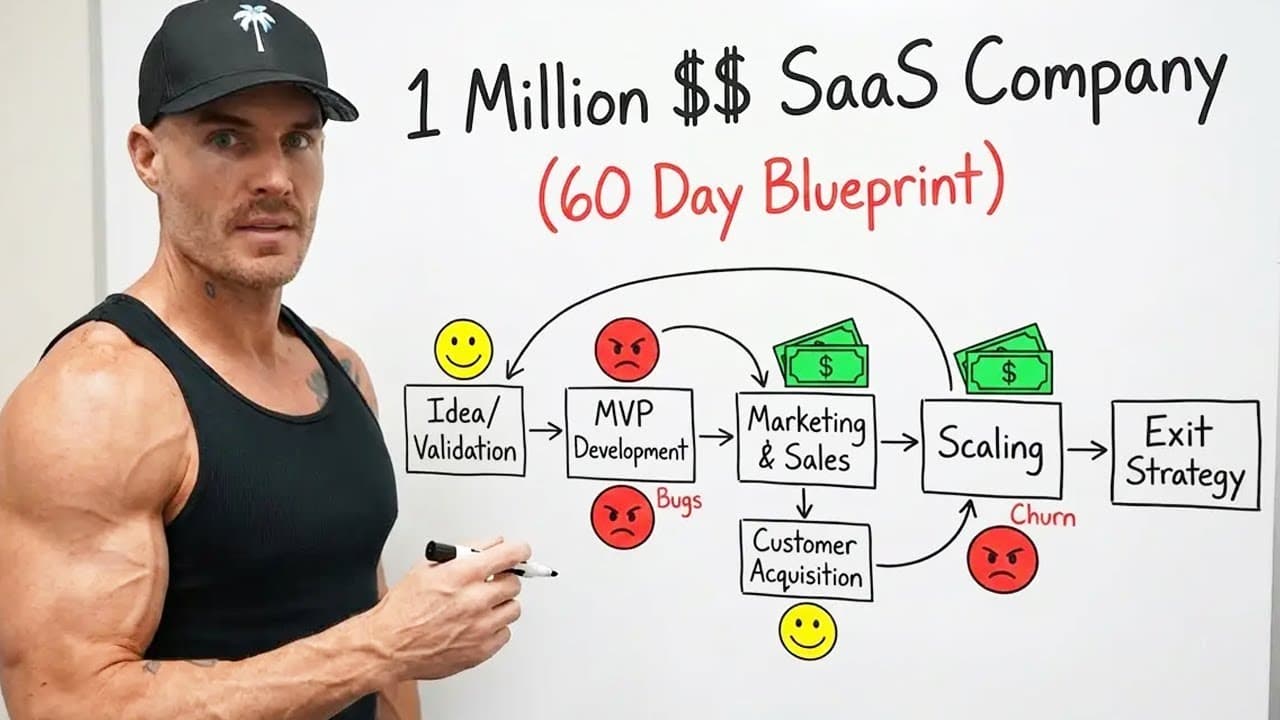
Start by finding a specific breakage inside a business, then build a small software product that fixes it and secure customers before making a large investment. Focus first on micro-apps capable of reaching $20,000 to $50,000 in monthly revenue, use recurring income to improve the product, and hire developers once revenue allows the founder to concentrate on broader CEO responsibilities.
Transcript
So, this is the most impactful thing I can teach you because it's made me hundreds of millions of dollars. This is also something that nobody wants to learn. It's probably going to be one of my lowest viewed videos. So, if you can make it to the end of this video, you're in the tippity top of the 1% who knows the most important thing I can possibly... Read More
Key Insights
- SaaS is presented as a long-term business model built around recurring customer payments. A customer paying $100 can continue paying for years when the product works and delivers its promised result, allowing revenue to accumulate instead of requiring the company to replace every sale each month.
- The recommended first product is a small application that fixes a clearly identified breakage inside a business. The founder argues that this research-driven approach removes the need to invent a large, original product and reduces the risk of building software that customers do not need.
- The initial target is a portfolio of small SaaS products rather than an immediate billion-dollar platform. The stated goal is to develop multiple applications capable of producing $20,000, $30,000, or $50,000 per month, improve through repetition, and identify which products can scale further.
- Coding knowledge is useful for producing early applications quickly, particularly when combined with vibe coding. However, the founder says a company leader should eventually hire developers because spending all available time programming prevents the CEO from handling the other work required to operate and grow the business.
- A SaaS company does not necessarily require substantial starting capital. The founder says he has launched multiple software businesses with small investments or through bootstrapping, and his proposed process seeks customer evidence before significant spending to improve the likelihood that the product will generate revenue.
- Recurring revenue creates a snowball effect when new subscriptions stack on existing subscriptions. At a price of $500 per month, four new customers represent $2,000 in added monthly revenue, and maintaining that acquisition pace for twelve months would produce $24,000 in monthly revenue.
- Lower market saturation can make a specialized SaaS product easier to sell than a crowded offer. The suggested objective is to become one of very few providers selling something businesses genuinely need, instead of competing against thousands of similar businesses for the same customers.
- Hyros is described as generating about $40 million in annual recurring revenue and growing roughly 40% to 50% per year. The founder expects revenue of approximately $50 million to $60 million by the end of 2026 and uses a five-to-six-times SaaS multiple to discuss valuation potential.
Install to Summarize YouTube Videos and Get Transcripts
Explore YouTube Video Summarizer or Get YouTube Transcript Extractor
Questions & Answers
Q: How do you find a profitable SaaS product idea?
Find a specific breakage inside an existing business and design a small software product that fixes it. The process should be based on researching real operational problems rather than trying to invent a large product from imagination. Customer evidence should come before substantial investment, helping confirm that businesses need the solution and are willing to become customers.
Q: Can you start a SaaS company without much money?
A SaaS company can be started with little money or through bootstrapping, according to the founder’s experience launching multiple software businesses. The proposed method begins with a small application and seeks customer validation before major spending. Investment and risk still exist, but a founder does not necessarily need a large development budget or a full team at the beginning.
Q: Do you need to know how to code to start SaaS?
You do not need to personally code the final software product, although learning to code is described as highly valuable. Basic coding knowledge and vibe coding can help a founder build early micro-apps quickly. After the business starts generating revenue, the recommended move is to hire developers and reserve the founder’s time for the wider responsibilities required of a CEO.
Q: What type of SaaS product should a beginner build first?
A beginner should start with a small micro-app rather than attempting to build a platform comparable to Salesforce, Hyros, Gamma, or Slack. The immediate objective is to solve a narrow business problem and work toward monthly revenue of $20,000, $30,000, or $50,000. Building several smaller products also creates repeated opportunities to improve the founder’s software-business skills.
Q: Why does recurring revenue make SaaS attractive?
Recurring revenue allows each retained subscription to stack on top of subscriptions acquired previously. A customer can continue paying for years as long as the software works and delivers the promised result. This gives the business income it can count on for continued product improvement and reduces the need to recreate every dollar of revenue through entirely new monthly sales.
Q: How can four SaaS customers per month create $24,000 in monthly revenue?
If the software costs $500 per month, four new customers add $2,000 in monthly recurring revenue. Repeating that acquisition result each month for twelve months creates $24,000 in monthly subscriptions because earlier customers continue paying while later customers are added. The example assumes customers remain subscribed and the product continues providing the result it promises.
Q: Why should a SaaS founder eventually hire developers?
A founder should hire developers once the company generates enough money because personally coding everything consumes time needed for other company responsibilities. The founder’s role as CEO includes work beyond software development, such as finding customers, retaining them, improving the offer, and scaling the company. Early revenue can fund a development team while the founder concentrates on those broader demands.
Q: How does competition affect the choice of a SaaS market?
The suggested strategy is to choose a specialized market where few companies sell a solution that businesses genuinely need. The founder contrasts this with crowded models such as e-commerce, agencies, advertising services, and influencer businesses, where many sellers compete for the same customers. Lower saturation can reduce the skill threshold required to stand out and win meaningful revenue.
Summary & Key Takeaways
-
The proposed starting point is not a large platform comparable to Salesforce, Hyros, Gamma, or Slack. A beginner should identify a specific operational breakage within a business, create a small application that repairs it, and validate customer demand before committing substantial money to development or attempting to build a billion-dollar company.
-
Small SaaS products can be started with little money, according to the founder’s experience bootstrapping several companies. Basic coding and vibe coding can accelerate early micro-app development, but the longer-term plan is to use initial revenue to hire developers so the founder can address the company’s wider responsibilities as CEO.
-
Recurring subscriptions allow revenue to accumulate as customers continue paying while the product delivers its promised result. At $500 per month, four new customers add $2,000 in monthly recurring revenue. Repeating that pace for a year produces $24,000 in monthly revenue before accounting for customer losses or other business changes.
Read in Other Languages (beta)
Share This Summary 📚
Summarize YouTube Videos and Get Video Transcripts with 1-Click
Try YouTube Summary with ChatGPT & Claude or YouTube Transcript Generator
Explore More Summaries from Alex Becker Business 📚
Summarize YouTube Videos and Get Video Transcripts with 1-Click
Try YouTube Summary with ChatGPT & Claude or YouTube Transcript Generator