How to Execute One Shot One Kill Trade Setup
TL;DR
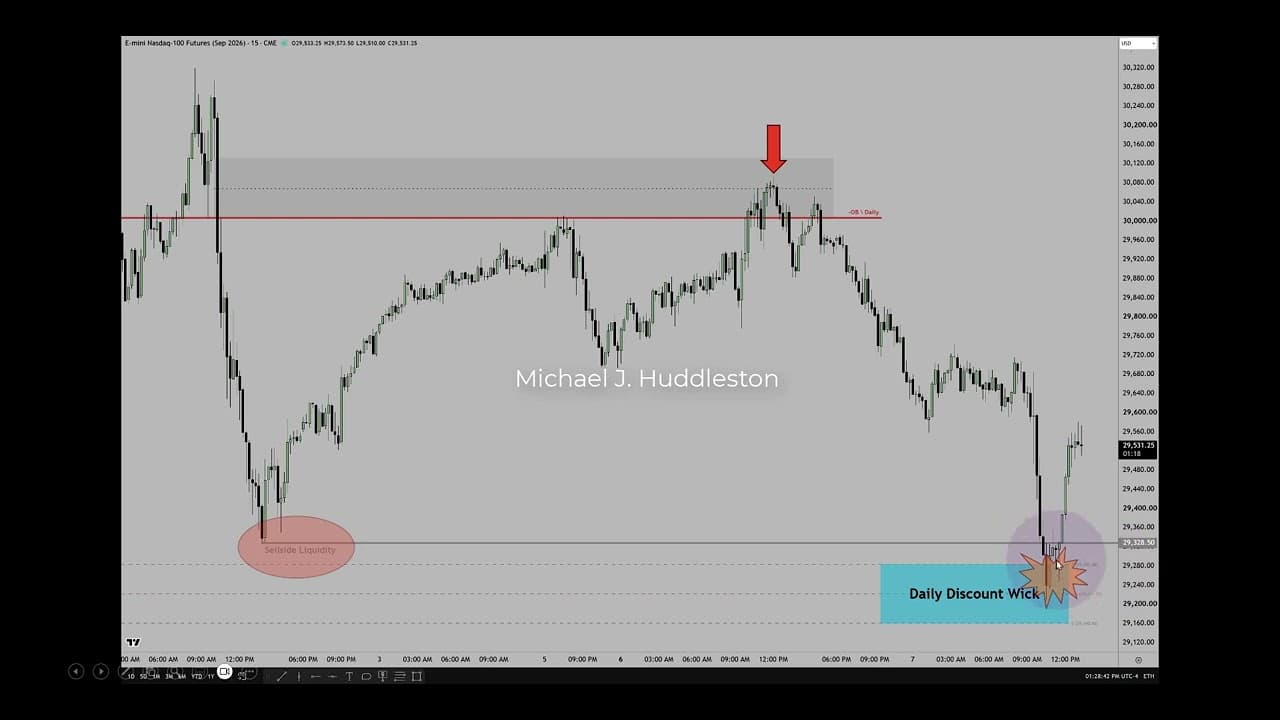
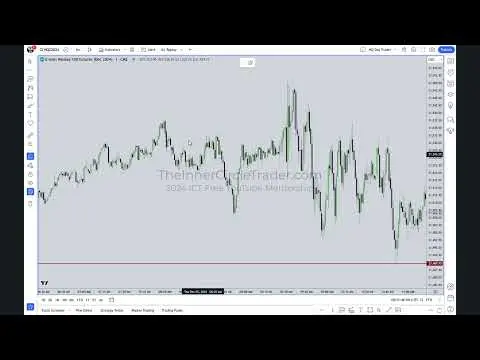
Execute the One Shot One Kill Trade Setup by using the NASDAQ daily chart to establish an order-block boundary and discount-wick levels, then move to the 15-minute chart to frame an intraday move. In the reviewed setup, price reached the 29,221.75 consequent-encroachment level before moving into the daily discount wick. Read on for the exact chart sequence, confirmation rules, and liquidity targets used in the review.
Transcript
All right, folks. So, we're going to be looking at the NASDAQ here. Uh, I did the PowerPoint perspective today because it helps me stay very focused. Helps me get through it succinctly and it avoid all the little potential rabbit trails I can go down. I don't have much time today and I'm going to be doing this earlier than I was expecting to. my wi... Read More
Key Insights
- The NASDAQ daily chart is crucial for identifying key trading levels.
- Order blocks and discount wicks are essential reference points.
- The 15-minute time frame is a strong tool for intraday trading.
- Consequent encroachment is a key concept for framing trades.
- A one shot one kill setup aims for a precise, high-probability trade.
- Smart money concepts involve understanding liquidity and market structure.
- Fair value gaps indicate potential price inefficiencies to exploit.
- The strategy emphasizes precision and patience in trade execution.
Install to Summarize YouTube Videos and Get Transcripts
Explore YouTube Video Summarizer or Get YouTube Transcript Extractor
Questions & Answers
Q: How do you execute the One Shot One Kill Trade Setup?
Start with the NASDAQ daily chart and mark the opening price of the last up-close candle as the order-block reference, then use the discount wick to frame the lower boundary. Move to the 15-minute chart and watch how price reacts around those daily levels, the gap’s consequent encroachment, and nearby buy-side or sell-side liquidity. In the reviewed setup, the expected sequence was a move toward the gap’s consequent encroachment followed by a rollover toward sell-side liquidity and the daily discount wick.
Q: Why does the setup begin with the NASDAQ daily chart?
The daily chart supplies the higher-time-frame boundaries used to evaluate intraday price action. In this review, the key references were a discount wick and the opening price of the last up-close candle, which represented the order block and change in the state of delivery. These levels acted as qualifiers that increased confidence in setups below the one-hour and daily time frames.
Q: How is the 15-minute chart used in this trade setup?
The 15-minute chart is described as a strong go-to, or bellwether, time frame for intraday and short-term trading. It can frame day trades and scalps while helping the trader align with a move already underway on a higher time frame. In the review, the two daily-chart boundaries were carried directly onto the 15-minute chart.
Q: What was the consequent-encroachment level in the reviewed NASDAQ setup?
The consequent-encroachment level was measured at 29,221.75. Price traded down to that level and also breached the prior Thursday’s low; there had been no trading on Friday. That reaction occurred within the broader area anticipated for the move.
Q: How does a close below consequent encroachment change the framework?
While price remains above consequent encroachment, the upper half of the discount wick must be considered because price could reach it and turn bullish. Only after price closes below consequent encroachment does the framework shift to referencing the lower area and using only the lower half. This rule determines which portion of the daily wick remains relevant.
Q: How are buy-side and sell-side liquidity used in the setup?
On the 15-minute chart, an old high indicated buy-side liquidity resting above it. After the Monday 9:30 Eastern time open, price moved down, rallied through that buy-side liquidity, and entered a gap. The anticipated next phase was movement toward the gap’s consequent encroachment, followed by a rollover toward sell-side liquidity.
Q: How is the order block selected in this review?
The order block was tied to the opening price of the last up-close candle, where the change in the state of delivery was identified. Although another candle had a larger body, it was not used because price had not traded below it and remained inside the existing range. The speaker explicitly distinguishes this order-block theory from supply-and-demand analysis.
Q: Why is the setup called One Shot One Kill?
The approach focuses on waiting for a single short-term setup framed by higher-time-frame levels rather than continually seeking another trade. After the reviewed move reached the daily discount wick, the speaker said his trading was finished for the week and that he would spend the rest of it giving lectures. The example emphasizes selectivity and patience around a specifically anticipated price run.
Summary & Key Takeaways
-
The video focuses on a NASDAQ trading strategy using daily and 15-minute charts to identify key levels such as order blocks and fair value gaps. The approach is to execute high-probability trades with precision, using concepts like consequent encroachment and smart money techniques.
-
Emphasizing the importance of understanding market structure, the strategy involves looking for one shot one kill setups, which are trades that aim for a precise, high-probability outcome. The video also discusses the importance of liquidity and how to identify potential price inefficiencies.
-
The trading strategy is designed to be executed with patience and precision, using key insights from daily and intraday charts. By understanding the underlying market mechanics, traders can aim for consistent profitability while minimizing risk.
Read in Other Languages (beta)
Share This Summary 📚
Summarize YouTube Videos and Get Video Transcripts with 1-Click
Try YouTube Summary with ChatGPT & Claude or YouTube Transcript Generator
Explore More Summaries from The Inner Circle Trader 📚


Summarize YouTube Videos and Get Video Transcripts with 1-Click
Try YouTube Summary with ChatGPT & Claude or YouTube Transcript Generator