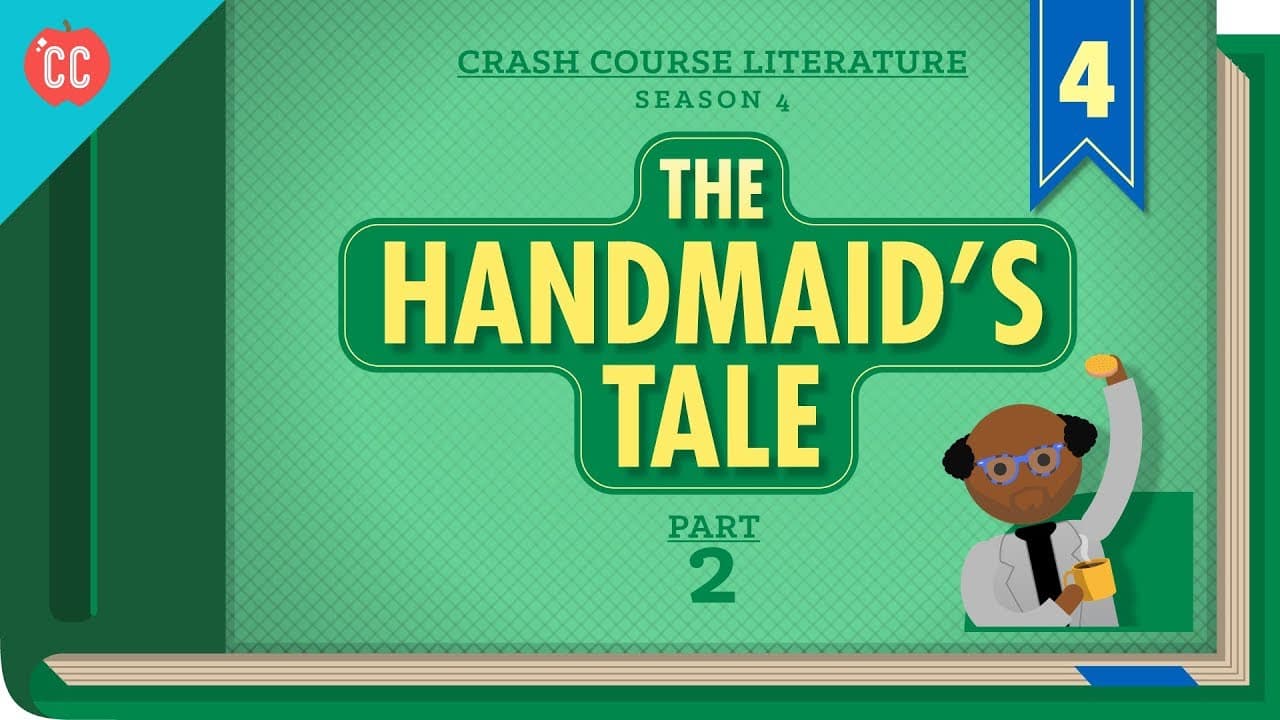
The Handmaid's Tale, Part 2: Crash Course Literature 404
TL;DR
Explores narrative perspectives in The Handmaid's Tale.
Transcript
I’m John Green and this is Crash Course Literature. So some of you might be familiar with Margaret Atwood’s The Handmaid’s Tale from the Hulu series starring Elisabeth Moss, which is a great show. It’s especially enjoyable if your favorite emotional experiences are fear, loathing, and waking nightmares. But the book is even better. Now, that’s not ... Read More
Key Insights
- The Handmaid's Tale is set in a dystopian society where women's reproductive rights are controlled by the state, highlighting themes of oppression and autonomy.
- Margaret Atwood's novel is presented from a female perspective, raising questions about the relationship between gender and narrative structure.
- The concept of écriture féminine, or 'women's writing,' is explored through Offred's bodily experiences and storytelling, emphasizing openness and difference.
- Offred's narrative is structured by male scholars, complicating the notion of a purely female perspective in the text.
- The novel's plot mirrors a classic 'male' trajectory, but questions arise about how narrative structure is influenced by gender and who controls the story.
- The 'Historical Notes' section reveals a future where misogyny persists, suggesting that societal change is complex and ongoing.
- Professor Piexoto's lecture reflects continued patriarchal attitudes, critiquing Offred's narrative for lacking a traditional historical perspective.
- The novel warns against complacency in the fight for equal rights, emphasizing that freedoms should not be taken for granted.
Install to Summarize YouTube Videos and Get Transcripts
Explore YouTube Video Summarizer or Get YouTube Transcript Extractor
Questions & Answers
Q: What is the setting of The Handmaid's Tale?
The Handmaid's Tale is set in the Republic of Gilead, a dystopian society where fertile women, known as Handmaids, are forced to bear children for the ruling class. The society is characterized by strict control over women's reproductive rights and a rigid class system, reflecting themes of oppression and autonomy.
Q: How does Margaret Atwood explore the concept of a female perspective in her novel?
Margaret Atwood explores the female perspective in The Handmaid's Tale by presenting the narrative through Offred, a Handmaid. The novel delves into the relationship between gender and narrative structure, questioning whether there is an inherently male or female way to tell a story. Atwood uses Offred's bodily experiences and storytelling as a means of exploring écriture féminine, or 'women's writing,' which emphasizes openness and difference.
Q: What role do male scholars play in Offred's narrative?
In The Handmaid's Tale, male scholars play a significant role in shaping Offred's narrative. The story is recorded on cassette tapes by Offred and later arranged into a coherent text by male scholars. This raises questions about the ownership of narrative and the influence of gender on storytelling, as the structure of Offred's story is determined by those outside her perspective.
Q: How does the novel's plot structure relate to gender?
The plot structure of The Handmaid's Tale mirrors a classic 'male' trajectory, characterized by arousal, expectation, and climactic release. However, the novel challenges simplistic gendered approaches to narrative by raising questions about how narrative structure is influenced by gender and who controls the story. The complexity of narrative choices defies easy categorization based on gender alone.
Q: What is the significance of the 'Historical Notes' section?
The 'Historical Notes' section at the end of The Handmaid's Tale reveals a future where misogyny persists, suggesting that societal change is complex and ongoing. It presents a lecture by Professor Piexoto, who critiques Offred's narrative for lacking a traditional historical perspective. This section highlights continued patriarchal attitudes and serves as a reminder that the struggle for gender equality is far from over.
Q: How does the novel warn against complacency in the fight for equal rights?
The Handmaid's Tale serves as a cautionary tale, warning against complacency in the fight for equal rights. It illustrates how freedoms can be eroded and emphasizes that the battles for equal opportunity and protection under the law are never fully won. The novel urges readers to remain vigilant and not take their freedoms for granted, as echoed in Offred's mother's warning.
Q: What is écriture féminine and how is it reflected in the novel?
Écriture féminine, or 'women's writing,' is a concept explored in The Handmaid's Tale through Offred's narrative. It emphasizes openness and difference, encouraging exploration of desires and perspectives outside traditional gender norms. Offred's bodily experiences and storytelling reflect this concept, as she finds ways to express her existence and autonomy despite the oppressive society she inhabits.
Q: How does Professor Piexoto's lecture reflect continued patriarchal attitudes?
Professor Piexoto's lecture in the 'Historical Notes' section reflects continued patriarchal attitudes, as he critiques Offred's narrative for not aligning with traditional historical perspectives focused on great men and empire-building. His objectification of female colleagues and dismissal of Offred's storytelling highlight the persistence of misogyny and the challenges of dismantling patriarchal structures, even in a future society.
Summary & Key Takeaways
-
John Green analyzes The Handmaid's Tale, focusing on its narrative perspective and the implications of telling a story from a female viewpoint. He examines how gender influences narrative structure and the concept of 'women's writing.'
-
Offred's story is shaped by male scholars, raising questions about the ownership of narrative and the intersection of gender and storytelling. The novel's plot mirrors a classic male trajectory, but challenges simplistic gendered approaches.
-
The 'Historical Notes' section reveals a future where misogyny persists, highlighting the ongoing struggle for gender equality. The novel serves as a cautionary tale, urging readers not to take their freedoms for granted.
Read in Other Languages (beta)
Share This Summary 📚
Summarize YouTube Videos and Get Video Transcripts with 1-Click
Try YouTube Summary with ChatGPT & Claude or YouTube Transcript Generator
Explore More Summaries from CrashCourse 📚


Summarize YouTube Videos and Get Video Transcripts with 1-Click
Try YouTube Summary with ChatGPT & Claude or YouTube Transcript Generator