How Does Tokenization Work in Large Language Models?
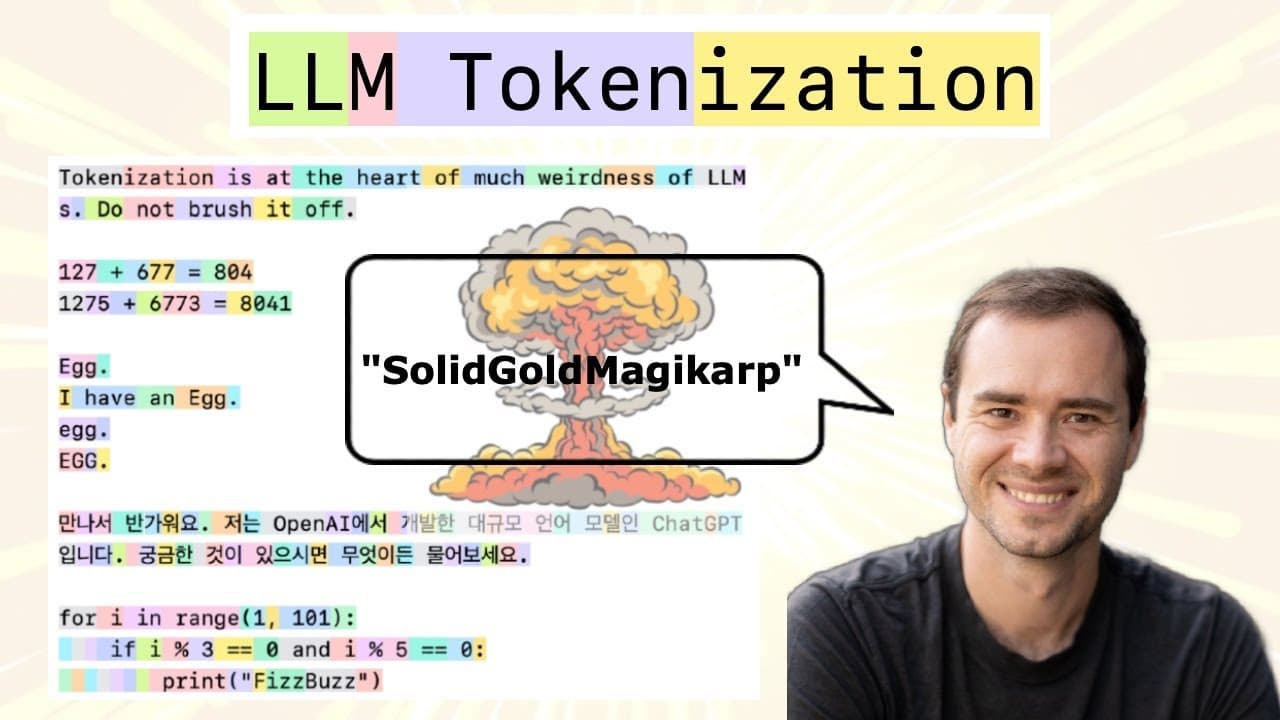
TL;DR
Tokenization converts text into sequences of tokens, which are essential for large language models like GPT-2. The Byte Pair Encoding (BPE) algorithm merges frequent token pairs to create a more efficient vocabulary, addressing challenges posed by multiple languages and special characters that can affect performance.
Transcript
hi everyone so in this video I'd like us to cover the process of tokenization in large language models now you see here that I have a set face and that's because uh tokenization is my least favorite part of working with large language models but unfortunately it is necessary to understand in some detail because it it is fairly hairy gnarly and ther... Read More
Key Insights
- ❓ Tokenization is a crucial step in language models that involves converting text into tokens, enabling analysis or generation tasks.
- 🌥️ The Byte Pair Encoding (BPE) algorithm is commonly used for tokenization in large language models like GPT-2.
- ❓ Tokenization can be challenging due to multiple languages, special characters, and its impact on language model performance.
Install to Summarize YouTube Videos and Get Transcripts
Explore YouTube Video Summarizer or Get YouTube Transcript Extractor
Questions & Answers
Q: What is tokenization?
Tokenization is the process of converting text into smaller units called tokens, which are used as the input for large language models.
Q: Why is tokenization important?
Tokenization allows language models to process and understand text by breaking it down into manageable units. It is a necessary step in preparing text for analysis or generation tasks.
Q: What is the Byte Pair Encoding (BPE) algorithm?
BPE is an algorithm used for tokenization in language models. It finds frequent pairs of tokens in a corpus and merges them into new tokens to compress the text sequence.
Q: What are some challenges with tokenization?
Tokenization can be challenging due to issues such as handling multiple languages, special characters, and the impact on the performance of language models. It requires careful consideration of the vocabulary and merging rules.
Q: How does tokenization affect the performance of language models?
The quality of tokenization can impact the performance of language models. Poor tokenization can lead to issues like difficulties in spelling tasks, challenges with non-English languages, and problems with simple arithmetic.
Q: What are some common techniques used in tokenization?
Besides BPE, other techniques include character-level tokenization, chunk-level tokenization, and the use of embedding tables and transformers in large language models.
Q: Can tokenization be language-specific?
Yes, tokenization methods can be language-specific as different languages may have unique requirements or structures. Some tokenizers may be designed specifically for certain languages or language families.
Q: What is the relationship between tokenization and the vocabulary size?
Tokenization affects the vocabulary size of a language model. The choice of vocabulary size depends on factors like the type of language model, the complexity of the text data, and the desired level of granularity in token representation.
Summary & Key Takeaways
-
Tokenization is the process of converting text into sequences of tokens, which are smaller units of text used in language models.
-
Large language models, like GPT-2, use more complicated schemes for tokenization compared to naive approaches.
-
The Byte Pair Encoding (BPE) algorithm is commonly used for tokenization, where frequent pairs of tokens are merged into new tokens to compress the text sequence.
-
Tokenization can be challenging due to issues such as handling multiple languages, special characters, and the potential impact on the performance of language models.
Read in Other Languages (beta)
Share This Summary 📚
Summarize YouTube Videos and Get Video Transcripts with 1-Click
Try YouTube Summary with ChatGPT & Claude or YouTube Transcript Generator
Explore More Summaries from Andrej Karpathy 📚

Summarize YouTube Videos and Get Video Transcripts with 1-Click
Try YouTube Summary with ChatGPT & Claude or YouTube Transcript Generator