How to Compress a Decade of Progress Into One Year
TL;DR
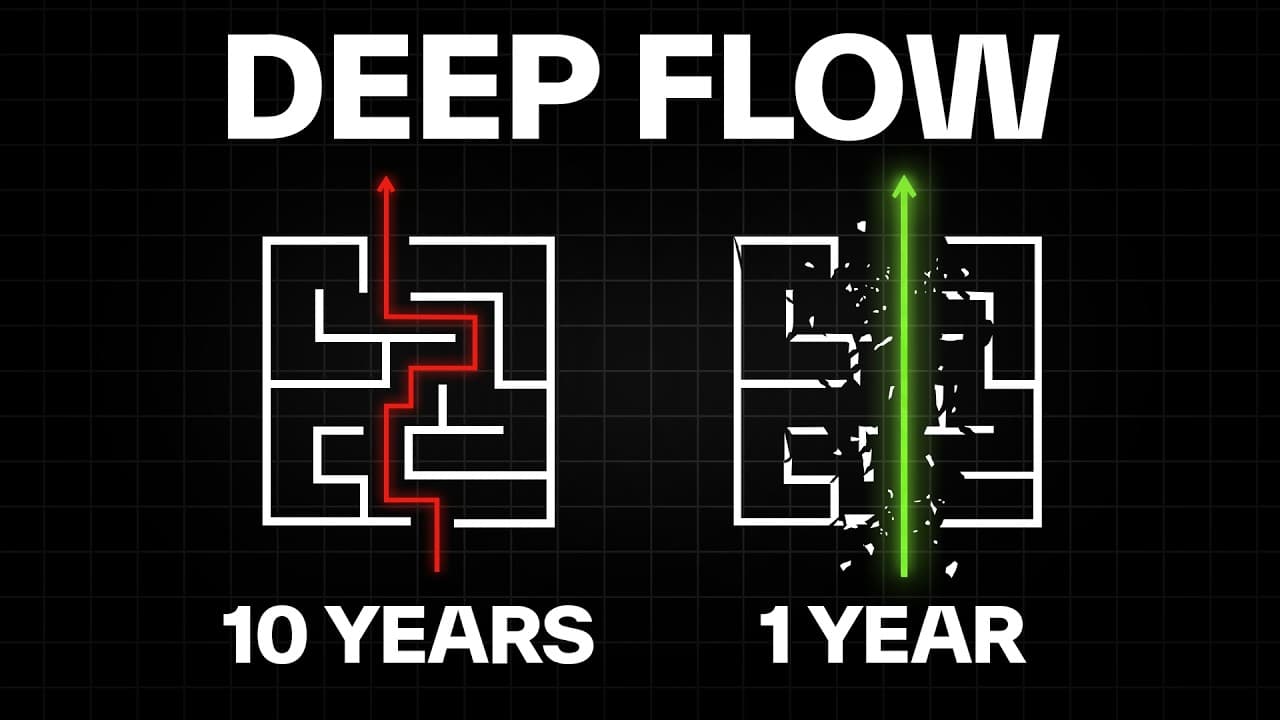
Concentrate on one measurable, life-changing goal for a bounded 12-month period when an unusual opportunity matches your ability to capitalize on it. Create three personally relevant performance commitments, establish fixed start and finish dates, protect focused work, and replace fragmented family time with concentrated presence. The approach is designed as a temporary sprint, not a permanent lifestyle.
Transcript
Quite a while ago, thankfully, I was sleeping on the couch in my grandmother's house in Dublin. Steven Kotler, leading expert in the world on flow state. He called me and we had our final discussion about whether to pursue the vision that we'd mapped out, which was to synthesize all the neuroscience literature on flow state, turn it into a methodol... Read More
Key Insights
- Professional productivity is unevenly distributed across a career, with much of a person's consequential output potentially occurring during three or four concentrated periods. Richard Koch calls these periods accomplishment islands, while complexity science and systems theory describe the broader pattern of compressed output as burstiness.
- An accomplishment island exists when an external opportunity coincides with the capacity to capitalize on it. Market changes, emerging demand, financial runway, expertise, and favorable positioning can collectively indicate that a rare window for unusually consequential work has opened.
- Incrementally increasing effort is insufficient when the available opportunity could permanently change a life or career. The intensity of the response must match the significance of the opportunity, which may require intentionally restructuring routines, priorities, environment, and commitments for a limited period.
- A one-year decade is a bounded protocol for compressing approximately a decade of progress into 12 months. It aims to create the conditions for a burst of output and reach a new performance level, rather than establish an extreme routine that must continue indefinitely.
- The first requirement is one narrowly focused and objectively measurable massive goal. Concentrating on a single outcome protects cognitive resources, while documenting how success would affect the rest of one's life supplies motivation and helps justify the sacrifices required during the intense year.
- Three extreme guidelines serve as forcing functions for peak performance when they are based on the individual's known performance patterns. The examples given are moving into solitude, maintaining complete sobriety without caffeine, and waking at 4:30 a.m. every day.
- Fixed start and finish dates create urgency and clarify that the demanding routine is temporary. Choosing a specific Monday and an endpoint exactly 12 months later frames the effort as a sprint toward a new altitude, which the speaker says helps reduce burnout risk.
- Concentrated family presence can replace scattered, distracted interaction during an intensive work period. Completing focused work before children wake, working while they attend school, removing devices during family breaks, and eliminating low-value evening activities can protect both performance and relationships.
Install to Summarize YouTube Videos and Get Transcripts
Explore YouTube Video Summarizer or Get YouTube Transcript Extractor
Questions & Answers
Q: What is an accomplishment island in a career?
An accomplishment island is a brief period of exceptionally consequential productivity within a career. Richard Koch's study of achievement patterns is presented as showing that professional output does not accumulate evenly across a lifetime. Instead, much of what matters may emerge during three or four concentrated bursts separated by longer stretches of more typical output. Complexity science and systems theory call this uneven production pattern burstiness.
Q: How can you recognize an accomplishment island?
An accomplishment island becomes likely when two conditions appear together: an unusual external opportunity and a genuine capacity to exploit it. The opportunity might involve a market shift or newly emerging demand. Capacity can include financial runway, relevant expertise, and strong positioning. A person may be facing such a window when those conditions create a chance to act decisively in a way that was not previously possible and may not remain possible.
Q: What is a one-year decade?
A one-year decade is a protocol intended to compress roughly a decade of progress into a single 12-month period. It is used to seize an accomplishment island by temporarily creating unusually intense and optimized working conditions. The objective is not merely to complete more tasks. It is to reach what the speaker calls the peak performance plane and secure an advancement that continues influencing work, skills, relationships, and opportunities after the year ends.
Q: How should you choose a goal for a one-year decade?
Choose one massive, narrowly focused outcome that would be exceptionally ambitious to achieve within 12 months. The goal must also be specific enough that success or failure will be clear at the end of the period. Write down both the outcome and what achieving it would change across the rest of your life. That long-term meaning can sustain commitment when the work becomes difficult and justify an unusually intense year.
Q: Why should a one-year decade focus on only one major goal?
A one-year decade focuses on one major goal because multiple objectives fragment cognitive resources and reduce the intensity available for any single outcome. The framework assumes that peak-level focus can be sustained on only one major objective at a time. Narrowing the target also makes daily priorities clearer, allows progress to be measured against one finish line, and supports the prolonged concentration required for an unusually consequential burst of work.
Q: How do extreme guidelines improve performance during the year?
Extreme guidelines act as forcing functions that create conditions for a fundamentally different level of performance. They should be personally relevant rather than arbitrary, based on patterns the individual knows support focused work. The speaker's commitments include living in solitude in Costa Rica, taking only one pre-planned trip, remaining completely sober without caffeine, and waking at 4:30 a.m. daily. Each commitment is tied to routine stability, reward sensitivity, or easier flow entry.
Q: Why does a one-year decade need fixed start and finish dates?
Exact start and finish dates establish urgency and tell the brain that the extreme effort is temporary. The framework recommends selecting a specific Monday that matches the opportunity and setting the endpoint exactly 12 months later. This boundary frames the year as a sprint to a higher level rather than a permanent lifestyle. Knowing that the intensity will end is presented as essential for sustaining the required effort without treating the routine as indefinitely livable.
Q: How can parents balance family life with a one-year decade?
Parents can protect family relationships by concentrating both work and presence instead of scattering distracted attention throughout the day. The speaker suggests completing a morning flow block before children wake, working intensely while they are at school, and making breaks or evenings fully present and device-free. Low-value activities such as scrolling or half-watching television can be removed. However, a child's first year, difficult transition, or health situation may make the timing inappropriate.
Summary & Key Takeaways
-
Professional achievement can occur in concentrated bursts called accomplishment islands rather than accumulating evenly throughout a career. Such a period becomes possible when an external opportunity, such as new demand or a market shift, coincides with sufficient capacity, including financial runway, expertise, and favorable positioning, to pursue it aggressively.
-
A one-year decade is a protocol for using an accomplishment island to pursue roughly a decade of progress within 12 months. It requires one narrowly focused, measurable goal whose long-term importance can justify an unusually intense year. Multiple major objectives are discouraged because they divide cognitive resources and weaken sustained focus.
-
Execution begins with three dramatic, personally predictive performance commitments and exact start and finish dates. The daily structure should prioritize work during naturally focused hours, stable routines, and repeatable high-output conditions. Parents can reduce fragmentation by concentrating work and offering children shorter periods of complete, device-free presence.
Read in Other Languages (beta)
Share This Summary 📚
Summarize YouTube Videos and Get Video Transcripts with 1-Click
Try YouTube Summary with ChatGPT & Claude or YouTube Transcript Generator
Explore More Summaries from Rian Doris 📚

Summarize YouTube Videos and Get Video Transcripts with 1-Click
Try YouTube Summary with ChatGPT & Claude or YouTube Transcript Generator