How to Get Productive Faster With MECLABS AI
TL;DR
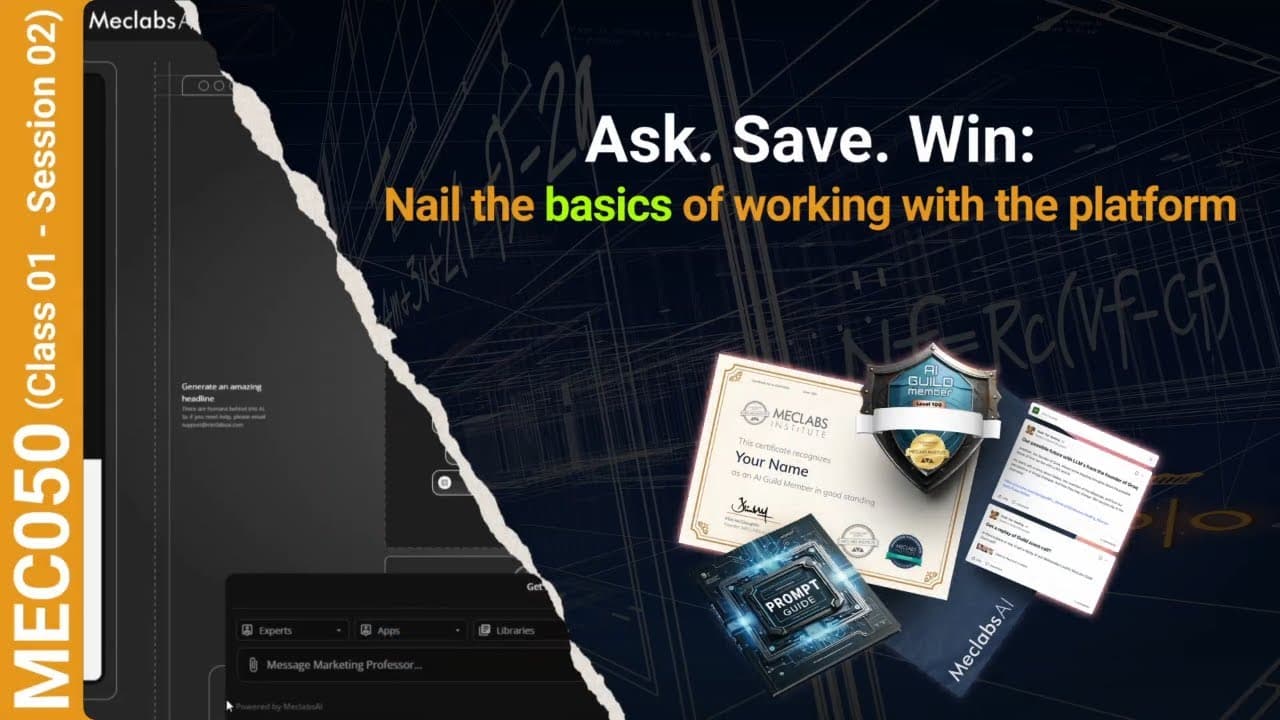
Treat MECLABS AI as a group of people to get to know, then speak naturally and use follow-up questions to shape the help you receive. When stuck, ask AI Mentor which expert or question to use, request explanations at a specific grade level, add a familiar metaphor, and save or share useful results as part of mastering the platform basics.
Transcript
I'm going to meab right now I'm going to ask you a question as I ask the question I'm going to start the timer this question is for everyone in the group I'd like you to paste your answer in chat okay all right now this is not as simple as it sounds we're going to use this to power what comes next and soon I'll show you how this exercise connects w... Read More
Key Insights
- MECLABS AI is presented as a group of specialists to get to know, rather than conventional software to memorize. Thinking of each expert as a person encourages natural conversation, clearer requests, and continued interaction when the first response does not fully solve the problem.
- AI Mentor is the recommended starting point when a user does not know which expert to consult. It can identify an appropriate specialist, such as the Data Scientist for multivariable testing, and help users determine what question they should ask next.
- Natural speech is a practical way to communicate complex requests to MECLABS AI. The instructor dictates a request for conceptual explanations, mathematical detail, practical differences, future use guidance, and a 20-minute lesson without first translating the request into a formal prompt formula.
- Follow-up questions are essential when an answer is unclear or too difficult. A user can identify the specific obstacle, such as challenging mathematics, and immediately ask the same expert to explain it again using simpler language and a more accessible structure.
- A grade-level request is a direct method for controlling explanation complexity. Asking for a fourth-grade or sixth-grade explanation tells the expert to simplify its communication while preserving the main distinction the user is trying to understand.
- Metaphors connect unfamiliar ideas with something the learner already understands. The demonstration uses cookies and a kitchen experiment to make the distinction between A/B testing and multivariable testing easier to grasp after the mathematical explanation feels difficult.
- MECLABS AI works as a two-way source of information rather than a fixed book or one-way lesson. Users can question an answer, redirect the expert, request another format, and continue refining the exchange until the explanation becomes useful.
- Faster time to productivity depends on both mindset and platform basics. The session combines conversational habits with practical capabilities, including navigation, saving, sharing, and starring, so participants can preserve useful work and operate the platform more effectively.
Install to Summarize YouTube Videos and Get Transcripts
Explore YouTube Video Summarizer or Get YouTube Transcript Extractor
Questions & Answers
Q: How do you get started when you do not know which MECLABS AI expert to ask?
Start with AI Mentor and explain what you are trying to understand or accomplish. Ask it who you should talk to, rather than guessing among the available experts. In the session, AI Mentor identifies the Data Scientist as the appropriate resource for deeper knowledge about multivariable testing. The user can then open that specialist and continue the conversation with a more detailed request.
Q: How should you communicate with MECLABS AI for better results?
Communicate naturally, as if you were speaking with a knowledgeable person supported by a specialist team. State what you understand, what remains unclear, and what kind of response would help. The instructor asks for differences between A/B and multivariable testing, the mathematics, a 20-minute lesson, and guidance about future use in one spoken request, without relying on a memorized formula.
Q: How can MECLABS AI create a structured lesson from a question?
Describe both the subject and the learning outcome you want. The instructor asks the Data Scientist to explain A/B testing and multivariable testing, show the mathematics, distinguish the methods, and build a 20-minute lesson that supports deep understanding. The response is organized into conceptual overviews, mathematical foundations, application scenarios, introductions to each method, and their key differences.
Q: What should you do when an AI explanation is too difficult?
Ask a follow-up question that names the difficulty and specifies how the explanation should change. In the demonstration, the instructor says that the mathematics seems hard and requests an explanation at a fourth-grade level. This keeps the conversation moving and allows the expert to revise its communication instead of forcing the user to accept an answer that remains confusing.
Q: Why should you ask for a metaphor in an AI explanation?
A metaphor can connect an unfamiliar concept to something the learner already recognizes. The instructor combines a lower grade-level request with a request for a good metaphor, then receives an explanation based on making and testing cookies in a kitchen. This approach is presented as a way to simplify communication and connect new material with existing understanding.
Q: What does it mean to get to know MECLABS AI instead of learning it?
Getting to know MECLABS AI means treating its experts as conversational partners rather than treating the platform as software that requires memorized formulas. Users speak naturally, discover which specialist is useful, ask follow-up questions, and adjust the response when needed. This mindset encourages an ongoing relationship with the available experts and their supporting teams as real tasks and learning needs arise.
Q: How does MECLABS AI help users get unstuck?
MECLABS AI can help users identify both the right expert and the right next question. If a user does not know who to consult, AI Mentor can recommend a specialist. If a response is confusing, the user can ask that specialist to simplify it, explain it at a chosen grade level, use a metaphor, or answer again. The tool therefore participates in resolving the obstacle.
Q: Which platform basics support faster productivity in MECLABS AI?
The session identifies navigation, saving, sharing, and starring as foundational capabilities participants will practice together. These operational basics complement the conversational mindset of treating the experts like people, asking AI Mentor for direction, speaking naturally, and refining answers through follow-up questions. Together, the capabilities help users locate assistance, preserve useful work, distribute results, and return to important material more efficiently.
Summary & Key Takeaways
-
The session begins with a group exercise asking participants to use MECLABS AI to explain multivariable testing. When uncertainty appears, the instructor demonstrates the central workflow: ask AI Mentor which specialist can help, move to the recommended expert, and describe the desired lesson naturally instead of relying on rigid formulas.
-
The Data Scientist is asked to compare A/B testing with multivariable testing, show the mathematics, and organize the response as a 20-minute lesson. The resulting outline includes conceptual explanations, mathematical foundations, application scenarios, and key differences, showing how detailed instructions can turn a question into a structured learning experience.
-
The instructor frames MECLABS AI as a conversational tutor supported by a team of specialists. Users can ask follow-up questions, request simpler language, specify a grade level, and ask for metaphors. These habits support the broader goal of faster productivity while participants practice navigation, saving, sharing, and starring useful work.
Read in Other Languages (beta)
Share This Summary 📚
Summarize YouTube Videos and Get Video Transcripts with 1-Click
Try YouTube Summary with ChatGPT & Claude or YouTube Transcript Generator
Explore More Summaries from Flint McGlaughlin 📚
Summarize YouTube Videos and Get Video Transcripts with 1-Click
Try YouTube Summary with ChatGPT & Claude or YouTube Transcript Generator