How to turn AI gaps into a billion-dollar business
TL;DR
The key is to identify where AI still makes mistakes and connect buyers with experts who can correct those errors. Start with revenue from a current client by offering a service that fixes model outputs, then scale by hiring professionals to grade AI responses. The result is a repeatable, service-based path to a large company.
Transcript
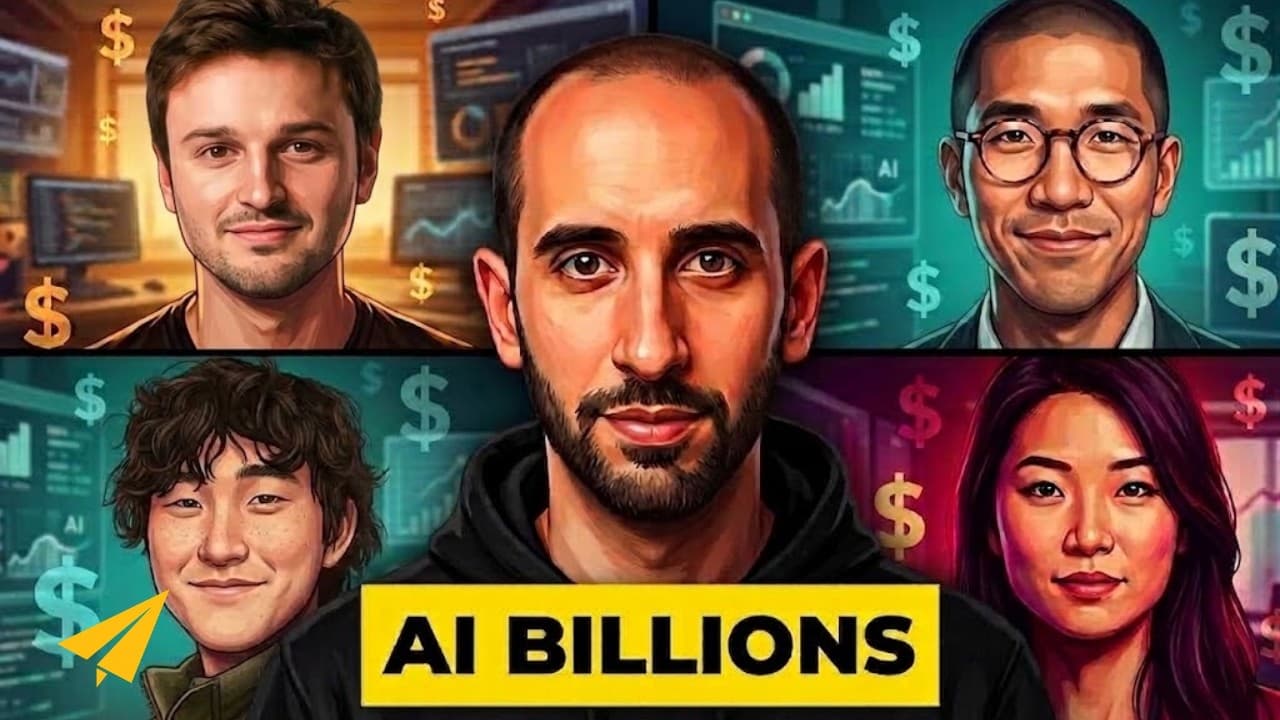
Three 22-year-olds became billionaires by paying doctors and lawyers to grade AI answers for OpenAI anthropic. The money is going to whoever spots what AI still gets wrong and sells the fix to the people building it. The Federal Reserve reported that AI adoption still at only 18% of American firms at the end of 2025. So more than eight out of every... Read More
Key Insights
- AI quality gaps drive new business opportunities by supplying human judgment where models fail
- A scalable model exists by hiring real doctors, lawyers, engineers to score AI outputs and guide improvements
- Early revenue from existing clients validates demand before heavy capital investment
- Non-technical, service-based solutions can outperform breakthrough algorithms in revenue impact
- A decisive move is targeting tasks that labs and clients struggle to outsource
- Hiring and coordinating a large contractor network enables rapid scale and price leverage
- The fastest path to billion-dollar status is solving a concrete buyer problem with predictable workflows
- Founders can replicate this model in other industries by identifying unaddressed but essential tasks
Install to Summarize YouTube Videos and Get Transcripts
Explore YouTube Video Summarizer or Get YouTube Transcript Extractor
Questions & Answers
Q: What is the core play behind turning AI gaps into value for clients?
The core play is to identify tasks where an AI model can produce outputs that are imperfect and then provide expert evaluation to correct those outputs. By coordinating doctors, lawyers, engineers, and other specialists to review AI results, a service is created that directly improves decision quality for clients. This approach leverages existing expertise rather than creating new technology and scales through a structured workflow that iterates on scoring guides for the next batch of outputs.
Q: How did the founders monetize early on according to the video?
They started from a recruiting model that connected skilled professionals with AI labs needing evaluation of AI outputs. By handling the process and payments across countries, they earned a fee from each engagement. This initial, boring-looking service proved there was demand for human judgment in AI workflows and laid a foundation for rapid growth without relying on a new algorithm.
Q: What does the video say about the scale of the contractor network?
The video notes that by October 2025 the company was managing about 30,000 contractors and paying out roughly $2 million a day. This scale demonstrates how a service-based model can transition from a small operation to a global, high-volume network that supports large enterprise customers like OpenAI and Anthropic.
Q: Who are the three founders and what is notable about their ages?
The founders are Brendan Foody, Admath, and Surya Midha. They are highlighted as being 22 years old when they became billionaires, making them among the youngest self-made billionaires on the list. Their story emphasizes that a non-technical, business-focused approach can achieve rapid wealth by solving practical problems.
Q: What makes the business model attractive to large AI labs and firms?
Labs and firms want reliable evaluation of AI outputs to ensure quality and safety. The service provides trained professionals to validate and score AI results, creating a scalable way to improve model reliability across domains like coding, medicine, and law. This reduces risk and increases trust in AI deployments, which laboratories value highly.
Q: What is the key strategic move that enabled fast growth, according to the transcript?
The key move was identifying a high-value task that AI labs could not efficiently do themselves and outsourcing it to a network of experts who can grade and guide AI outputs. This creates a repeatable, fee-based workflow where the company acts as the orchestrator, handling recruitment, payments, and workflow management for a diversified client base.
Q: How does the video suggest beginners can replicate the model in their industry?
The video suggests looking for a problem where buyers pay for a fix that improves AI decision quality and then offering to take on the workflow at a flat rate. By focusing on an essential task that many clients struggle with or dislike performing themselves, you can assemble a similar expert network and start generating revenue quickly.
Q: What role does customer acquisition play in the narrative of these companies?
Customer acquisition is central because they demonstrated revenue by selling services that solve immediate client pain points. By winning early clients who value improved AI accuracy, they funded growth and expanded to involve broader industries. The emphasis is on delivering measurable improvements and forging long-term relationships rather than chasing a single breakthrough.
Summary & Key Takeaways
-
The video analyzes how three young founders built a billion-dollar company by outsourcing expert judgment to correct AI outputs, highlighting the market need where AI models still err and firms will pay for fixes.
-
It emphasizes starting with a revenue-generating service for existing clients, then expanding by coordinating large teams of vetted professionals who guide model accuracy across domains.
-
It showcases multiple case studies of founders who capitalized on boring, high-demand tasks, turning them into scalable, high-value businesses.
Read in Other Languages (beta)
Share This Summary 📚
Summarize YouTube Videos and Get Video Transcripts with 1-Click
Try YouTube Summary with ChatGPT & Claude or YouTube Transcript Generator
Explore More Summaries from Evan Carmichael 📚



Summarize YouTube Videos and Get Video Transcripts with 1-Click
Try YouTube Summary with ChatGPT & Claude or YouTube Transcript Generator