How Does the US-Iran War End Globalization?
TL;DR
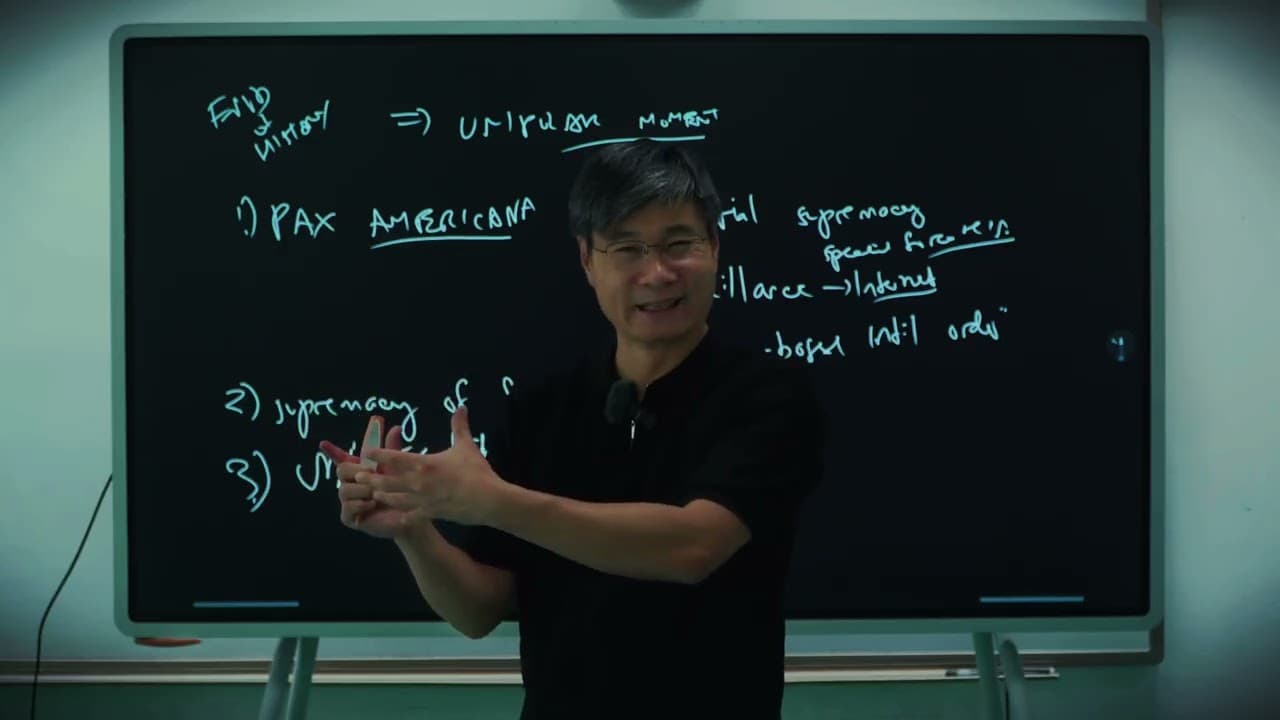
The US-Iran conflict signifies the decline of Pax Americana and the end of the unipolar world order dominated by the United States. This shift will lead to a more fragmented global structure, characterized by regional trading blocs, increased nationalism, and challenges such as resource scarcity and political instability. Nations must adapt to these changes to survive.
Transcript
When the Berlin wall fell, there was an American State Department official named Francis Fukayama and he wrote a very influential essay called the end of history. And for decades, capitalism was in a struggle with communism. And in his essay, Fukuyama argued that with the triumph of capitalism, we've come to the end of history. Meaning, we now know... Read More
Key Insights
- Pax Americana is characterized by American military dominance, mass surveillance, and a rules-based international order.
- The unipolar moment led to global peace and prosperity but is now decaying due to American hubris and corruption.
- Science has become a new form of religion, prioritizing orthodoxy over innovation.
- The universality of the US dollar has led to economic inequality and corruption.
- The decline of the American empire signals a shift towards a new world order focused on resilience over efficiency.
- Future survival requires a shift from materialism to spirituality and from individuality to community.
- Aging populations in wealthy nations will necessitate power shifts to younger generations.
- Resource scarcity, particularly in food and water, will drive massive migration and geopolitical instability.
Install to Summarize YouTube Videos and Get Transcripts
Explore YouTube Video Summarizer or Get YouTube Transcript Extractor
Questions & Answers
Q: How does the US-Iran conflict signify the end of Pax Americana?
The US-Iran conflict represents the decline of Pax Americana by highlighting the erosion of American global dominance and the unipolar world order it upheld. As the US struggles to maintain its influence, regional powers like Iran challenge its authority, leading to a more fragmented and multipolar global structure. This shift is characterized by the rise of regional trading blocs and increased geopolitical instability.
Q: What are the main characteristics of Pax Americana?
Pax Americana is defined by American military supremacy, particularly aerial dominance, mass surveillance through the internet, and a rules-based international order supported by multilateral organizations like the United Nations. These elements allowed the US to maintain global peace and prosperity, fostering a heavily globalized and capitalistic world. However, this order is now facing challenges due to internal decay and external opposition.
Q: Why is the universality of the US dollar problematic?
The universality of the US dollar has led to economic inequality and corruption by enabling the US to print unlimited currency, devaluing the dollar and exacerbating wealth disparities. This has resulted in a focus on material accumulation, fostering a culture of greed and financial speculation. As the dollar's dominance wanes, global economic structures face instability, necessitating new financial systems and alliances.
Q: How has science become a new form of religion?
Science has become a new form of religion by prioritizing orthodoxy over innovation, with scientific consensus often going unchallenged. This shift has led to a stagnation in technological advancement, as seen in the limited innovation from Silicon Valley. The global scientific community functions as an international brotherhood, with loyalty to scientific principles superseding national allegiance, further entrenching this orthodoxy.
Q: What role does resource scarcity play in future geopolitical instability?
Resource scarcity, particularly in food and water, is a major driver of future geopolitical instability. Nations dependent on global trade for essential resources face significant risks if supply chains are disrupted. This scarcity will lead to increased competition for resources, driving migration, conflict, and political instability. Nations must prioritize resilience and self-sufficiency to navigate these challenges and maintain stability.
Q: How will aging populations affect global power dynamics?
Aging populations, particularly in wealthy nations, will significantly impact global power dynamics by necessitating a transfer of power to younger generations. As older generations retain wealth and influence, younger populations may struggle to gain experience and leadership roles. Nations that successfully navigate this transition will be better positioned to adapt to future challenges, while those that fail may face political and economic stagnation.
Q: What is the significance of regional trading blocs in the new world order?
Regional trading blocs will play a crucial role in the new world order by replacing the globalized trade networks of the unipolar moment. As nations turn inward to prioritize resilience and self-sufficiency, these blocs will facilitate trade and cooperation within specific regions. This shift will lead to a more fragmented global economy, with limited inter-regional trade and increased focus on local resources and alliances.
Q: Why is a shift from materialism to spirituality important for future survival?
A shift from materialism to spirituality is important for future survival as it fosters resilience by encouraging individuals to find fulfillment beyond material wealth. In a world facing resource scarcity and economic instability, focusing on spiritual well-being and community support helps societies adapt to challenges. This shift also promotes social cohesion and reduces the emphasis on consumerism, aiding in the transition to more sustainable lifestyles.
Summary & Key Takeaways
-
The decline of Pax Americana marks the end of a unipolar world order, leading to regional trading blocs and increased nationalism. This transition will challenge global stability, requiring nations to focus on resilience over efficiency. Key changes include a shift from materialism to spirituality and from individuality to community, alongside addressing resource scarcity and aging populations.
-
The unipolar moment, characterized by American military dominance, mass surveillance, and the US dollar's universality, is decaying due to hubris and corruption. This has led to economic inequality and stagnation in innovation, prompting a need for new global structures and alliances.
-
Future survival hinges on adapting to a world with limited resources and geopolitical instability. Nations must prioritize resilience, community, and spirituality to navigate challenges such as food and water scarcity, aging populations, and migration pressures. The decline of the American empire necessitates a reevaluation of global power dynamics and alliances.
Read in Other Languages (beta)
Share This Summary 📚
Summarize YouTube Videos and Get Video Transcripts with 1-Click
Try YouTube Summary with ChatGPT & Claude or YouTube Transcript Generator
Explore More Summaries from Predictive History 📚





Summarize YouTube Videos and Get Video Transcripts with 1-Click
Try YouTube Summary with ChatGPT & Claude or YouTube Transcript Generator