How Will AI Reshape Business and Jobs in 2026?
TL;DR
AI capabilities are advancing so quickly that companies, knowledge workers, and established software platforms may face severe disruption in 2026. GPT 5.2 strengthens an increasingly close race among OpenAI, Google, Anthropic, and xAI, while reported comparisons suggest machines can already complete some knowledge work faster, more cheaply, and often better than humans.
Transcript
OpenAI releases GPT 5.2. The capabilities are just shockingly different than they were a few weeks prior. OpenAI has just unveiled GBT 5.2, which it's billing as its most advanced frontier model yet. The value that we see people getting from this technology and thus their willingness to pay makes us confident that we will be able to significantly r... Read More
Key Insights
- GPT 5.2 is presented as OpenAI's most advanced frontier model, with capabilities that the hosts describe as shockingly different from those available several weeks earlier. Their strongest evidence is practical experience completing coding and building tasks that they say were previously beyond reach.
- Frontier AI competition is becoming a closer horse race among OpenAI, Google, Anthropic, and xAI. The discussion says Google remains strong while OpenAI has responded with GPT 5.2, Google launched a deep research agent, and forthcoming Grok releases add further competitive pressure.
- Compute scarcity is described as a constraint on releasing and serving more capable models. The hosts suggest laboratories may hold back attractive capabilities when infrastructure cannot satisfy demand, while competitive pressure can force earlier releases despite usage limits, slower responses, and insufficient available capacity.
- Rapid model improvement can come from three proposed levers: allocating more compute, adjusting safety behavior, and applying targeted post-training. The discussion treats these mechanisms as plausible explanations for how OpenAI could release GPT 5.2 only a month after GPT 5.1.
- AI assistants are approaching platform scale, with ChatGPT described as nearing 900 million active users and almost a billion users. The hosts argue that this scale could let an AI interface absorb functions of operating systems and applications, potentially making more on-screen experiences AI-generated.
- Leading AI companies are pursuing differentiated strategies. OpenAI is described as seeking the default consumer subscription, Anthropic as concentrating on enterprise APIs and code generation, xAI as emphasizing brute-force scaling and benchmarks, and Google as pursuing broad domination across the technology stack.
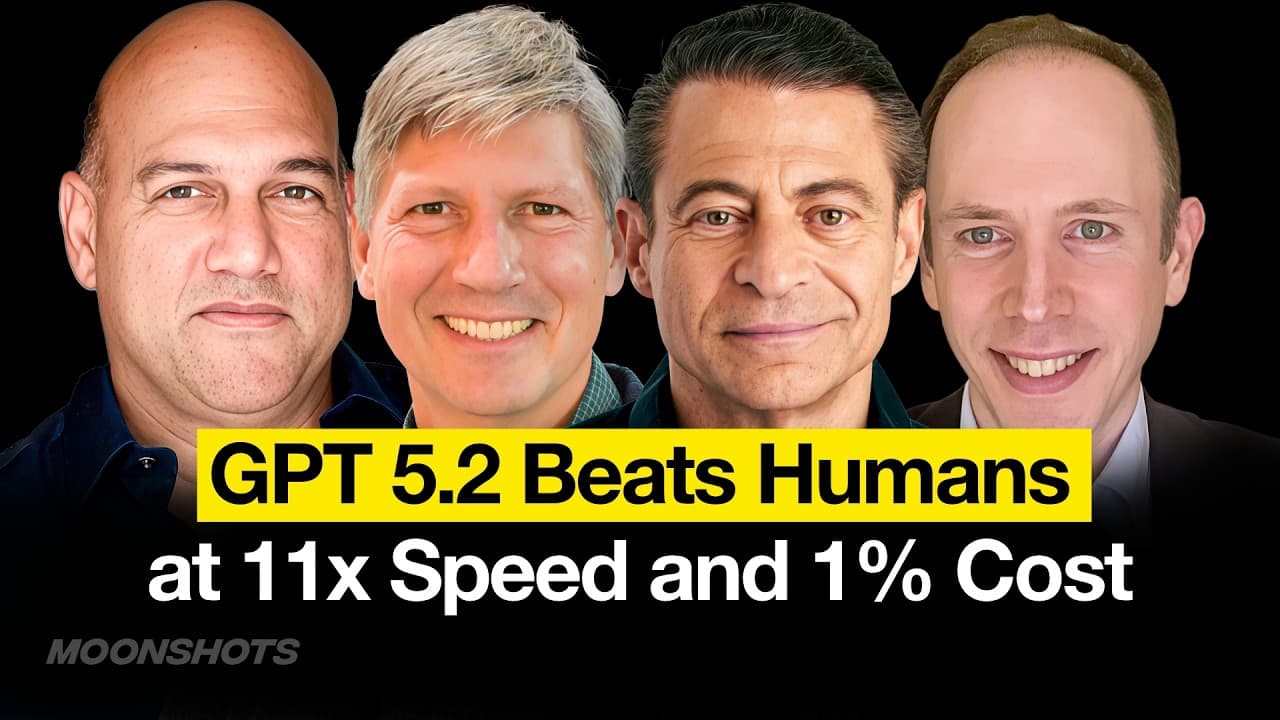
- Knowledge work faces acute economic pressure because the cited comparisons favored machines in 71% of cases. In those comparisons, machines reportedly performed the work at more than 11 times human speed and at less than 1% of the cost of a human professional.
- Corporate disruption could accelerate sharply in 2026, according to the episode's central prediction. The hosts connect that outlook to rapid AI progress and cite 1.1 million layoffs in 2025, described as the largest total since the 2020 pandemic, as evidence of existing workforce strain.
Install to Summarize YouTube Videos and Get Transcripts
Explore YouTube Video Summarizer or Get YouTube Transcript Extractor
Questions & Answers
Q: How could GPT 5.2 affect businesses and knowledge workers?
GPT 5.2 could accelerate automation by enabling companies to complete coding, building, and other knowledge tasks that recently required more human effort. The hosts say current capabilities are shockingly different from those available a few weeks earlier. They also cite comparisons in which machines produced better results 71% of the time, at more than 11 times human speed and below 1% of human professional cost.
Q: Why was GPT 5.2 released so soon after GPT 5.1?
The discussion attributes the rapid release to competitive pressure from other frontier laboratories, particularly Google, Anthropic, and xAI. GPT 5.1 had arrived only a month earlier, but OpenAI reportedly needed to respond to a closer market race. The hosts propose that OpenAI could move quickly by allocating more compute, modifying safety behavior, and using targeted post-training to improve selected capabilities and benchmarks.
Q: What limits the availability of advanced AI models?
Compute capacity is presented as a major limitation on model availability. More capable systems can require additional infrastructure and may produce longer response times, while heavy demand can exhaust daily capacity. The hosts suggest AI laboratories sometimes delay capabilities because they cannot reliably serve them at scale, but competitive pressure may force releases before enough data center compute is available for unrestricted access.
Q: How are OpenAI, Anthropic, xAI, and Google competing?
The four laboratories are described as following distinct strategies. OpenAI wants to become the default core subscription for consumers. Anthropic appears focused on enterprise APIs and code generation, with Accenture planning to train 30,000 people on Claude. xAI emphasizes brute-force scaling and benchmark performance, while Google takes a more balanced approach involving pre-training, post-training, and broad control of the technology stack.
Q: Could AI assistants replace operating systems and apps?
AI assistants could absorb many functions currently divided among operating systems and individual applications, according to the discussion. ChatGPT is described as nearing 900 million active users and almost a billion users, which gives an AI interface enormous reach. The hosts ask whether every pixel on a mobile device could eventually be AI-generated, while noting that established platform companies face pressure to adapt.
Q: Why does the episode predict corporate disruption in 2026?
The prediction rests on the speed of AI improvement and its potential cost advantage over human knowledge workers. The episode argues that people are failing to project how rapidly adoption could reach a tipping point. It forecasts the biggest collapse of the corporate world in business history during 2026 and links that risk to automation, changing software interfaces, competitive pressure, and workforce displacement.
Q: What evidence does the episode give for AI-driven job pressure?
The episode cites 1.1 million layoffs during 2025, calling that the highest figure since the 2020 pandemic. It also describes comparisons between humans and machines performing knowledge work. Machines reportedly delivered better work in 71% of those comparisons, operated at more than 11 times human speed, and cost less than 1% as much as a human professional, creating a strong automation incentive.
Q: How does de-extinction technology reconstruct extinct animals?
Colossal's approach is described as combining ancient DNA with the closest living relative of an extinct animal. Researchers identify genetic differences connected to phenotypes such as hair length, snout length, tusks, and cold tolerance, then construct an approximation rather than recovering one unchanged historical organism. The discussion says available mammoth DNA ranges from roughly 10,000 years old to 1.2 million years old and represents evolutionary variation.
Summary & Key Takeaways
-
GPT 5.2 arrived amid intense competition among frontier AI laboratories. The discussion attributes its apparent improvements to possible increases in compute, adjustments to safety settings, and targeted post-training. The hosts report that its practical coding and building capabilities feel substantially stronger than those available only a few weeks earlier.
-
The competitive landscape includes OpenAI pursuing a default consumer subscription, Anthropic emphasizing enterprise APIs and code generation, xAI focusing on brute-force scaling, and Google seeking broad control of the technology stack. Rapid consumer adoption also raises the possibility that conversational AI interfaces could absorb functions traditionally handled by operating systems and apps.
-
The episode predicts major corporate and workforce disruption as AI becomes faster and less expensive than human professionals for some knowledge tasks. It connects these changes with employment losses, infrastructure constraints, regulation, chip trade, energy, entertainment, materials science, drones, space exploration, and proposals such as universal basic income.
Read in Other Languages (beta)
Share This Summary 📚
Summarize YouTube Videos and Get Video Transcripts with 1-Click
Try YouTube Summary with ChatGPT & Claude or YouTube Transcript Generator
Explore More Summaries from Peter H. Diamandis 📚






Summarize YouTube Videos and Get Video Transcripts with 1-Click
Try YouTube Summary with ChatGPT & Claude or YouTube Transcript Generator