Why Is AI Adoption Slower Than AI Progress?

TL;DR
AI adoption is advancing more slowly than technical capability because economies, institutions, regulations, organizations, and human habits have substantial inertia. The transition may resemble a rising tide rather than a single disruptive event, even as agent swarms, cheaper Chinese models, open-source investment, frontier model competition, and lower-cost robotaxi hardware continue pushing the technology forward.
Transcript
Sam Alman went on video this week to tell the world that he was wrong about the impact of advancing AI. >> We've all been too ambitious on timelines even with this incredible technology. >> He now believes it will be something slower, more like a rising tide. Superficial layer. I agree. Going one layer down though. >> So first there was Open Claw t... Read More
Key Insights
- AI adoption is slower than technical progress because economies contain substantial inertia. People continue using familiar tools, purchasing from established companies, and following existing routines even after more capable technology becomes available, delaying the practical disruption that frontier AI systems might otherwise produce.
- The singularity is presented as a continuing transition rather than one isolated event. Rapid advances in AI can coexist with gradual social and economic change because technical possibility does not automatically produce immediate institutional deployment, widespread organizational redesign, or altered human behavior.
- Institutional deployment is constrained by coordination, incentives, regulation, and organizational limits. Frontier laboratories may underestimate adoption timelines when they treat rapidly expanding technical capabilities as equivalent to implementation across governments, companies, and other institutions that change at a more linear pace.
- Economic inertia can make the AI transition smoother as well as slower. Altman describes this resistance to immediate change as positive in some respects because it may give society and businesses more time to adapt to a technology he considers among humanity's most incredible inventions.
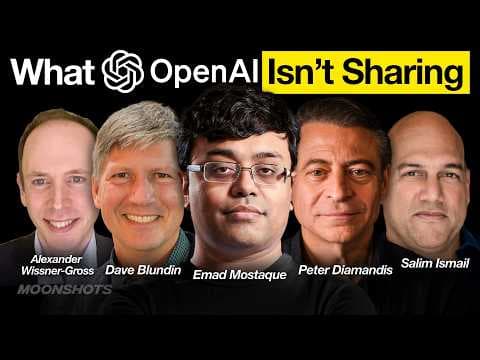
- AI agent swarms are already being used experimentally by individuals. Emad Mostaque says he has 18 Grokbots working together in a small swarm, while the panel describes Grokbot as a genuinely useful consumer AI product and discusses the broader rise of coordinated agents.
- Frontier AI competition includes Gemini, NVIDIA, Chinese models, and Anthropic. The episode highlights Gemini's performance on agent benchmarks, NVIDIA's reported $6 billion open-source bet, Chinese models described as 100 times cheaper, and questions about whether Anthropic should pursue an initial public offering.
- Waymo's sixth-generation platform emphasizes lower hardware costs and purpose-built design. The discussion says Waymo unveiled the Ohi vehicle, a robotaxi minivan designed by Chinese electric vehicle maker Zeekr, while raising concerns about Western companies relying on white-labeled Chinese hardware.
- Rapid AI progress is changing the hosts' daily work even before society fully catches up. They say they review roughly 400 stories to select about 15 for discussion and publish the podcast twice weekly, illustrating the volume and speed of developments they monitor.
Install to Summarize YouTube Videos and Get Transcripts
Explore YouTube Video Summarizer or Get YouTube Transcript Extractor
Questions & Answers
Q: Why is AI adoption slower than AI progress?
AI adoption is slower because technical capability is only one layer of change. Economies have inertia, customers keep buying from familiar companies, workers continue using established tools, and institutions face coordination, incentive, and regulatory constraints. Human beings and organizations also adapt less quickly than frontier models improve, creating a persistent gap between what AI can do and what society deploys.
Q: How did Sam Altman's view of AI disruption change?
Sam Altman says he previously expected much faster disruption after GPT-4 arrived in 2023, particularly in software and business. He now believes the economy and society will adapt more slowly because people preserve familiar purchasing patterns and working methods. He sees that inertia as partly beneficial because it could make the major transition ahead smoother and less abrupt.
Q: Is the singularity a single event or a gradual process?
The discussion characterizes the singularity as a process rather than one sudden event. AI technology may progress rapidly, but organizations, institutions, regulation, and human behavior move on different timelines. The resulting transition can resemble a rising tide, with capabilities accumulating quickly while their practical effects spread gradually through businesses, governments, and everyday life.
Q: What is the difference between AI capability and deployment?
AI capability describes what advanced systems can technically accomplish, while deployment requires organizations and institutions to integrate those abilities into real operations. Deployment is affected by coordination, incentives, regulation, existing vendors, established tools, and human adaptability. The panel argues that frontier laboratories can misjudge timelines when they assume technical possibility will translate directly into immediate economic or institutional change.
Q: How is Emad Mostaque using Grokbots?
Emad Mostaque says he has implemented Grokbot and operates 18 Grokbots together in a small swarm. The example is presented during a discussion of consumer AI products and the rise of coordinated AI agents. The panel describes Grokbot as genuinely useful, suggesting that practical consumer applications are emerging even while broad institutional adoption remains slower than model development.
Q: How is Waymo reducing robotaxi hardware costs?
Waymo announced a significant redesign and cost savings for its sixth-generation vehicle platform. The discussion says the company unveiled the Ohi, a purpose-built robotaxi minivan designed by Chinese electric vehicle maker Zeekr. The episode frames this as vertical integration and reliance on original-equipment manufacturing, while also expressing concern about Western companies using white-labeled Chinese hardware.
Q: What forces are shaping the frontier AI lab race?
The frontier AI race includes competition over agent performance, model cost, open-source systems, and access to capital. The episode highlights Gemini's agent benchmarks, NVIDIA's reported $6 billion open-source bet, Chinese models described as 100 times cheaper, and debate about an Anthropic initial public offering. Together, these topics show competition extending beyond raw model capability into economics and strategy.
Q: Why could economic inertia help society adapt to AI?
Economic inertia slows immediate disruption because people and organizations retain existing tools, suppliers, and routines. Altman views this resistance as positive in some ways because it can make the transition smoother and slower. Instead of every software business or institution changing at once, adoption can unfold over time, giving society and the economy more opportunity to adjust to expanding AI capabilities.
Summary & Key Takeaways
-
Sam Altman says he previously overestimated how quickly advanced AI would disrupt software and business. Technical capability can improve rapidly while customers retain familiar vendors, tools, and routines. Economic inertia, institutional lag, coordination problems, incentives, regulation, and limited human adaptability may therefore make the transition smoother and slower than early forecasts suggested.
-
The discussion presents the singularity as a process rather than a single event. Technology and organizations move at different speeds, creating a gap between what AI can technically accomplish and what society can deploy. The hosts argue that this transition remains historically significant even when practical implementation trails rapidly improving model capabilities.
-
Other topics illustrate the breadth of current competition: Emad Mostaque operates 18 Grokbots as a swarm, Gemini competes on agent benchmarks, NVIDIA is associated with a $6 billion open-source bet, and Chinese models challenge Anthropic with claims of far lower costs. Waymo also redesigned its robotaxi platform to reduce hardware costs substantially.
Read in Other Languages (beta)
Share This Summary 📚
Summarize YouTube Videos and Get Video Transcripts with 1-Click
Try YouTube Summary with ChatGPT & Claude or YouTube Transcript Generator
Explore More Summaries from Peter H. Diamandis 📚





Summarize YouTube Videos and Get Video Transcripts with 1-Click
Try YouTube Summary with ChatGPT & Claude or YouTube Transcript Generator