How Will AI Coding Agents Transform Software?
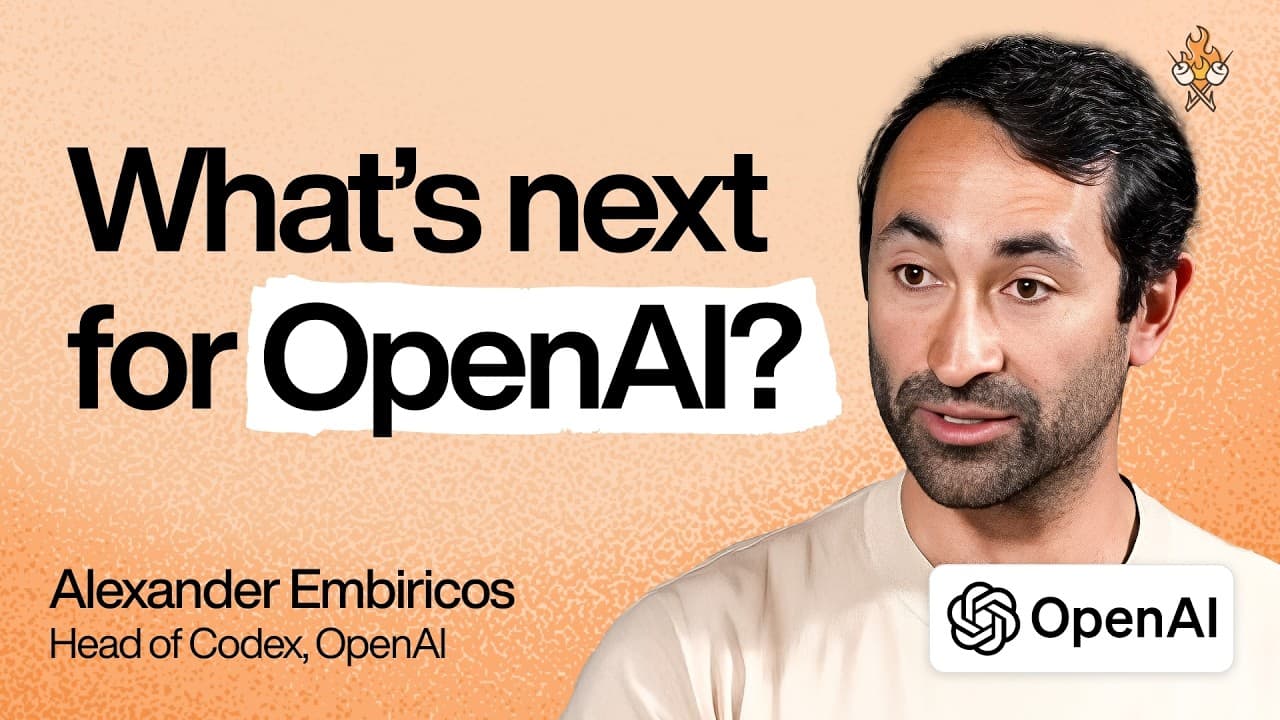
TL;DR
AI coding agents are evolving from prompted tools into proactive engineering teammates that can write, review, debug, and help operate software. Codex has grown 20x since August, while its use on projects such as the Sora Android app suggests that the emerging constraint is no longer only generating code, but helping humans review and coordinate an expanding volume of AI-produced work.
Transcript
do lead work on Codex. Codex is Open's coding agent. We think of Codex as just the beginning of a software engineering teammate. It's a bit like this really smart intern that refuses to read Slack, doesn't check Data Dog unless you ask it to. I remember Carpot that he tweeted the gnarliest bugs that he runs into that he just spends hours trying to ... Read More
Key Insights
- Codex is designed as a software engineering teammate, not merely a code generator. The vision includes participation across the development lifecycle, from writing implementation code and investigating bugs to reviewing changes and eventually taking useful actions proactively without waiting for every explicit instruction.
- Codex has grown 20x since August and now processes trillions of tokens weekly, according to the description. Its rapid expansion illustrates both strong demand for coding agents and the speed at which OpenAI expects teams to build, evaluate, and scale products.
- The Sora Android app was built in 18 days with help from Codex, then released publicly 10 days later. The 28-day path from starting a new application to public availability is presented as a striking example of AI-assisted product development acceleration.
- Codex already contributes to infrastructure used for its own training. It writes substantial portions of the code that manages training runs, reviews code, and has detected notable configuration mistakes, offering an early glimpse of agents helping maintain the systems responsible for improving them.
- The hardest software bugs can benefit from extended autonomous investigation. The interview cites cases in which difficult problems that resisted other attempts were assigned to Codex, allowed to run for about an hour, and successfully solved without continuous human guidance.
- The next development bottleneck is reviewing AI-generated work rather than producing more code. As agents create changes faster and operate across parallel tasks, product teams must improve how humans inspect, understand, validate, and safely accept the resulting output.
- Coding is a core capability for broadly useful AI agents because writing code is described as the most effective way for models to operate computers. If a super assistant must perform real actions, a coding agent may provide the foundation for many other agent types.
- OpenAI's product development model is highly empirical and bottom-up. Uncertainty about future capabilities, technical feasibility, and user response makes rapid experimentation more valuable than rigid long-term direction, while feedback sources such as Reddit expose both praise and recurring product complaints.
Install to Summarize YouTube Videos and Get Transcripts
Explore YouTube Video Summarizer or Get YouTube Transcript Extractor
Questions & Answers
Q: What is OpenAI trying to make Codex become?
OpenAI is trying to develop Codex into a software engineering teammate that participates throughout the development lifecycle. The intended role extends beyond responding to isolated coding prompts. Codex can write code, investigate difficult bugs, review changes, support training infrastructure, and catch configuration errors. A major future objective is proactivity, meaning the agent should identify and perform useful work instead of waiting for a person to specify every action.
Q: Why has Codex become important to software teams?
Codex can accelerate several kinds of engineering work, including implementation, debugging, code review, and infrastructure maintenance. The description says it has grown 20x since August and serves trillions of tokens weekly. The interview also reports that it can spend extended time investigating difficult bugs and sometimes solve problems that resisted other approaches. These capabilities allow engineers to delegate substantial tasks rather than request only short code completions.
Q: How did Codex help accelerate the Sora Android app?
Codex helped the Sora team build a fully new Android application in 18 days. The team then took another 10 days to reach public availability, producing a total development and release timeline of 28 days. The example is used to demonstrate how an AI coding agent can compress product development when it assists with implementation and enables a team to move through engineering work much faster.
Q: Why is code review becoming a major AI development bottleneck?
Code review becomes a bottleneck when agents produce changes faster than people can understand and verify them. The interview says the team is increasingly focused on making AI-generated code easier to review, not only easier to write. This shift matters because rapid generation alone does not eliminate the need for human judgment. People still need clear ways to inspect changes, catch mistakes, understand consequences, and decide what should be accepted.
Q: Why might every useful AI agent need coding abilities?
Coding may be central to many AI agents because useful assistants must perform actions on computers, not merely discuss what a person should do. The interview's key learning is that models become much more effective at completing tasks when they can use a computer, and writing code is presented as the best way for them to do that. Consequently, building a general-purpose agent may begin with building a capable coding agent.
Q: How does Codex contribute to its own training systems?
Codex writes a substantial amount of the code used to manage its training runs and key supporting infrastructure. It also participates in code review and has caught noteworthy configuration mistakes. These uses offer an early example of an AI system helping operate the engineering processes involved in developing it. The interview characterizes this as a glimpse of a future in which Codex can be on call for its own training.
Q: What limits productivity as AI coding agents improve?
The interview identifies human typing speed and multitasking speed as underappreciated limiting factors. As agents become capable of generating code, investigating problems, and handling several tasks, people may struggle to provide instructions, review outputs, and coordinate work quickly enough. The constraint therefore shifts away from model capability alone and toward the rate at which humans can communicate decisions, evaluate results, and supervise an expanding volume of parallel activity.
Q: How does OpenAI organize product development under uncertainty?
OpenAI emphasizes bottom-up work, humility, rapid trials, and empirical learning because teams do not know exactly which capabilities will emerge, which ideas will work technically, or which successful demonstrations will become useful products. Instead of relying entirely on a fixed direction, teams try ideas quickly and study real outcomes. Product staff also monitor feedback, including praise and complaints on Reddit, to understand whether tools genuinely accelerate users or create confusion.
Summary & Key Takeaways
-
Codex is being developed as a software engineering teammate that can participate across the development lifecycle. It already writes code supporting its own training infrastructure, reviews changes, finds configuration mistakes, and solves difficult bugs. The long-term goal is proactivity, allowing the agent to notice and perform useful work with less prompting.
-
OpenAI's product culture emphasizes exceptional speed, ambition, bottom-up experimentation, and empirical learning. Teams cannot confidently predict which model capabilities will appear, which technical approaches will work, or which products users will adopt. As a result, they try ideas quickly, observe real outcomes, and remain willing to redirect effort based on evidence.
-
AI-assisted development is shifting the bottleneck from producing code to reviewing and coordinating it. Codex helped the Sora team create a new Android app in 18 days and release it publicly after 28 days total. As agents generate more work in parallel, human typing, multitasking, and verification capacity become increasingly important constraints.
Read in Other Languages (beta)
Share This Summary 📚
Summarize YouTube Videos and Get Video Transcripts with 1-Click
Try YouTube Summary with ChatGPT & Claude or YouTube Transcript Generator
Explore More Summaries from Lenny's Podcast 📚






Summarize YouTube Videos and Get Video Transcripts with 1-Click
Try YouTube Summary with ChatGPT & Claude or YouTube Transcript Generator