What Is Beijing Opera and How Did It Evolve?
TL;DR
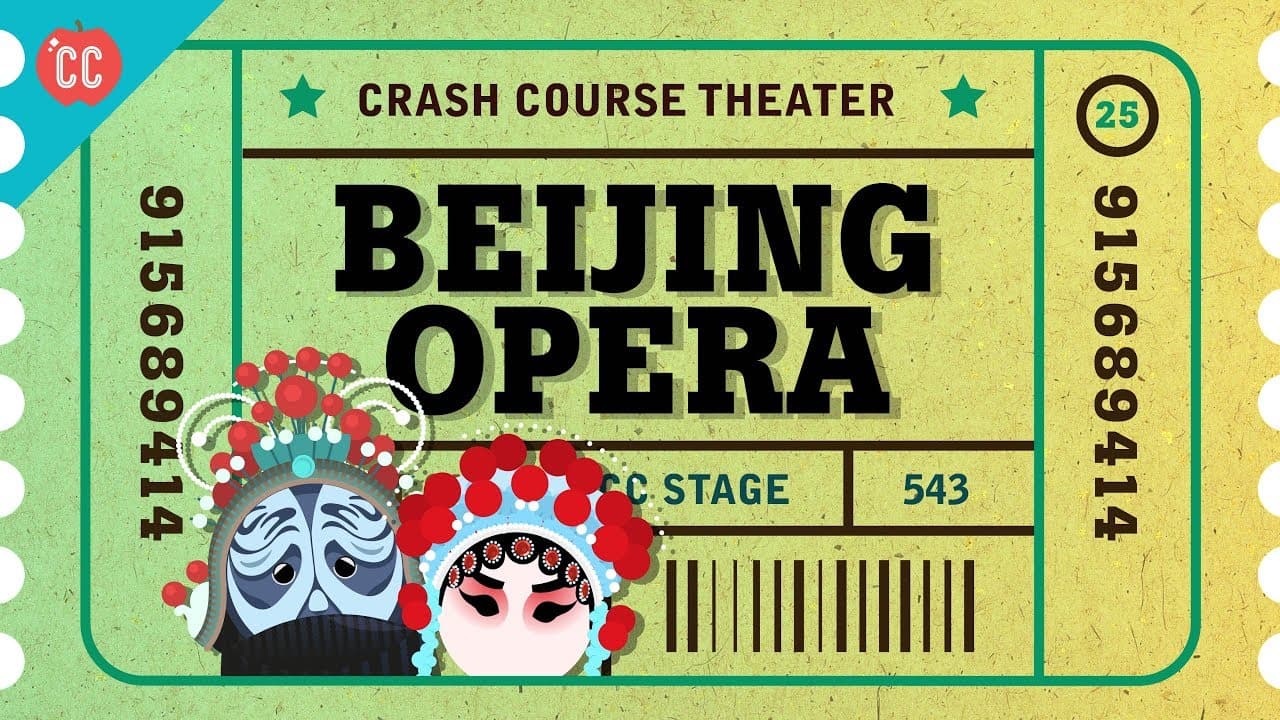
Beijing Opera originated from classical Chinese drama and evolved through historical events like the Cultural Revolution. It features minimal staging, elaborate costumes, and symbolic props, with its roots tracing back to religious rituals and later integrating music, dance, and acrobatics during the Tang and Yuan Dynasties.
Transcript
Hey there! I’m Mike Rugnetta, this is Crash Course Theater, and today our coverage of elaborate stage makeup and costuming continues as we cover Beijing Opera— Very nice Slim! I like all this effort you’ve been putting in lately. Though the Yin and Yang is a little on the nose. As Yorick is demonstrating, today we’re heading to China to explore the... Read More
Key Insights
- Beijing Opera originated from classical Chinese drama, evolving through history and cultural shifts, including the Cultural Revolution.
- Early Chinese performances were tied to religious rituals, seeking blessings for fertility, harvest, and success in war.
- During the Han Dynasty, performance art became more secular, featuring acts like tightrope-walking and sword-swallowing.
- The Tang Dynasty saw the integration of music, dance, and acrobatics, leading to the establishment of the Pear Garden training school.
- The Mongol invasion during the Yuan Dynasty surprisingly led to a golden age of literature and drama in China.
- Zaju and chuan-qi are two distinct styles of Chinese drama, with differing structures, scales, and musical accompaniments.
- Beijing Opera is characterized by minimal staging but elaborate costuming and makeup, with symbolic props and set elements.
- Communism and the Cultural Revolution greatly impacted Beijing Opera, leading to the creation of new, politically aligned works.
Install to Summarize YouTube Videos and Get Transcripts
Explore YouTube Video Summarizer or Get YouTube Transcript Extractor
Questions & Answers
Q: What were the origins of early Chinese performances?
Early Chinese performances were closely linked to religious rituals. These performances included songs and dances that petitioned gods for fertility, a good harvest, and success in war. As Daoism developed, wu priests staged elaborate seances that were sometimes adapted into court performances with added humor and effects.
Q: How did the Tang Dynasty contribute to Chinese theater?
During the Tang Dynasty, performers began to combine music, dance, and acrobatics in innovative ways. Emperor Xuanzong established the Pear Garden, a training school intended to further these innovations. This period marked a shift towards performance traditions that integrated various artistic disciplines, setting the stage for future developments in Chinese theater.
Q: How did the Mongol invasion affect Chinese drama?
The Mongol invasion during the Yuan Dynasty surprisingly led to a golden age of literature and drama in China. Many educated bureaucrats, displaced by the Mongols' preference for handling affairs internally, turned to writing. This period saw the development of zaju and chuan-qi drama styles, with plays drawing from history, legend, and novels.
Q: What are the characteristics of zaju and chuan-qi dramas?
Zaju dramas typically consist of four acts, with only the protagonist singing, and require distinct vocal timbres and rhyme schemes for each act. In contrast, chuan-qi plays have thirty to fifty acts without fixed rhyme schemes and are written for a pentatonic scale. The stories in both styles draw from history, legend, and literature.
Q: How did Beijing Opera develop its unique style?
Beijing Opera developed in 1790 when various troupes came to Beijing for Emperor Qian Long's eightieth birthday. They combined their regional theatrical forms into a new style, known as jingxi. This style emphasized acting, singing, and dancing over literary elements, with minimal staging but elaborate costumes and symbolic props.
Q: What role do costumes and makeup play in Beijing Opera?
Costumes and makeup in Beijing Opera are elaborate and color-coded, playing a crucial role in character portrayal. There are numerous types of dress and makeup, each associated with specific character types and moods. Makeup designs, especially for jing characters, are complex and pattern-coded, with colors indicating character traits and roles.
Q: How did communism impact Beijing Opera?
Communism significantly impacted Beijing Opera, especially during the Cultural Revolution. Many traditional plays were seen as anti-communist and were replaced with new works that aligned with communist ideologies. These new operas often contained political messages, like 'The White-Haired Girl,' which depicted themes of social justice and redistribution.
Q: What are the official story types in Beijing Opera?
Officially, Beijing Opera stories are categorized into two types: civil and military. However, there is considerable overlap between these categories. The operas draw from history, legend, and literature, often ending happily. The scripts focus on the high points of stories, with narrative and acrobatic interludes connecting the scenes.
Summary & Key Takeaways
-
Beijing Opera, a fusion of classical Chinese drama, evolved through historical and cultural changes, including the Cultural Revolution. Early performances were religious rituals, but later became secular with acrobatics and dance. The Yuan Dynasty's Mongol invasion surprisingly boosted literature and drama, leading to styles like zaju and chuan-qi.
-
Beijing Opera's minimal staging contrasts with its elaborate costuming and makeup, using symbolic props. The Tang Dynasty integrated music, dance, and acrobatics, while the Yuan Dynasty's Mongol invasion ushered a literary golden age. Communist influence reshaped the opera, creating politically aligned works.
-
Early Chinese theater was religious, evolving into secular performances with acrobatics. The Tang Dynasty's Pear Garden school promoted innovation. The Yuan Dynasty's Mongol invasion boosted drama, creating zaju and chuan-qi styles. Beijing Opera's minimal sets and elaborate costumes were later influenced by communism and the Cultural Revolution.
Read in Other Languages (beta)
Share This Summary 📚
Summarize YouTube Videos and Get Video Transcripts with 1-Click
Try YouTube Summary with ChatGPT & Claude or YouTube Transcript Generator
Explore More Summaries from CrashCourse 📚

Summarize YouTube Videos and Get Video Transcripts with 1-Click
Try YouTube Summary with ChatGPT & Claude or YouTube Transcript Generator