What Is Unsupervised Machine Learning and How Does It Work?
TL;DR
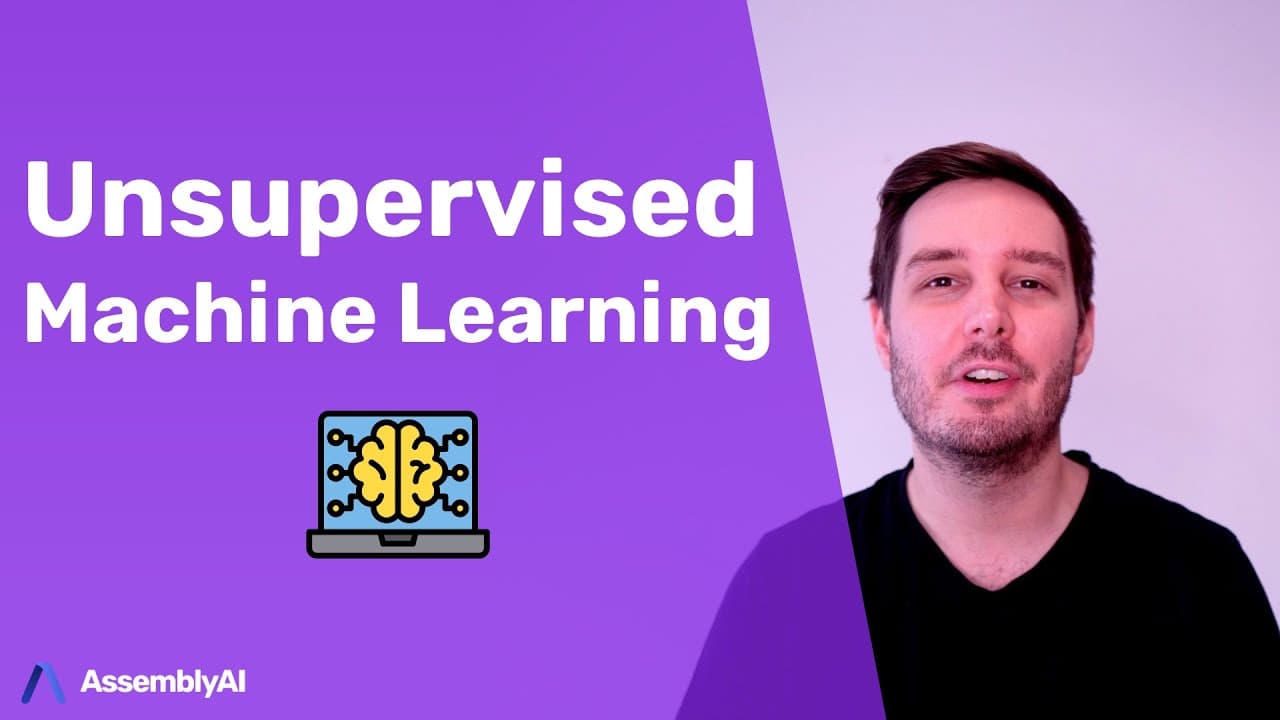
Unsupervised machine learning uses unlabeled data to discover patterns without human intervention, making it crucial for various applications. Key techniques include clustering, outlier detection, and latent variable modeling, often implemented using neural networks like autoencoders for tasks such as image denoising and compression.
Transcript
welcome back to another machine learning explained video by assembly ai in this video we talk about unsupervised learning in one note we also have a video about supervised learning on our channel and i highly recommend that you check this out as well and now without further ado let's get started in the last video we learned about supervised learnin... Read More
Key Insights
- ❓ Unsupervised learning leverages unlabeled data for pattern recognition without human intervention.
- 🈸 Applications of unsupervised learning include clustering, outlier detection, and latent variable modeling.
- 🖐️ Neural networks like autoencoders play a vital role in unsupervised learning tasks such as denoising images and compression.
- 🎰 Understanding unsupervised learning is essential for various machine learning applications and tasks.
- ❓ Principal Component Analysis (PCA) is a popular method for dimensionality reduction in unsupervised learning.
- 🆘 Unsupervised learning techniques help preprocess data before moving on to supervised learning tasks.
- 🏷️ Autoencoders in neural networks are crucial for image denoising and compression without explicit labels.
Install to Summarize YouTube Videos and Get Transcripts
Explore YouTube Video Summarizer or Get YouTube Transcript Extractor
Questions & Answers
Q: What is unsupervised learning and how does it differ from supervised learning?
Unsupervised learning deals with unlabeled data to find patterns, while supervised learning uses labeled data with known outcomes for training machine learning models.
Q: What are some key applications of unsupervised learning?
Some applications include clustering, outlier detection, latent variable modeling, and neural networks like autoencoders for tasks such as denoising images and video compression.
Q: How does clustering work in unsupervised learning?
Clustering groups similar objects together based on characteristics without predefined labels, allowing for segmentation in various domains such as e-commerce customer analysis.
Q: What is the role of neural networks in unsupervised learning, specifically autoencoders?
Autoencoders are neural networks that encode data into a low-dimensional representation for tasks like image denoising and compression without needing explicit labels.
Summary & Key Takeaways
-
Unsupervised learning utilizes unlabeled data to identify patterns without human intervention.
-
Applications include clustering, outlier detection, latent variable modeling, and neural networks like autoencoders.
-
Understanding unsupervised learning is crucial for various machine learning tasks.
Read in Other Languages (beta)
Share This Summary 📚
Summarize YouTube Videos and Get Video Transcripts with 1-Click
Try YouTube Summary with ChatGPT & Claude or YouTube Transcript Generator
Explore More Summaries from AssemblyAI 📚





Summarize YouTube Videos and Get Video Transcripts with 1-Click
Try YouTube Summary with ChatGPT & Claude or YouTube Transcript Generator