How to Build AI Fluency with the Four Ds
TL;DR
Build AI fluency by practicing four competencies: delegation, description, discernment, and diligence. Decide how humans and AI should divide work, communicate intentions clearly, evaluate outputs critically, and remain accountable for responsible use. These skills apply across automation, augmentation, and agency, and they improve through intentional practice, iterative collaboration, transparency, and continued investment in human expertise.
Transcript
Hello and welcome to our final session covering the foundations of AI fluency. I'm Professor Rick Dacen from the Ringling College of Art and Design. Over a short period, we've covered quite a lot of ground together exploring the AI fluency framework and seeing how it applies to everyday collaboration with AI. Let's take a moment to reflect on what ... Read More
Key Insights
- Delegation is the competency of deciding which work AI should perform, which work humans should handle, and which work should be completed collaboratively. Effective delegation combines knowledge of the problem, awareness of AI capabilities, and human judgment about how responsibilities should be distributed.
- Description is the practice of clearly communicating the desired product, the preferred process, and the expected interaction performance. Effective description can take the form of a thoughtful conversation that supplies relevant context, concrete examples, and feedback instead of relying only on elaborate prompts.
- Discernment is the critical evaluation of AI products, processes, and interaction performance. It is a non-negotiable human responsibility because evaluating quality and appropriateness helps protect against AI limitations while enabling stronger results through iterative collaboration.
- Diligence is the responsible selection, use, and deployment of AI systems. It includes creation diligence, transparency about AI's role, and deployment diligence, while recognizing that the human user remains accountable for the final product and its effects on other people.
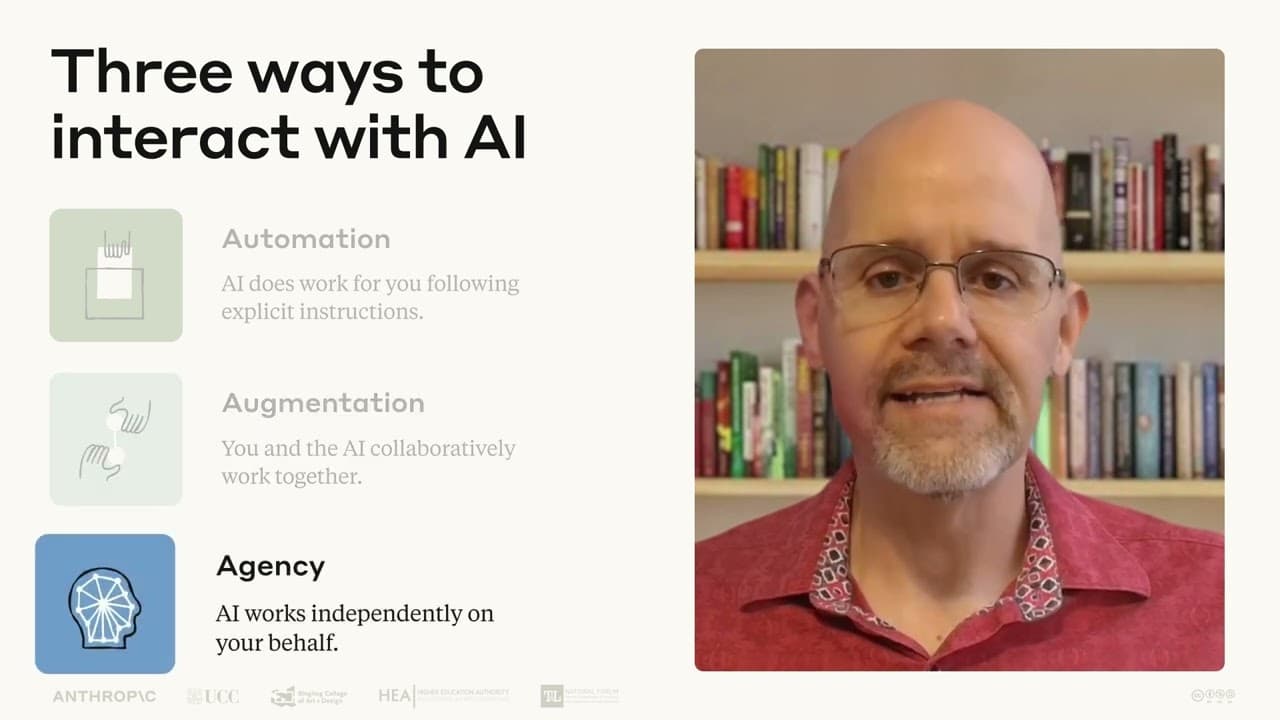
- Automation is an interaction mode in which AI performs specific tasks according to human instructions. The four competencies still apply because users must choose appropriate tasks, describe requirements, assess the resulting work, and take responsibility for how that work is used.
- Augmentation is an interaction mode in which a person and AI work together as thinking partners. Iterative conversation allows each participant to build on the other's strengths, potentially producing results that neither the person nor the AI could easily create independently.
- Agency is an interaction mode in which AI is configured to act independently on a person's behalf. Independent action does not remove human responsibility, since users must still delegate appropriately, evaluate behavior and outputs, select systems thoughtfully, and remain accountable for deployment.
- AI fluency is developed through practice, awareness, commitment, and intentional use rather than perfected overnight. Continued investment in personal expertise and attention to technological change help users apply the framework appropriately as generative AI assistants evolve.
Install to Summarize YouTube Videos and Get Transcripts
Explore YouTube Video Summarizer or Get YouTube Transcript Extractor
Questions & Answers
Q: What are the four core competencies of AI fluency?
The four core competencies are delegation, description, discernment, and diligence, collectively called the four Ds. Delegation allocates work between humans and AI. Description communicates the desired product, process, and interaction performance. Discernment evaluates outputs, processes, and behaviors. Diligence addresses responsible system selection, transparency, accountability, and the ethical and safe deployment of AI-assisted work.
Q: How does delegation improve collaboration with AI?
Delegation improves collaboration by determining which tasks AI should perform, which responsibilities should remain exclusively human, and where the two should work together. Sound decisions depend on human understanding of the problem, awareness of the AI system's capabilities, and judgment about each participant's strengths. Iterative collaboration can then create results that neither participant could easily produce alone.
Q: How should users describe tasks to an AI system?
Users should clearly communicate what they want produced, how they want the task approached, and what kind of interaction would be most helpful. These dimensions are called product, process, and performance description. Effective instructions do not always require an elaborate prompt. A thoughtful conversation containing context, examples, feedback, and clarification can connect human intentions with AI capabilities more effectively.
Q: Why is discernment necessary when using AI?
Discernment is necessary because users must critically evaluate AI outputs, working processes, and interaction behavior for quality and appropriateness. AI capabilities do not eliminate their limitations, so evaluation remains a non-negotiable human responsibility. Strong discernment protects against inadequate results and supports an iterative process in which human expertise and AI capabilities combine to produce better work.
Q: What does diligence mean in AI-assisted work?
Diligence means using AI responsibly throughout creation and deployment. It includes thoughtfully selecting AI systems, being transparent about the role AI played, taking responsibility for the final product, and considering its impact on other people. Transparency helps build trust and integrity, while accountability remains with the human user regardless of how much assistance the AI provided.
Q: What are automation, augmentation, and agency in AI use?
Automation occurs when AI completes specific tasks by following human instructions. Augmentation occurs when a person and AI collaborate as thinking partners. Agency occurs when AI is configured to act independently on a person's behalf. The four competencies apply to all three modes, so delegation, clear description, critical discernment, and responsible diligence remain necessary regardless of the AI's independence.
Q: How can someone develop stronger AI fluency?
AI fluency grows through repeated, intentional practice rather than instant mastery. Users develop it whenever they delegate work, describe their needs, evaluate the quality of AI outputs, and apply diligence to creation and deployment. Continued investment in personal expertise, awareness of technological change, iterative conversation, and accountability helps these competencies improve naturally over time.
Q: What role does human expertise play in effective AI use?
Human expertise and judgment provide the foundation for effective AI use. They help users understand problems, recognize appropriate opportunities for AI assistance, distribute work wisely, evaluate output quality, and remain responsible for consequences. AI systems are powerful but are not universal solutions. Their usefulness and safety depend on how thoughtfully people guide, assess, and deploy them.
Summary & Key Takeaways
-
The AI fluency framework consists of delegation, description, discernment, and diligence. Together, these competencies help people allocate work appropriately, communicate effectively with AI, evaluate results and interactions critically, and use AI responsibly. They provide a practical foundation for working with generative AI assistants as their capabilities continue to evolve.
-
The framework applies across automation, augmentation, and agency. Automation involves AI completing instructed tasks, augmentation involves people and AI collaborating as thinking partners, and agency involves AI acting independently on a person's behalf. Each interaction mode still requires human expertise, judgment, clear communication, critical evaluation, and accountability for outcomes and effects.
-
AI fluency develops through continued practice rather than immediate mastery. People improve by repeatedly delegating tasks, describing desired products and processes, discerning output quality, and applying diligence throughout creation and deployment. The goal is an increasingly aware, committed, and intentional approach that supports effective, efficient, ethical, and safe human-AI collaboration.
Read in Other Languages (beta)
Share This Summary 📚
Summarize YouTube Videos and Get Video Transcripts with 1-Click
Try YouTube Summary with ChatGPT & Claude or YouTube Transcript Generator
Explore More Summaries from Anthropic 📚






Summarize YouTube Videos and Get Video Transcripts with 1-Click
Try YouTube Summary with ChatGPT & Claude or YouTube Transcript Generator