How Does Bank Debt Create and Destroy Money?
TL;DR
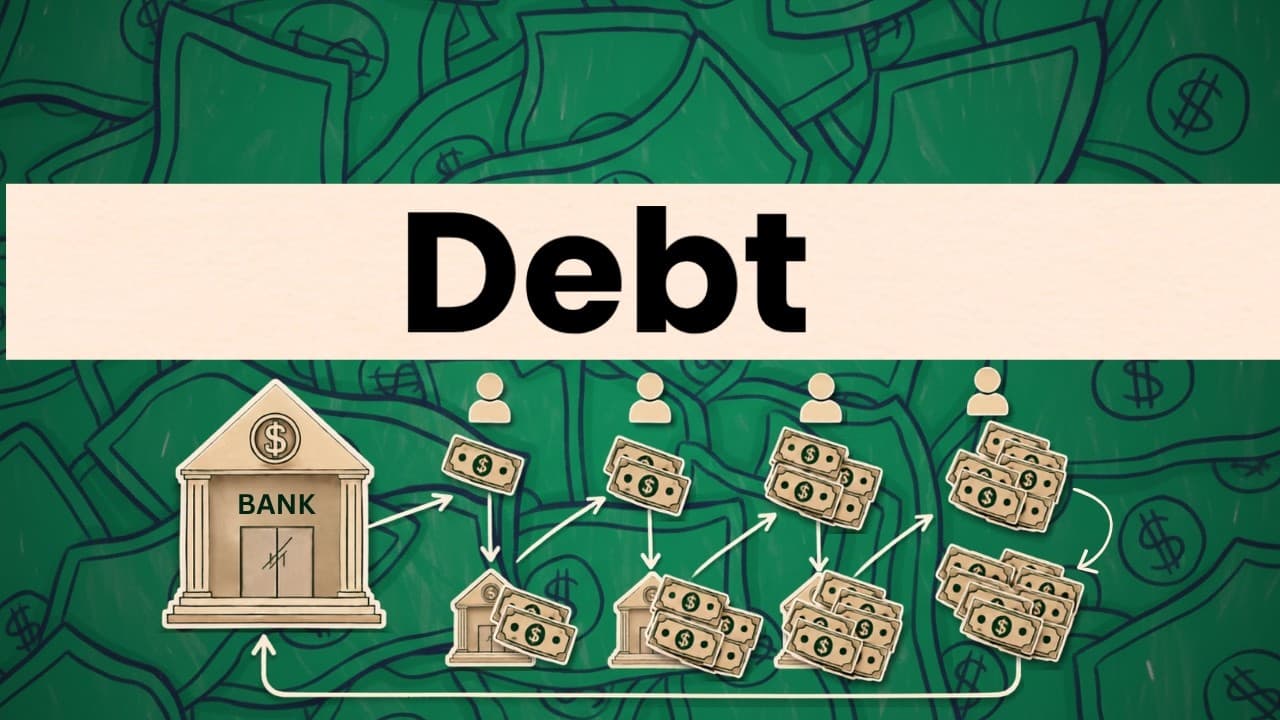
Commercial banks create digital money when they approve loans, recording the loan as an asset and the matching deposit as a liability. Principal repayments remove that money from circulation, while banks retain interest as income. The economic effect depends on where credit flows: mortgages can raise existing property prices, while business loans can support jobs, equipment, products, and additional output.
Transcript
In 2014, an economics professor walked into a small bank in Germany and convinced them to do something nobody had ever done in the history of banking. They let him sit right there in the room while they approved a loan. The books were open and the system was running. He watched the bankers, step-by-step, create money out of absolutely nothing and b... Read More
Key Insights
- Commercial bank money is created when a private bank approves a loan and credits the borrower’s account. The bank does not typically transfer cash, use another customer’s deposit, or reduce its reserves at that moment. It creates a new deposit through an accounting entry.
- The monetary system contains three described forms of money: central bank reserves used between banks, physical cash issued by the central bank, and digital commercial bank deposits. The transcript states that cash represents less than 3% of money, while commercial bank money represents the remaining 97%.
- Double-entry bookkeeping records a new loan on both sides of a bank’s balance sheet. The signed loan becomes an asset because the bank owns the borrower’s future payments, while the credited deposit becomes a liability because the bank owes that account balance to the customer.
- Principal repayment destroys commercial bank money rather than transferring it into a vault or another customer’s account. The same accounting system that creates the deposit when lending occurs removes the principal as repayment occurs, while the interest paid by the borrower is retained by the bank.
- Bank lending is constrained primarily by decisions about whom to finance, according to the transcript. It also states that legal reserve requirements are zero in most Western countries, challenging the familiar story that banks must keep 10% of deposits before lending the remainder.
- Mortgage lending is attractive to banks because a house provides collateral that can be taken if the borrower stops paying. Business lending is presented as almost three times riskier because a failed business may leave the bank without an equivalent recoverable asset.
- Easy mortgage credit can raise property prices because every approved mortgage creates new purchasing power that enters the housing market. When more money competes for the same number of houses, prices rise even though the transactions do not create new factories, jobs, products, or housing.
- Productive business credit can increase real economic capacity when borrowers hire workers, purchase equipment, and develop products. The transcript argues that many small banks are better suited to these loans because processing a $50,000 business loan can require nearly the same effort as processing a $50 million corporate loan.
Install to Summarize YouTube Videos and Get Transcripts
Explore YouTube Video Summarizer or Get YouTube Transcript Extractor
Questions & Answers
Q: How do commercial banks create money through loans?
Commercial banks create money by approving a loan and crediting the borrower’s deposit account with the loan amount. At the same moment, the bank records the borrower’s signed repayment obligation as an asset and the new deposit as a liability. The two entries expand together, so the bank does not need to transfer another depositor’s money or hand over physical cash.
Q: What are the three types of money in the banking system?
The transcript identifies central bank reserves, physical cash, and digital commercial bank money. Central bank reserves are available to banks for settling payments with one another, not directly to ordinary customers. Cash consists of banknotes and coins issued by the central bank. Commercial bank money consists of digital deposits that private banks create when they issue loans.
Q: Why is the traditional fractional-reserve lending story described as wrong?
The traditional story says banks retain 10% of customer deposits and lend the remaining 90%, with repeated lending creating additional money. The transcript rejects this account because a bank can create a new deposit directly when it approves a loan. It also states that legal reserve requirements are zero in most Western countries, rather than the assumed 10%.
Q: What happens to money when a bank loan is repaid?
The principal portion of a bank loan disappears as it is repaid because repayment reverses the deposit money created when the loan was issued. The principal does not move into a vault or become another customer’s deposit. Interest is treated differently: it is paid by the borrower and retained by the bank as income, rather than being deleted with the principal.
Q: Why do banks prefer mortgages over small-business loans?
Banks prefer mortgages because the property serves as collateral. If a mortgage borrower stops paying, the bank can take the house, reducing its exposure to loss. A small business may fail without leaving an equally valuable recoverable asset, making such lending almost three times riskier according to the transcript. Mortgages can therefore be easier to approve than smaller business loans.
Q: How can mortgage lending increase house prices?
Each approved mortgage creates new deposit money that can be spent in the property market. When banks direct large amounts of new credit toward a fixed number of existing houses, more purchasing power competes for those properties and pushes prices upward. The transaction changes ownership of the house but does not itself create another house, factory, job, or product.
Q: How does business lending affect the real economy?
Business lending can expand real economic activity when the borrowed money finances workers, equipment, and product development. The transcript contrasts a $1 million loan used to purchase an existing house with the same amount lent to a small business. The house loan changes ownership, while the business loan can produce additional employment, output, products, and material economic capacity.
Q: Why does the transcript propose having many small banks?
The transcript proposes many small banks because large banks have weak financial incentives to process modest business loans. A $50,000 small-business loan can require almost the same effort and paperwork as a $50 million corporate loan, while producing a much smaller payout. Smaller banks could focus more closely on financing local businesses that hire workers, buy equipment, and create products.
Summary & Key Takeaways
-
Commercial banks create most money by issuing loans, not by transferring existing deposits or lending central bank reserves. When a bank approves a $10,000 loan, it records the borrower’s obligation as a $10,000 asset and the new account balance as a $10,000 liability. Both entries appear simultaneously through double-entry bookkeeping.
-
The principal portion of a loan is destroyed as the borrower repays it, reversing the money creation that occurred when the loan was issued. Interest follows a different path because the bank retains it as income. Banks therefore participate in both expanding and contracting the supply of commercial bank money through lending and repayment.
-
The direction of new credit shapes economic outcomes. Mortgage lending sends newly created money toward existing property and can push prices higher, while lending to businesses can finance workers, equipment, products, and additional output. The proposed remedy is a larger network of small banks focused on productive business lending rather than existing assets.
Read in Other Languages (beta)
Share This Summary 📚
Summarize YouTube Videos and Get Video Transcripts with 1-Click
Try YouTube Summary with ChatGPT & Claude or YouTube Transcript Generator
Explore More Summaries from LITTLE BIT BETTER 📚




Summarize YouTube Videos and Get Video Transcripts with 1-Click
Try YouTube Summary with ChatGPT & Claude or YouTube Transcript Generator