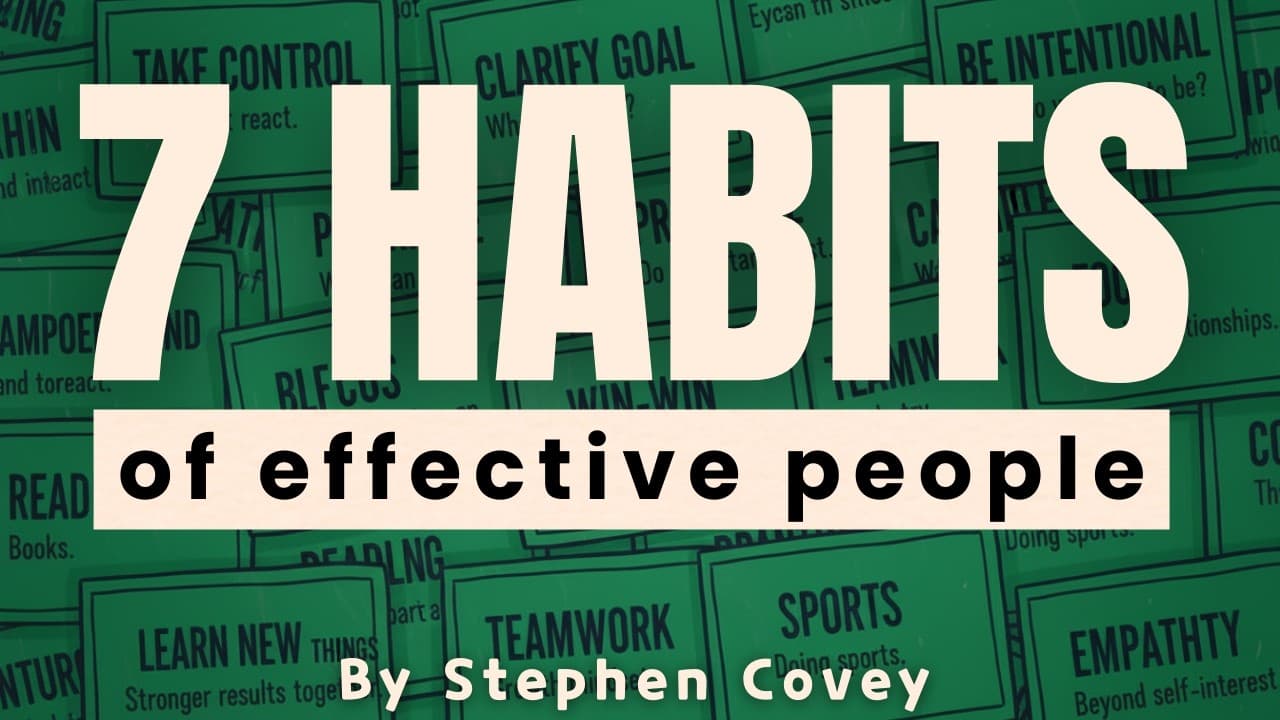
What Are the 7 Habits of Highly Effective People?
TL;DR
Highly effective people are proactive: they focus energy on what they can change instead of blaming management, the economy, or bad luck. They begin with the end in mind, prioritize important-but-not-urgent work, seek win-win agreements, listen to understand before being understood, and synergize by combining complementary strengths, the way Steve Jobs and Steve Wozniak built Apple.
Transcript
Seven Habits of Highly Effective People by Stephen Covey habit number one proactivity several years ago I was meeting with two of my former colleagues from an internship program that I attended when I was a student all three of us worked in the same department and afterwards we became regular employees I left the company after a few months but they... Read More
Key Insights
- Proactivity is the first habit: proactive people spend limited energy only on things they can control, such as learning new skills, while reactive people blame the economy, inflation, management, and low salaries to justify staying stuck.
- Beginning with the end in mind means imagining your own funeral and how you want to be remembered, then checking whether your daily actions actually move you toward that goal, friendship, or parenting outcome.
- Clarity about your end goal makes it easier to say no. Writing goals on one side of a paper and daily actions on the other for a week reveals how many activities and people have nothing to do with your goals.
- Prioritizing uses a time management matrix separating important from urgent. Quadrant two, not urgent but important, covers personal and professional development, and highly effective people deliberately focus there.
- Many people stay stuck in quadrant three, treating urgent interruptions like calls and WhatsApp messages as if they were important, while others waste time in quadrant four on leisure and phone games.
- Win-win is a cooperative paradigm where your success does not require others to lose. Rewarding only one winner, like a single trip to Bermuda, actually induces competition and kills cooperation.
- Seek first to understand, then to be understood: like a doctor diagnosing before prescribing, you must listen empathically. Words are only 10 percent of communication, tone is 30 percent, and body language is 60 percent.
- Synergy combines complementary strengths for results neither could reach alone, like birds flying in a V formation or Steve Jobs the salesperson pairing with Steve Wozniak the engineer to create Apple.
Install to Summarize YouTube Videos and Get Transcripts
Explore YouTube Video Summarizer or Get YouTube Transcript Extractor
Questions & Answers
Q: What does it mean to be proactive according to the 7 Habits?
Being proactive means spending your limited energy only on things you can change or control, rather than complaining about what you cannot. The video contrasts two colleagues: both criticized bad management and low salaries, but the proactive one learned new skills and moved to a better company, while the reactive one blamed the economy, inflation, and company culture as justification for staying stuck with the same salary and position.
Q: What does 'begin with the end in mind' mean?
It means starting with a clear idea of your destination, goal, or objective before acting. The video suggests imagining your own funeral three years from now and how friends, coworkers, and family would remember you. With that end in mind, it becomes easier to say no to things that do not move you closer, and you can reflect on whether each daily act is compatible with the goal you want to achieve.
Q: How does the time management matrix help you prioritize?
The matrix separates the important from the urgent across four quadrants. Quadrant one is urgent and important, like deadline tasks. Quadrant two is not urgent but important, covering personal and professional development. Quadrant three is urgent but not important, like phone calls and messages. Quadrant four is low importance leisure. Highly effective people focus on quadrant two, while many people stay stuck in quadrant three thinking it is quadrant one.
Q: What is a win-win mindset and why does it matter?
Win-win means creating agreements that seek mutual benefit, a cooperative rather than competitive paradigm where your success is not achieved at the expense of others. The video's example is two book-summary YouTube channels recommending each other, so both gain subscribers. A president who offered only one trip to Bermuda actually induced employees to compete and stopped cooperating, showing that a flawed win-lose reward system produces poor teamwork.
Q: Why should you seek first to understand, then to be understood?
Because prescribing without diagnosing fails, just as an ophthalmologist who hands you his own glasses and tells you to think positive never solves your vision problem. To interact effectively you must understand others through empathic listening, using both your ears and your heart to observe emotions, not just hear words. This improves interactions with friends, bosses, and colleagues and prevents the misunderstandings common in phone and text communication.
Q: How much of communication is body language versus words?
According to communication experts cited in the video, words are only 10 percent of everything we communicate. Tone and other sounds account for 30 percent, and body language accounts for 60 percent. This is why so many misunderstandings occur while talking on the phone or texting, where tone and body language are missing. To truly understand someone, you should listen not only with your ears but also observe the emotions being expressed.
Q: What is synergy and can you give an example?
Synergy is cooperation that produces results more effectively than working alone, because time is limited and no one can be good at everything. In nature, birds fly in a V formation so those behind ride the air current created by those in front. A real-life example is Steve Wozniak, a great engineer, and Steve Jobs, a great salesperson, whose synergy created Apple; working individually, they might never have built it.
Q: What is the difference between reactive and proactive people?
Reactive people focus on things they cannot change or control, constantly complaining about the economy, inflation, management, bad company culture, and low salaries, using these as excuses for not being successful. Proactive people do not waste limited energy on what they cannot change; they accept they cannot change the company but can learn new skills and move elsewhere. The two colleagues in the story illustrate this: same complaints, opposite outcomes based on which mindset they chose.
Summary & Key Takeaways
-
The first habit is proactivity. A story of two colleagues who both criticized bad management and low pay shows the difference: the proactive one learned new skills and moved to a better company, while the reactive one blamed the culture and stayed stuck complaining.
-
Habits two and three focus your life. Begin with the end in mind by picturing how you want to be remembered, then align daily acts to that goal. Prioritize using the time matrix, concentrating on quadrant two, the important but not urgent work.
-
Habits four through six build relationships. Win-win seeks mutual benefit rather than competition. Seek first to understand through empathic listening, since body language carries most meaning. Synergize by combining complementary strengths, as Steve Jobs and Steve Wozniak did to create Apple together.
Read in Other Languages (beta)
Share This Summary 📚
Summarize YouTube Videos and Get Video Transcripts with 1-Click
Try YouTube Summary with ChatGPT & Claude or YouTube Transcript Generator
Explore More Summaries from LITTLE BIT BETTER 📚
Summarize YouTube Videos and Get Video Transcripts with 1-Click
Try YouTube Summary with ChatGPT & Claude or YouTube Transcript Generator